
(Niagara At Large is posting the following media release from Buffalo, N.Y.-based Great Lakes United and a coalition of citizen groups around the Great Lakes basin.)
Conservation and fishing groups are calling on the federal government to improve outdated laws and prevent the next invasion
Buffalo, NY (February 28, 2011) — Asian carp were allowed into this country under a law governing animal imports that was passed in 1900, and which has remained unchanged, despite a drastically different global trade reality. As two species of Asian carp, the bighead and silver carp, knock at the door of the Great Lakes, conservation and fishing groups are calling on federal officials to finally update import screening laws before the next invader gets here.
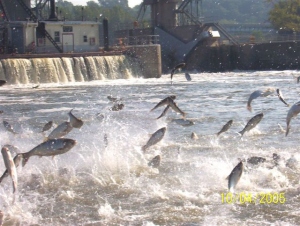
Asian Carp working their way north from the Mississippi River watershed and now on the verge of invading Lake Michigan.
“Stopping Asian carp should have happened before the first shipment. This incredible threat, this incredible expense, was avoidable,” said Jennifer Nalbone, Director of Navigation and Invasive Species for Great Lakes United. “It’s time for the antiquated Lacey Act to be modernized so that we never have to fight off another invasion like this again.”
During the 111 years since the Lacey Act was adopted, only about 40 animal groups have been prohibited under this legislation, and usually long after the animals have been imported, escaped into the wild, and are causing harm. By modernizing the Lacey Act, the U.S. Congress can empower the FWS to first assess the potential risks associated with a species proposed for import before deciding whether to allow or prohibit its trade into the United States.
“Right now, the next species that might terrorize the Great Lakes could be on its way to the U.S.,” said Max Muller, Policy Director for Environment Illinois. “We need Congress to plug the gaping loophole that allows invasive species to be imported into the country, and leaves states like Illinois holding the bag.”
Bighead and silver carp are just two of the non-native fish and wildlife species that have been imported into the U.S. and that are becoming established and spreading across the country, causing significant environmental and economic damage. Scientists have been working to detect, monitor and respond to these threatening species and others for decades.
“In hindsight, if Asian carp had not been allowed into North America, we would have avoided a crisis that very well may permanently alter the ecology of the Mississippi River and could forever change the Great Lakes, two of the largest and most important ecosystems in this country,” said Phil Moy, Fisheries and Invasive Species Specialist from Wisconsin Sea Grant and chair of the Technical and Policy Workgroup for the Asian Carp Regional Coordinating Committee.
The northern snakehead is another species imported into the country under the Lacey Act, and is out-competing other species for food and habitat. The species was imported for the Asian food market and pet trade and first discovered in the wild in a Maryland pond in 2002, where they were released by someone who no longer wanted them.
Although the snakeheads were eradicated from the pond, they later began appearing in the Potomac River and are now well established in the Potomac River and several of its tributaries in Maryland and Virginia. One northern snakehead was caught in Chicago’s Burnham Harbor in 2004. Northern snakeheads are aggressive predators that can push out native fish species. According to a risk assessment performed by Canada’s Department of Fisheries and Oceans, they could establish in portions of the Great Lakes, including Lake Erie and Lake St. Clair.
In addition to Asian carp and northern snakehead, aquarium clams and snails, like the Asiatic clam and the banded and oriental mystery snails, have established populations throughout the region. If screened for invasiveness before importation, all of these species could have been prevented from being imported into the country.
“In this globalized world, animals are traded across continents every day, and the rules governing the live animal trade in this country need to be brought into the 21st Century,” said Dr. Phyllis Windle, National Environmental Coalition on Invasive Species (NECIS) spokesperson.
“We need to stop the Asian carp, and we also need to learn a lesson from all this,” said Captain Rick Unger, President of the Lake Erie Charterboat Association. “It’s time to make the changes necessary to ensure the next big invader doesn’t threaten the Great Lakes fishing and boating community.”
“Our screening law was outmoded 4 decades ago when Asian carp first entered the country,” said Joel Brammeier, president of the Alliance for the Great Lakes. “We have to slam the barn door closed before another new invasion is unleashed.”
As a leading import market, the United States receives hundreds of millions of non-native animals each year. Often, they escape from captivity, are dumped by those who no longer want them, or are released into ecosystems by floods and storms. These non-native animals can spread widely, crowd out native wildlife, fundamentally alter natural systems, and spread infectious pathogens and harmful parasites.
Resources:
Risk Assessment for Northern Snakehead (Channa argus) in Canada:
http://www.dfo-mpo.gc.ca/csas-sccs/Publications/ResDocs-DocRech/2005/2005_075-eng.htm
Factsheet on the Lacey Act with examples of other imported invasive species and diseases:
www.necis.net/wp-content/uploads/2011/02/2011-screening-factsheet-FINAL.pdf
(Visit Niagara At Large at www.niagaraatlarge.com for more news and commentary on matters of interest and concern to residents in your greater Niagara region and beyond.)


As an angler and conservationist, I’ve watched this influx of invasive species with concern for the last 25 years. Asian carp have been shown to completely decimate fisheries in sections of the Mississippi basin. The entry point to the Great Lakes is the Chicago Sanitary and Ship Canal. An electric barrier has been set along with some chemical measures with limited success to prevent migration into the Great Lakes watershed. The solution is to close the locks entirely. Illinois and Chicago have been reluctant to do this resulting in court cases from other US states and Ontario.
As a Director for the Long Point Anglers Association in 2004, I was tasked with creating a species identification program. This consisted of signage and brochures to help anglers identify not only indigenous species but to vigilant about new and unreported species. Other initiatives included education directed to kids through fishing derbies and events sponsored by the OFAH, Canadian Tire and OMNR. Education on fish handling and promotion of live release was also a big part of these events. Small programs such as this along with Angler Diaries help OMNR and DFO biologists monitor our waters.
Better laws restricting the importation of invasive species and education are still necessary to keep potential fishery disasters from occurring ,
LikeLike
The Obama White House is not going to get involved in the Chicago plan to stop the release of water from the Chicago River, so we are all doomed, Stephen Harpers crowd don’t seem to have a back bone, and tell the US to protect our Great Lakes system. Where is Trudeau now that we need him? where is Iggy who knows Obama from University days. we will see the death of the Great Lakes fishing industry pretty soon.
LikeLike