
Do We Want More People – Even People With Jobs – Going Homeless and Crowding Food Banks?
A Brief News Commentary by Niagara At Large reporter/publisher Doug Draper
Posted October 14th, 2026 on Niagara At Large
 To paraphrase the old song from the Great Depression of the 1930s; “Brother can you spare another nickel and dime?”
Another nickel and dime per hour is what Ontario Premier Doug Ford and his Conservative government, figuratively speaking, reached into the change pouches of their wallets and tossed minimum wage workers across Niagara and the rest of the province who are already struggling to keep a roof over their heads, pump gas into their cars and buying enough food to feed themselves and their families.
For those out there who wonder why we have a growing homeless crisis and why we have an unprecedented number of people, including minimum wage workers and college and university students, lining up at food banks, the Ford government’s latest paltry thirty-five cents per hour wage hike is one of the reasons why.

If you need a wage you can live on, this “Buck a Beer’ guy is not your friend.
In Niagara, this leaves many people who we all meet working in grocery stores, restaurants and a large number of other minimum wage jobs now making $17.95 per hour – at least $3.45 less per hour in our region than of the province the bare minimum financial experts in organizations like the Workers’ Action Centre, Canadian Centre for Policy Alternatives and Ontario Living Wage Network to survive with any kind of dignity.
It has always left me mystified and angry when any groups lobby for a decent living wage for all and you get businesses, chambers of commerce and governments like those of Ford and his Conservatives pushing back with arguments like this is going to hurt businesses and the economy and is going to do more to put people out of work than to help them.
Little or no thought is given by those who oppose a minimum wage that is more in line with a living wage to the likelihood that people will have more money to spend in their communities and will be less likely to be in a position where they need to come begging for services paid with the tax dollars of those same businesses to keep from going hungry and homeless.
Little or no thought is given to the fact that it is not those at the highest rungs of the ladder who keep their money in the community and do not fly it off to another country or or some tax haven in the Caribean or elsewhere. It is the everyday, hard-working Ontarian who spends their money here, if they are just paid well enough to do just that.
Collectively, we are fortunate enough to live in one of the most prosperous countries in the world. Surely we have the means to guarantee a living wage for all.
-
Doug Draper, Niagara At Large
Now here are a few other responses to the Ford government’s miserly and totally inadequate minimum wage increase – .
A Minimum Wage Update from the Workers’ Action Centre of Ontario, October 6, 2026
Ontario’s minimum wage has gone up by 35¢
On October 1, 2026, the minimum wage increased from $17.60 to 17.95. For a full-time worker working 35 hours, that is an increase of about $637.00 a year. This change happens annually since 2014 because workers won a law requiring the minimum wage to increase by the rate of inflation measured by the Consumer Price Index (CPI).
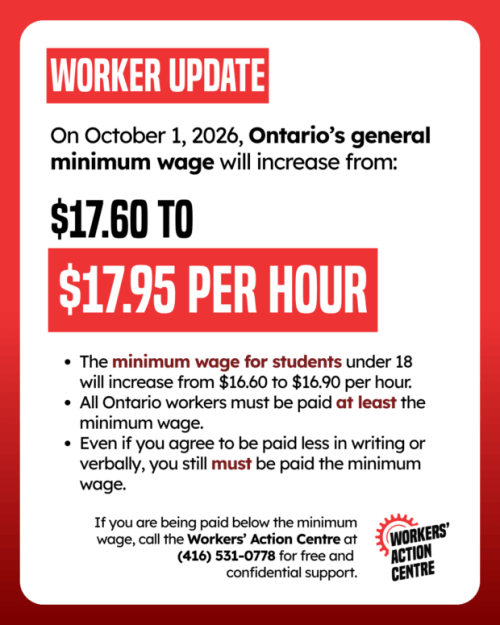
Yes, every little bit counts. But too many of us will still struggle to get by on $17.95 an hour. Ontario needs a higher minimum wage on top of our annual increases. Here’s one reason why.
The CPI does not match the actual inflation experienced by workers
CPI measure, which determines the annual increase, is a broad average. It does not reflect the experience of minimum wage workers who disproportionately spend more of their income on basic necessities.
Since 2002, Ontario’s CPI has increased by 70.0%.
Yet in that same time, the cost of basic needs have gone even higher:
- Groceries increased by 102.3%
- Eating out increased by 108.1%
- Utilities increased by 108.8%
- Vehicle maintenance increased by 92.5%
- Gasoline increased by 146.9%
(Source: Statistics Canada)
We will only get a higher minimum wage if we fight for it. What minimum wage would you fight for? And what minimum wage do you believe workers can win together?
 About us – The Workers’ Action Centre (WAC) is a worker-based organization. We are committed to improving the lives and working conditions of people in low-wage and unstable employment. Thousands of working families are struggling to make ends meet, so we take action and organize for decent work. We believe that the leaders in the fight for decent work should be the workers directly affected by poor working conditions. Workers have firsthand experience of problems at work, and have the best insight into what will bring fairness and dignity to Ontario’s workplaces.
The livable wage for the Niagara region in Ontario is $21.40 per hour (grouped under the Brant Haldimand Norfolk Niagara region), as tracked by the Ontario Living Wage Network. [1, 2]
Key Details
- Living Wage Rate: $21.40 per hour (based on a standard 35- to 40-hour work week to cover basic expenses like food, shelter, and transportation). [1, 2]
- Comparison to Minimum Wage: Ontario’s general minimum wage is $17.95 per hour (increased on October 1, 2026), leaving a gap of $3.45 per hour between the legal minimum and the calculated living wage. [1]
Context: The living wage reflects actual local costs for housing, childcare, food, and modest community participation. [1, 2]
Ontario’s minimum wage is falling further behind the living wage –
From the Canadian Centre for Policy Alternatives and Ontario Living Wage Network
 Every year the minimum wage in Ontario has a modest increase. And every year the actual living wage pulls further away. 2026 is no different.
The gap between Ontario’s minimum wage and living wage continues to grow.
The minimum wage is a legal floor: the minimum amount the provincial government requires employers to pay workers. Although the rate increase is adjusted for inflation each year, it bears no relation to the cost of living. It is an arbitrary amount. In 2025, the minimum wage for most employees was $17.60, and on October 1, 2026, it will increase to $17.95.
In contrast, the living wage corresponds to the amount workers need to live a decent life. The Ontario Living Wage Network (OLWN) uses a robust calculation framework to estimate how much workers need to earn to afford basic needs like food, shelter and transportation, as well as modest community participation expenses, such as a modest vacation and after-school activities for the children.
While collecting expenses for their annual calculation, the OLWN gathers figures for a four-person family with two adults and two children, a single-parent family, and a single adult living alone. The calculation work also accounts for government income supports like the Canada Child Benefit, which boost family incomes, plus any other applicable taxes, transfers and benefits. Since living costs vary across regions—especially rents—the OLWN calculates 10 local living wage rates instead of a single rate for the entire province.
In 2025, living wages across Ontario ranged from $21.05 to $27.60, which is much higher than the $17.60 minimum wage.
For a related news report on this issue, click on – https://www.cbc.ca/news/canada/toronto/ontario-minimum-wage-increase-9.7364666
NIAGARA AT LARGE Encourages You To Join The Conversation By Sharing Your Views On This Post In The Space Following The Bernie Sanders Quote Below and by sharing the Niagara At Large site at www.niagaraatlarge.com with all of your friends and associates.
“A Politician Thinks Of The Next Election. A Leader Thinks Of The Next Generation.” – Bernie Sanders –

