
“I’ll be seeing you in ev’ry lovely summer’s day, In everything that’s light and gay, I’ll always think of you that way, I’ll find you in the morning sun and when the night is new, I’ll be looking at the moon, but I’ll be seeing you.”
-
Lyrics from one of Frank Sinatra’s earliest hits.
From Doug Draper, Niagara At Large
By September of 1941, most of Europe was under Nazi occupation and then-British Prime Minister Winston Churchill was pressing U.S. President Franklin Delano Roosevelt and Canadian Prime Minister William Lyon MacKenzie King for more supplies and military support as his country braced for itself for a possible invasion of his country’s shores.
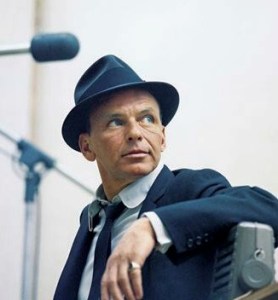
Frank Sinatra during those golden years at Capitol, with Nelson Riddle in the 1950s.
On a lighter note, baseball fans everywhere were tuned into radio sportscasts as the Brooklyn Dodgers were on their way to winning the National League pennant and facing World Series showdown against their arch rivals, the New York Yankees and their star slugger Joe DiMaggio.
Yet for a few hours on September 19th of that year, war and baseball were far from the minds of thousands of bobby soxers – the term used for teeny boppers in those days – as they packed main floor and balcony of Buffalo, New York’s grand old Shea’s Theatre to see one of the most popular bands of the era and a young singer who was becoming an international sensation.
The band, featuring one of the all-time great drummers, Buddy Rich, was led by jazz trombonist and composer Tommy Dorsey and the singer was Frank Sinatra, and my mother, then 15, was in the audience that day when this first of a brand new breed of pop singers took the stage to fans who let out screams every time he performed one of his hits, just as later generations would during an Elvis Presley or Beatles performance.
Seeing this up and coming superstar at Shea’s that day was one of the highlights of my mother’s teen years as she reminded me four decades later when I went with her and my father to see Sinatra in concert, this time several blocks across town from Shea’s, at the Buffalo Aud.
There must have been 16,000 people in the Aud the night I saw him with my parents. And yet as he sat on a stool below a spotlight with a glass of Jack Daniels in one hand and a cigarette in the other, and began singing the first lines of the bluesy ballad ‘One For My Baby’ – “It’s a quarter to three, no one in the place except you and me” – he had this remarkable ability to make you feel it was just you and him, sitting across a bar from one another as shared his feelings about breaking up with a girl he loved.
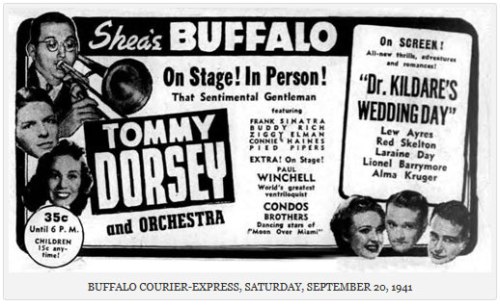
An add for the Tommy Dorsey-Frank Sinatra appearance at Shea’s Buffalo Theatre on September 19th, 1941. At this early stage, Sinatra isn’t featured in ads as the star he was already becoming. You can click on this image to blow it up to a size that makes it easier to read.
Sinatra ended that concert with a song that, like so many other songs in his repertoire, had become another anthem for him. The song was ‘New York, New York’, recorded in 1978 when he was in his mid-sixties, and there it was running up Billboard charts occupied by artists like Elton John, Madonna, Elvis Costello and David Bowie at the time.
At New Year’s celebrations in Times Square, Sinatra’s recording of ‘New York, New York’ is still the first song that blares through streets when the big ball finishes its countdown to midnight.
And like so many of his recordings from the 50s, when he was sharing the charts with Elvis, Little Richard and Chuck Berry, and from the 60s, when he was sharing them with the Rolling Stones, Bob Dylan and the Beatles, and on through the 70s into the 80s, there is something about the cool and swagger in his voice that still makes Frank Sinatra, who died in 1998 and who would have turned 100 this December 12th, sound so contemporary.
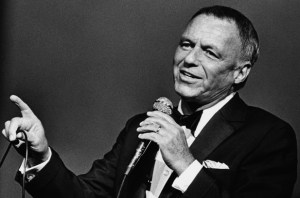
The way Frank looked around the time he performed at the Buffalo Aud in the late 1970s
Listen to almost any of his recordings on Capital in the 1950s or on his own label, Reprise, in the 1960s and 70s, and they sound like they could have been made yesterday.
I’ve been asked so many times over the years how I can like Frank Sinatra with all of that running around with a “rat pack” and the stories about palling around with mobsters. When I’m asked that, I think about a joke (at least they say it was just a joke) told by an old Vegas comedian named Shecky Greene who said he couldn’t care less about what anyone thinks of Frank because he saved his life once. As Greene tells it, he was standing outside a casino one night when a couple of goons approached and began laying a merciless beating on him until Frank came out from the shadows and said; “Okay boys. That’s enough.”
Obviously, Frank Sinatra never saved my life and I don’t care how many times he may have had dinner with Joey Gallo at Umberto’s Clam House.
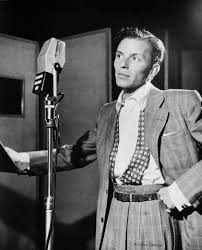
Frank Sinatra in the 1940s
What it always comes back to for me is the reason the world knows this guy who almost didn’t survive what was a difficult birth for his mother in cold-water flat in the Italian section of Hoboken, New Jersey 100 years ago this December 12th, 2015.
The reason is the music and a library of recordings of some of songs written by some of the best composers of the 20th century and a singer who, using his voice like some of the best musicians in the business played jazz on a horn.
Frank Sinatra, as so many other great singers from Tony Bennett to K.D. Lang and Bono, have said – no other singer has ever picked up a mike in front of Count Basie or any other powerhouse of a band like Sinatra.
He simply remains the all-time best there has ever been at it.
So Happy 100th Birthday Frank. I’m going to crank up your recordings of ‘I’ve Got You Under My Skin’ and ‘That’s Life’ to celebrate.
For more information on Frank Sinatra’s performances at Buffalo’s Shea’s Theatre and the University of Buffalo in September of 1941 click on http://libweb.lib.buffalo.edu/blog/?p=5276 .
NOW IT IS YOUR TURN. Niagara At Large encourages you to share your views on this post. A reminder that we only post comments by individuals who share their first and last name with them.
Click on www.niagaraatlarge.com for more news and commentary on Niagara At Large, an independent, progressive voice in the greater bi-national Niagara region.


What an unpleasant response, I know. Never could like Frank. Always slightly off-key to me. Now Lennon and Springsteen were another thing altogether. Wonderful. I even listened to the much admired Robert Harris on CBC Radio 1 admiring the Chairman of the Board, and still don’t get it.
LikeLike