
King Charles III Statement Highlights Historic Covenant Chain In Message To Inaugural Niagara Roundtable Conference
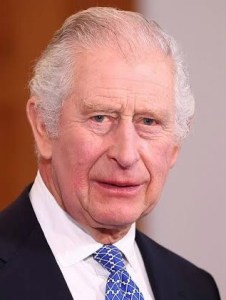
King Charles III
“I believe that such gatherings as this one, and the teachings they will inevitably convey, will inform and compel us further along the path of reconciliation.” – King Charles III
News from the Niagara Academy for Indigenous Relations and the Niagara-on-the-Lake Museum
Posted September 21st, 2026 on Niagara At Large
Niagara-on-the-Lake, Ontario — The Niagara Academy for Indigenous Relations and the Niagara-on-the-Lake Museum welcomed a significant message from His Majesty King Charles III recognizing the inaugural Niagara Roundtable Conference and the enduring importance of the Silver Covenant Chain of Friendship between the Crown and Indigenous nations.
The message, sent by The King on behalf of himself and Queen Camilla, offered “heartfelt greetings” to the historic gathering of the Niagara Roundtable and drew particular attention to Niagara’s important place in the history of Crown-Indigenous relations.
“It was at Niagara, over 250 years ago, that the Silver Covenant Chain of Friendship was extended across the Niagara River into the Great Lakes region,” The King stated, noting that the relationship had first been forged with his forebear, King Charles II.
His Majesty described that historic relationship as one that has evolved into the friendship he now cherishes with Indigenous peoples across Canada.
The King also referenced receiving a replica Covenant Chain wampum from the Mississauga Nation following his Coronation. The wampum is now displayed in his Chapel Royal, The King’s Anishinaabek Sacred Place, in Toronto.
Here is the full message from the King –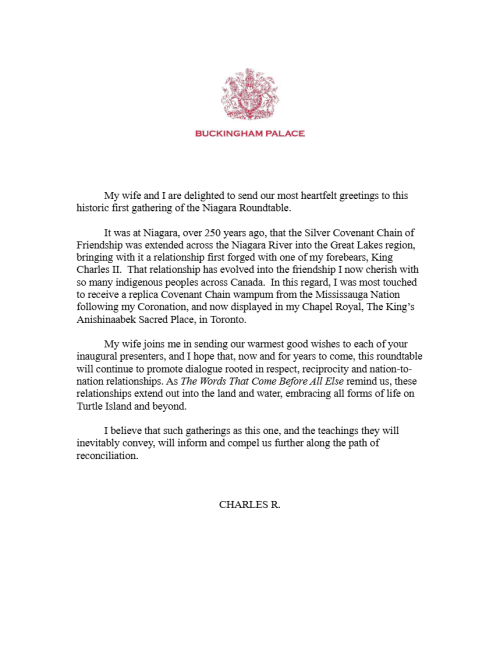
For the two partner organizations that developed the Conference, the Niagara Academy for Indigenous Relations and the Niagara-on-the-Lake Museum, the message carries particular significance because the Niagara Roundtable was established to examine the long and consequential history of relationships among Indigenous nations, newcomers, governments, institutions, and communities throughout the Niagara region and across Canada.
“The King’s recognition of the Silver Covenant Chain is profoundly relevant to the work of the Niagara Academy for Indigenous Relations,” said Rick Hill, the organization’s vice president.
“The Covenant Chain was never intended simply as an idea of the past. It represented an ongoing relationship requiring attention, renewal, reciprocity, and mutual responsibility. The knowledge holders and scholars who presented at the Roundtable revealed — in detail — numerous instances throughout history in which the Covenant Chain was referenced, understood, and affirmed by all parties involved.”
Held September 19 in the Upper Canada Hall at the Pillar and Post Conference Centre in Niagara-on-the-Lake, the Niagara Roundtable brought together First Nations leaders with Indigenous knowledge holders, scholars, historians, researchers, educators, cultural leaders, and a wide variety of organizational professionals to examine the dynamics and realities of Indigenous relations extending back some four centuries.
Providing welcoming remarks to the prestigious assemblage, centred on the theme of advancing the Covenant Relationship and Reconciliation, were MP for St. Catharines Chris Bittle, MP for Niagara Falls and Niagara-on-the-Lake Tony Baldinelli, and MPP for Niagara Falls, Fort Erie, and Niagara-on-the-Lake Wayne Gates. From the Municipal governance level, attending the Roundtable Conference was Lord Mayor of Niagara-on-the-Lake Gary Zalepa.
 “We were honoured to partner with the Niagara Academy for Indigenous Relations in hosting the Niagara Roundtable and are so encouraged by the attendance in the room and the knowledge shared by the presenters,” said Amy Klassen, executive director of the Niagara-on-the-Lake Museum.
“Museums have an important role to play in reconciliation by listening to Indigenous knowledge keepers, creating opportunities for people to learn and unlearn alongside us, and building respectful relationships with Indigenous communities. In Niagara, this also means understanding the history and ongoing significance of the Covenant Chain and the responsibilities it represents.”
Among the subjects explored by eighteen presenters were:
- Treaty Relations;
- John Norton’s Relations with Colonial and Imperial Authorities; The Silver Covenant Chain in the 21^st Century;
- Anishinaabek Wampum Belts and the Covenant Chain Relationship;
- Matriarchal Roles and Indigenous Women in Leadership; the Historic Relationship Between the Mohawk Nation and Palatine German communities;
- Joseph Brant and Diplomatic Relations in Upper Canada;
- Haudenosaunee Land Tenure; Intimate Relations and Blended Families of Niagara; Museums and their Indigenous Relations;
- Haudenosaunee Ecological and Diplomatic History of “The Wilderness,” and
- Place-Based Learning within Historic Landscapes.
The King’s message closely reflected the principles underlying the Roundtable. His Majesty expressed the hope that the gathering would continue “for years to come” to promote dialogue founded upon “respect, reciprocity and nation-to-nation relationships.” He further observed that these relationships extend to the land and water and embrace all forms of life on Turtle Island and beyond.
The message concluded with a powerful affirmation of the value of bringing people together to learn from these histories and teachings: “I believe that such gatherings as this one, and the teachings they will inevitably convey, will inform and compel us further along the path of reconciliation.”
“The significance of those words cannot be overstated,” said Tim Johnson, president of the Niagara Academy.
“Reconciliation requires more than acknowledgement. It requires knowledge of the relationships that came before us, an understanding of the commitments embedded within them, and a willingness to renew those relationships in ways that have meaning in the present.
“That is precisely why we created the Niagara Academy for Indigenous Relations and how the Niagara Roundtable will serve as an important educational launch pad for a variety of programs in the future.”
The Niagara Academy for Indigenous Relations intends the Niagara Roundtable to become an ongoing forum for scholarship, Indigenous knowledge, professional development, public education, and meaningful dialogue concerning the historic and contemporary relationships that have shaped Niagara and Canada.
 About the Niagara Academy for Indigenous Relations – The Niagara Academy for Indigenous Relations is an Indigenous-led not-for-profit organization that works to broaden public understanding of Indigenous relations, including through education and training, research, publishing, community collaboration, expressive arts, land-based learning, environmental awareness, and engagement grounded in Indigenous knowledge systems, scholarship, and cultural integrity.
 About the Niagara-on-the-Lake Museum – The Niagara-on-the-Lake Museum is a community-focused cultural hub housing one of Ontario’s most important local history collections. Located at 43 Castlereagh Street in a historic complex that includes Ontario’s first purpose-built museum building (Memorial Hall, opened in 1907) and an 1875 high school, the institution preserves over 50,000 artifacts documenting thousands of years of regional heritage.
NIAGARA AT LARGE Encourages You To Join The Conversation By Sharing Your Views On This Post In The Space Following The Bernie Sanders Quote Below and by sharing the Niagara At Large site at www.niagaraatlarge.com with all of your friends and associates.
“A Politician Thinks Of The Next Election. A Leader Thinks Of The Next Generation.” – Bernie Sanders

