
Ontario, Alberta and Saskatchewan Working Together to Protect Canadian Workers and Achieve Energy Security in the Face of Tariffs and Economic Uncertainty
A News Release from the Constituency Office of Niagara West Ford Government MPP Sam Oosterhoff
Posted August 8th, 2025 on Niagara At Large

From left to right, Ontario Premier Doug Ford, Alberta Premier Danielle Smith and Saskatchewan Premier Scott Moe embrace a future for Canada that involves the continued production and burning of ever more fossil fuels. Now they call on Canadians to join them in embracing such a future in the names of responding to Trump’s tariff war.
BEAMSVILLE – This past August 7th, the Ontario government issued a request for proposals to conduct a feasibility study exploring how best to establish a new economic and energy corridor.
This corridor would include new Alberta-to-Ontario pipelines, bringing Western Canadian oil and gas to refineries in Southern Ontario and tidewater ports including a new deep-sea port on the coast of James Bay.
These new pipelines, built entirely within Canada using Ontario and Canadian steel, would help achieve energy security by ensuring ongoing access to Canadian oil and gas for Canadian homes and businesses while also creating good-paying jobs across the country.
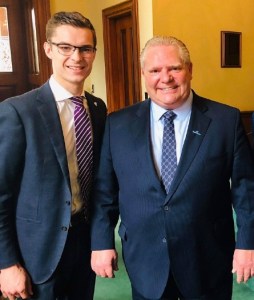
Niagara West Conservative MPP Sam Oosterhoff (left) and his boss, Premier Doug Ford. Sam Oosterhoff is serving as Ford’s Associate Minister of Energy-Intensive Industries
“This feasibility study marks a transformative milestone in securing our energy future and protecting Ontario jobs,” said Sam Oosterhoff, MPP for Niagara West.
“Canadians need to work together to build the infrastructure that will diversify our trading partners and end our dependence on the United States.”
“The last few months have shown that Canada can no longer rely on energy infrastructure that lies outside of our borders and can be shut down at a moment’s notice by another country,” said Hon. Doug Ford, Premier of Ontario.
“It is time for us to build cross-Canada infrastructure within our borders so we can protect our energy security, find new markets for Canadian energy and resources and create new jobs and opportunities for Canadian workers. Together, we are building a more competitive, resilient and self-reliant economy.”
New East-West pipelines would, if approved, help protect Canada’s economy, workers and energy security by making it easier to transport oil and gas from Western Canada to Ontario and reduce Canada’s reliance on the United States.
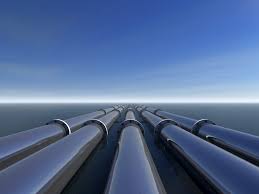 Pipelines are the safest and most cost-effective way to transport critical fuels. As this and all energy and trade infrastructure projects move forward, Ontario will continue to honour and fulfil its duty to consult with Indigenous communities and to advance economic reconciliation.
“In the face of unprecedented tariffs from the United States and increasing geopolitical instability, Canadians must work together across governments to build the energy and trade infrastructure we need to unlock new markets domestically and protect jobs,” said Hon. Kinga Surma, Minister of Infrastructure.
“Through our focus on new nation-building projects and partnerships, we are seizing a generational opportunity to bring sustainable prosperity to our Northern communities and strengthen both Ontario and Canada’s economy.”
The feasibility study will also explore the practicality and benefits of a new port outlet on James Bay, Hudson Bay and the Great Lakes, as well as consider the viability of a new or expanded refinery along the pipeline route.
This expanded capacity would provide additional opportunities to export Canadian energy outside the country, while creating new jobs and opportunities for Canadian workers in the petroleum refining sector.
The feasibility study will also consider the financial and commercial tools necessary to derisk a pipeline project, provide strategies to achieve Indigenous equity participation and consider the benefits of establishing a Canadian Strategic Petroleum Reserve.
 Canada is one of the few International Energy Agency member states that does not maintain a federally administered strategic petroleum reserve, which leaves Canadian homes and businesses exposed and vulnerable to cross-border pipelines disputes, extreme weather disruptions, geopolitical supply shocks and other disruptions in energy supply.
This reserve would be an emergency stockpile of petroleum that the province can utilize in emergency situations to minimize service interruptions to the flow of oil.
“By advancing a new East-West energy corridor – in partnership with the federal government and other provinces – we are strengthening domestic supply chains, unlocking the potential of our homegrown resources, and positioning Canada as a more competitive and self-reliant energy leader on the world stage,” said Hon. Stephen Lecce, Minister of Energy and Mines.
“This is about delivering long-term energy security, supporting future economic growth, and building a stronger, more resilient country for generations to come.”
This energy corridor stems from a recent Memorandum of Understanding among Ontario, Alberta and Saskatchewan which commits these provinces to identify areas of future collaboration that would protect Canadian workers, including new energy and trade infrastructure, and to continued cooperation in advancing the development of nuclear energy to meet growing energy needs.
Quick Facts:
- *The feasibility study will also scan for complementary development opportunities across Ontario, including all-season roads to and beyond the Ring of Fire, mineral exports, grid upgrades, broadband expansion and social facilities in growing communities.
- *As part of the study, the province will develop an Indigenous engagement roadmap to help ensure decisions will be made in a manner consistent with the recognition and affirmation of existing Aboriginal and treaty rights in section 35 of the Constitution Act, 1982, including the duty to consult.
- *Petroleum products account for nearly forty percent of Ontario’s end-use energy consumption, primarily serving the transportation sector, but also supporting home heating and key industrial applications.
A Footnote by Doug Draper at Niagara At Large – If you managed to read your way through the above news release, you may have noticed that ‘renewable energy’ and ‘climate change’ were not mentioned or even hinted at once in it.
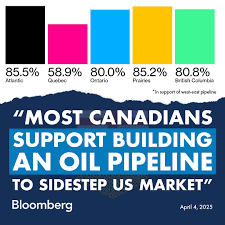 It has already become abundantly clear to this commentator that our Premier in Ontario, along with many other political leaders at all levels of government, across our province and country, are using the trade war with U.S. President Donald Trump as an excuse to weaken environmental protection measures and to kick the climate emergency we face to the curb so that they and their masters in the oil, gas and development industries can carry on with business as usual.
Through all of this, the existential threats the climate crisis poses to the health and economic welfare of our communities and, ultimately, to the survival of humans and other species on this planet are all but being ignored.
It is also becoming more apparent to me that except for a handful of environmental groups and what now seems to be a minority of citizens, that sweeping environmental protection and the climate crises to the side is okay for too many of us, unless or until, of course, our personal well-being and property are being directly threatened or destroyed.
All of this is enough to make me wonder if, all of these years, I have been wasting my time writing about and posting reports on environmental issues, especially when there is so much movement backwards to the dirty days before the first Earth Day in the spring of 1970.
I must admit that as of this writing, I am on the verge of saying; ‘To hell with it. I’ll spend more time playing my guitar,’ which would be something akin to fiddling while Rome burns down.
Then I think of my young daughter and her friends and their future and I can’t give up. At least not yet.
-
Doug Draper, Niagara At Large
NIAGARA AT LARGE Encourages You To Join The Conversation By Sharing Your Views On This Post In The Space Following The Bernie Sanders Quote Below.
“A Politician Thinks Of The Next Election. A Leader Thinks Of The Next Generation.” – Bernie Sanders


As a local artist and Torontonian who cares about how policies impact our communities, I appreciate this discussion about energy and infrastructure. It’s also important to remember the smaller things that bring us together. One of my favorite discoveries recently was a mosaic lamp workshop at DiyLabs where participants can design their own Turkish‑style lantern. It’s a fun activity and a relaxing way to connect with neighbors and celebrate creativity. Workshops like these help strengthen communities while the big decisions about pipelines and energy are being debated. https://diylabs.ca
LikeLike