
This Submission courtesy of the Hamilton public interest group Citizens at City Hall
(A Brief Note from Niagara At Large – We encourage you to regularly visit the website for this group, known as CATCH for short. We could use more ctizien watchdog groups on our municipal politics in the Niagara Region. You will find linkes for CATCH at the end of this post.)
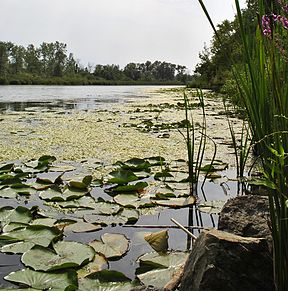
How much of this Hamilton Airport poison is now lingering in the Welland River watershed and when are our government agencies going to get to the bottom of it?
More than four years after it was discovered, the world-record levels of a toxic flame-retardant chemical that have contaminated the Binbrook Conservation Area reservoir and the Welland River still await a cleanup plan being bandied back and forth between the provincial Ministry of the Environment and Tradeport International. The city agreed to cover half the costs of the plan which remains secret more than 20 months after its promised completion.
In the meantime, scientists are identifying additional significant health effects of perfluoroctane sulphonate (PFOS), and hopes are fading that the federal government will help pay for a cleanup that will cost at least $2 million to remove the source contamination at the airport’s former fire training pad, and likely much more to remediate the downstream areas where extensive fish consumption warnings remain in place.
The problem was first identified when Environment Canada scientists accidentally found extreme levels of PFOS in the Binbrook reservoir (also known as Lake Niapenco) in late 2009. That led to fish sampling in 2010 and an MOE visit to test the airport fire pad in April of that year and eventually to a fish consumption warning released in March 2011 and made public by CATCH.
At that point the MOE claimed to be uncertain about the source. Environment Hamilton biologist Joe Minor confirmed that in April 2011 with his own test that showed extreme levels of the toxic chemical flowing off the airport property into the Welland River watershed that includes Lake Niapenco. The MOE “confirmed” Minor’s results a month later and ordered a cleanup plan.
Finger pointing between the city, Tradeport and the federal government on responsibility for the contamination occupied much of the remainder of the year, but in December 2011 council reluctantly agreed to foot half the bill for a consultant hired by Tradeport to create a detailed long-term cleanup plan. The “estimated cost” to the city at that time was $40,000 and the plan due date was August 2012.
It has repeatedly been delayed, with the last report on its whereabouts coming in May 2013 with Tradeport claiming that the MOE was dragging its feet on approval, the MOE replying that it had only received some of the test results from Tradeport two weeks earlier, and both parties plus the city maintaining that the ‘draft’ report originally submitted the previous November still couldn’t be made public.
In the same month, a Taiwan study found that “babies with higher PFOS exposures in the womb are born smaller and sooner.” It also noted that “the effects were found at levels of the perfluorinated chemical similar to those measured in U.S. and Canadian babies.”
Earlier studies have linked PFOS to kidney disease, breast cancer, ADHD, and the negation of childhood vaccination protection. It is highly persistent and bio-magnifies and bio-accumulates in living tissue. 3M voluntarily phased out production of the flame-retardant in 2002 and the chemical was subsequently added to the Stockholm Convention on Persistent Organic Pollutants and also subjected to Canadian “virtual elimination” legislation.
It appears that most of the airport contamination originated in the 1980s when the facility was owned by the federal government and operated by the former regional municipality of Hamilton-Wentworth, but the airport is now owned by the city and the feds have been reluctant to accept responsibility or any significant financial role in cleanup. That prospect appears to have diminished further with the revelations last week of more dramatic cuts to the budget of Environment Canada including over 40 percent reductions in pollution management and mitigation being imposed over the next three years.
Initial investigations found world-record levels of the chemical near the airport fire training pad, but the latest data to be released to the public was collected more than two and a half years ago in the summer of 2011. More thorough assessment of the problem promised in the cleanup plan remains secret despite the substantial financial contribution from local taxpayers. It can’t be extracted through freedom of information legislation because management of the airport is in the hands of a private company.
CATCH (Citizens at City Hall) updates use transcripts and/or public documents to highlight information about Hamilton civic affairs that is not generally available in the mass media. Detailed reports of City Hall meetings can be reviewed at hamiltoncatch.org. You can receive all CATCH free updates by sending an email to http://hamiltoncatch.org/newsletter/?p=subscribe. Sharing links are available on the hamiltoncatch.org.
(Nagara At Large invites you to share your views on this post. A reminder that we only post comments by individuals who share their first and last name with them.)
 Niagara At Large
Glad to see you posting this Doug! I subscribe to their email newsletter and hoped, when I saw it, that you would post it so others could see it as well. I live in the Hamilton area and am appalled by the lack of action and the indifference shown by all levels of government on this issue.
LikeLike
Will
The Federal indifference does not surprise me anymore and the City of Hamilton is up to their necks in debt much like Welland
LikeLike
Dear Mr. Draper,
Thanks for the heads up regarding the lack of attention to a serious pollution dump.
Commenter Will MacKenzie says he is appalled by the lack of action and the indifference shown by all levels of government on this issue.
But, why should there be any surprise?
Our local groups reported on a serious pollution dump right here in Niagara complete with actual ‘Certificate of Analysis’ serious enough to poison and kill 15 full grown Swans and who knows what other creatures were killed or how far and at what risk this poison poses on its way to Lake Ontario.
The Niagara Regional Government and the Ministry of Environment (MOE) has been refusing a ‘Freedom of Information’ request for several months, well past the legal timeline of 30 days.
The MOE’s ‘wholly-owned’ subsidiary, Niagara Peninsula Conservation AUTHORITY (NPCA), whose greatest claim to fame is nepotism and raising their wages by 40% operates a schizophrenic enterprise predicated on theorem and power grabbing autocracy instead of fair and equal treatment of Niagara Citizens.
These so-called environmental protection agencies certainly owe the Citizens a proper and meticulous explanation.
Sadly it appears the MOE and its NPCA have deteriorated into a feckless army of ‘Tax burners’.
LikeLike
I am sorry that the links didn’t show giving the actual analysis of the poisions dumped into our waters so I will link them here:
http://newsalertniagara.blogspot.com/2012/11/watersmart-niagara-how-does-that-work.html
http://newsalertniagara.blogspot.ca/2012/09/pollution-alert.html
http://newsalertniagara.blogspot.com/2013/12/conservationists.html
LikeLike
I didn’t say I was surprised … I said I am appalled!
As a matter of fact, I am getting somewhat angry about the situation and lack of action.
To Joseph Somers: the reason the City of Hamilton is in financial difficulty is because of ongoing and epidemic stupidity at City Hall! And now the man that I consider to be the most arrogant man I have ever met is running for mayor!
If Brad Clark wins the Hamilton mayoralty election, heaven help us!
He is more arrogant than even Pierre E. Trudeau – and I met and dealt with both of them in person!
LikeLike