
‘Public transportation needs to be seen as a critical public good that must be supported by (Niagara’s)Regional Council.’

Niagara resident and environmental activist Liz Benneian
A Call-Out for Building Niagara’s Public Transit System from Liz Benneian, Executive Director and Manager, of Environmental Education Ontariogreen and leading member of the citizens’ coalition Biodiversity and Climate Acton- Niagara
Posted December 11th, 2023 on Niagara At Large
Service cuts and fare increases were not what was envisioned for the Niagara community when the Region of Niagara amalgamated transit into a regional service.
However, that’s what current and future transit riders can expect now that Regional Council has asked the Niagara Region Transit Commission (NTC) to cut their proposed budget for a third time.
The NTC staff recommended a 10 per cent increase. This increase was meant to cover the takeover of responsibilities such as snow removal from bus stops formerly undertaken by Local Area Municipalities (LAMs) as well as inherited capital funding applications, and already in progress projects that had to be completed — costs which were not fully accounted for when the LAM’s transit operating budgets were consolidated to create the NTC’s first-year operating budget.
Additionally, buses are a capital asset that must be continually managed and renewed. Yet, because of the reduced ridership and revenues during COVID, and with the promise of regional amalgamation nearing, none of the LAMs to purchased new buses in recent years.
Following their first draft budget, NTC staff were asked by the NTC board to revisit the budget and came back with a 7.8 per cent increase which the board approved. However, the Regional Council rejected it.
The Regional Council then suggested NTC come back with a reduced budget that considered fares increases, service reductions, deferring capital reserve transfers and other measures. The NTC came back with a proposed 6.3 per cent budget increase.
Regional Council did not accept this proposal and has asked the NTC to come back to the December 14th budget committee meeting with more cuts.
The NTC is now in a situation where capital assets are ageing, and replacement needs are looming. At the same time, with COVID in the rear view mirror, ridership is rebounding as the Region’s schools attract more students and as new businesses and industries continue to choose to locate to the area.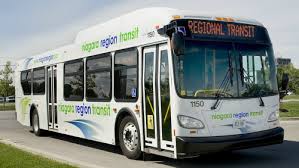
This is not the time for more cuts, less service and higher fares.
Public transportation needs to be seen as a critical public good that must be supported by Regional Council without further cuts for the following reasons:
Public Transit is Vital to the Economy –
The Greater Niagara Chamber of Commerce has supported improved, regionally integrated public transit service for years as a key economic driver.
Their surveys have found business leaders prioritized consolidated public transit with a single farebox as the most important political and economic issue for Niagara; infrastructure was a bigger issue for businesses than taxes and that businesses would much rather see investments now instead of tax cuts and deferrals; public was transit rated as one of the more important items affecting business, and nearly half of respondents said that public transit needed to receive more funding.
Will new employers continue to see Niagara as a location of choice if the workers they want have no way to get to their workplace?
Not everyone can afford a car. Especially as the cost of basics such as housing and food rise, an increasing number of Niagara’s citizens are having to make serious choices about whether car ownership is economically viable for them. The Region’s employers, and the people who work for them, need public transit.
Regional Transit Must Be GO-ready –
Being ready for GO, was one of the main drivers for consolidating Niagara’s transit system, but if it is underfunded now, how can it be ready for the new opportunities GO service will bring to the Region?
Public Transit is Needed to Serve Our Universities, Colleges and Schools –
Niagara’s major cities all have institutes of higher education that draw students from across Canada and internationally. It is imperative that public transit is available to get these students to their classes, their jobs, their homes, and their activities.
Keeping Bright Young Minds in Niagara –
Because Niagara is blessed with several institutions of higher learning, a wealth of talent from all around the world is graduated by these schools.
But young graduates, many with significant school-related debt, may not choose to stick around if they cannot get around. Being able to rely of efficient, affordable public transportation could be an advantage in helping Niagara retain the many bright young people that are graduating in our Region.
Public Transit Is Critical for Our Aging Population –
Niagara has a higher percentage of seniors than other areas in the Greater Golden Horseshoe. Most will eventually lose their driver’s licences. Many already do not drive due to health and/or economic factors. Increasingly public transportation will be needed for this key demographic.
Public Transit Is a Social Justice Issue –
Adults served by Community Living, people with disabilities, and many others who cannot drive for health or other reasons rely on public transit to get them to their services, their jobs, and their community activities.
It is not right that the most vulnerable in our society shoulder additional costs and suffer decreased service when simply providing an adequate levy could disperse this cost across all residents of Niagara, many of whom would have no difficulty absorbing a fractional increase on their property taxes.
Reliable, Efficient and Affordable Public Transit Makes Niagara Future Ready –
Niagara is expected to add another 300,000 people by 2051— a 60% increase.
Bluntly, even if it was desirable to do so, the Region and local municipalities cannot afford to build the road infrastructure needed to support single vehicle use for that many more people in such a short time frame.
It would be economically unsupportable, and it would come at great cost to our existing agricultural areas, our urban communities, our natural areas and to human health. The only way to improve regional transportation, given the expected population increase, in a financially sound and sustainable way is to improve Regional Public Transit, to employ other multi-modal transit options and to practice excellence in urban planning.
Serving New Communities and New Institutions –
Another part of being future ready is ensuring public transit is available to serve the new communities that are being built across Niagara. These new communities are being built with less parking.
This is partially an effort to reduce the cost of housing thus making it more affordable, but it also means that a higher percentage of new residents will be relying on public transit to get where they need to go. Additionally, we have new institutions, such as the new hospital in Niagara Falls that will need to be serviced by public transit. Cutting back on needed funding now will not position the Region to meet these current and near-future needs.
Meeting Greenhouse Gas Reduction Goals –
Transportation is a major cause of local greenhouse gas emissions. The Region has committed to lowering emissions and needs to put words into action by improving its Regional Transit Service and by improving that service’s capital assets by aiming it toward Zero Emissions. That cannot be done while cutting capital funding.
Public Transit is a Critical Public Asset, As Roads Are, and Need To be Funded as Such –
While some decision-makers balk at “subsidizing” public transportation, local governments have been subsidizing private vehicle transportation for more than a century.
The Greater Niagara Chamber of Commerce (GNCC) notes the biggest transportation-related recipient of tax subsidies is the private vehicle.
A GNCC 2017 report enumerated the millions of dollars spent by Niagara’s largest municipalities on road maintenance, street lighting, bridges, traffic signals etc. and noted these costs are paid out of general tax revenues which are not passed on to the private drivers who make up the overwhelming majority of traffic on these streets, concluding it “represents a massive taxpayer subsidy of private vehicles.” Public transit, especially at this critical juncture, and for all the reasons cited above, also needs substantive public funding, not penny pinching.
Liz Benneian – Executive Director and Manager, Environmental Education Ontariogreen and leading member of Biodiversity and Climate Action Niagara
To learn more about Biodiversity and Climate Action – Niagara and to offer your support to this citizen coalition’s advocacy work for protecting our natural resources and building healthier communities in Niagara, click on – https://www.facebook.com/p/Biodiversity-and-Climate-Action-Committee-Niagara-100069417398384/
To learn more about Environmental Education Ontariogreen, click on – http://www.ontariogreen.ca/ .
NIAGARA AT LARGE Encourages You To Join The Conversation By Sharing Your Views On This Post In The Space Following The Bernie Sanders Quote Below.
“A Politician Thinks Of The Next Election. A Leader Thinks Of The Next Generation.” – Bernie Sanders
 Niagara At Large
Regional Counsellors clearly haven’t read the recent Canadian Press Article ‘Climate change battering municipal finances across Canada’ Thomas MacDonald, The Canadian Press Published Dec. 11, 2023 or they would realize the importance of a good public transportation system.
https://www.stcatharinesstandard.ca/news/canada/climate-change-battering-municipal-finances-across-canada/article_bbf7326a-b71e-5765-8bdd-61dac2e4f2b6.html
LikeLike