
A Message from the desk of Pelham Mayor Dave Augustyn
September, 2015 – As I wrote about in the spring, the Ontario Government is reviewing the Greenbelt Plan, Growth Plan for the Greater Golden Horseshoe, Oak Ridges Moraine Plan, and Niagara Escarpment Plan.

Pelham, Ontario Mayor Dave Augustyn
In April, I wrote to the Expert Advisory Panel overseeing this Review and implored them to increase the protection of the Fonthill Kame. I recently sent another letter to the Panel, and I am hoping that you will too!
The “Fonthill Kame-Delta” is Niagara’s rare, 75-metre-tall, 1,000 hectare landmark that was formed by retreating glaciers 13,000 years ago. As the “hill” in Fonthill and Shorthills and the “ridge” in Ridgeville, the Kame boasts the highest point in the Niagara Region and serves as a significant water recharge area and forms the headwaters of the Twelve Mile Creek. Further, the Kame’s microclimatic and soil conditions create an ideal environment for tender fruit including peaches, sweet and sour cherries, and plums.
The Ministry of Natural Resources (MNR) identified the Fonthill Kame as provincially significant in 1976 and as a Provincial “Area of Natural and Scientific Interest” (ANSI) in 1988 as a way to help restrict development. The Province also protected parts of the Kame with general provisions in either the Niagara Escarpment Plan or specific provisions in the 2005 Greenbelt Plan.
And, after considerable public feedback, research and scientific evaluation, MNR confirmed a new ANSI boundary for the Kame in October 2013.
As the Province reviews the Greenbelt Plan and the Niagara Escarpment Plan, they could inadvertently lessen these protections.
That’s why I wrote the Expert Panel in April and urged them to reinforce the ANSI re-designation by increasing the protection of the Fonthill Kame in their land use Plans.
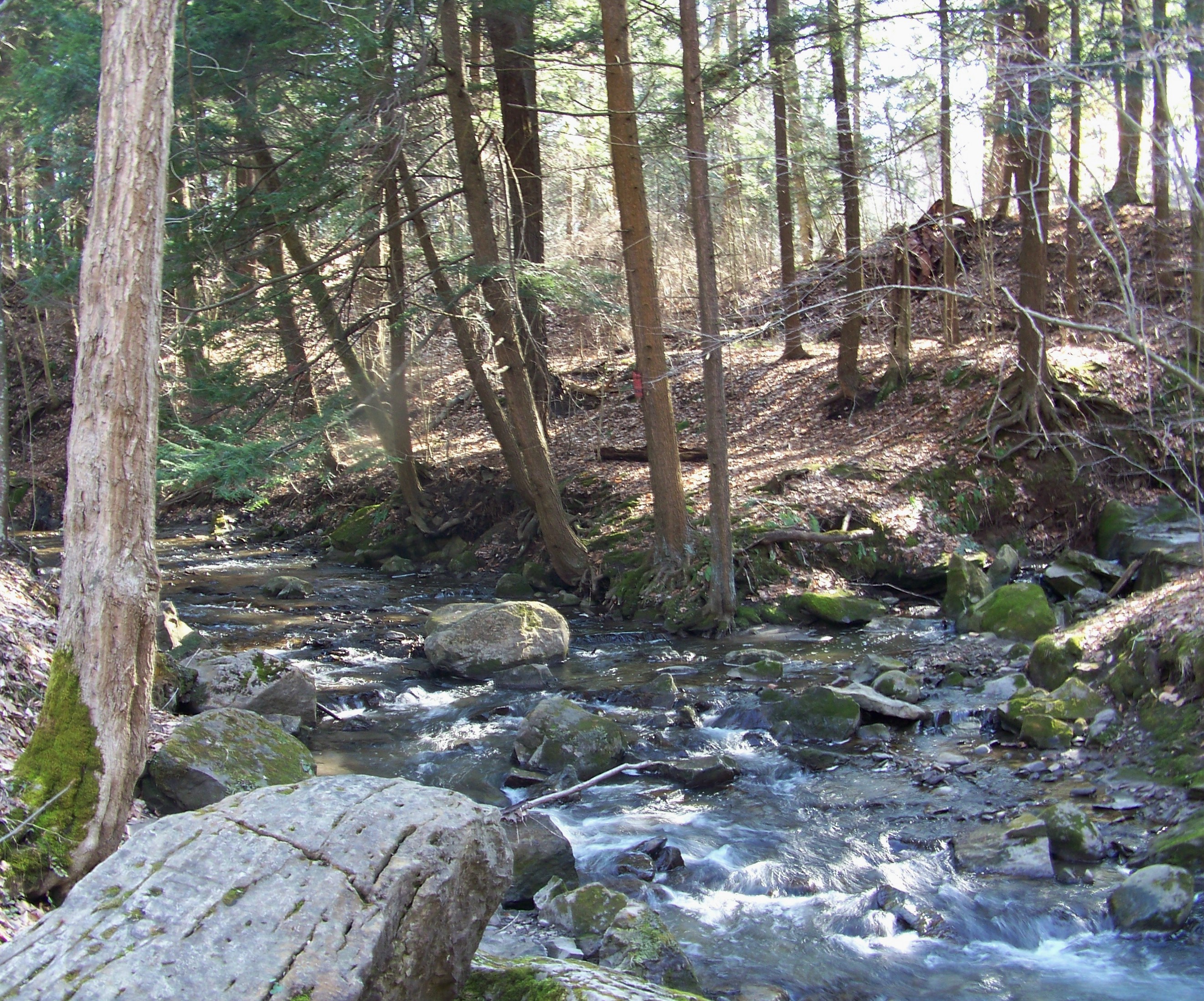
One of the many cold water streams running down from the Fonthill Kame and Short Hills to the headwaters of Twelve Mile Creek and Lake Ontario.
During the summer, Niagara Region approved maps and commentary as part of their submission to the Expert Panel. In that submission, Regional Council reiterated its request that the lands forming part of the “total morphology” of the Fonthill Kame be recognized and protected.
In fact, the Region suggested that lands as identified through scientific study by expert Dr. Menzies be added to the Niagara Escarpment Plan for increased protection.
Now, I am asking you to provide similar feedback to the Panel this month; please let them know that you are interested in protecting the Kame via the Niagara Escarpment plan to help curtail further aggregate extraction or development.
Please email your comments to landuseplanningreview@ontario.ca or send mail to:
Land Use Planning Review, Ministry of Municipal Affairs and Housing, Ontario Growth Secretariat, 777 Bay Street, Suite 425 (4th floor), Toronto, ON M5G 2E5.
Thank you, again, for helping to further protect the Fonthill-Kame so that its distinctive features, microclimatic and water recharge functions might be better safeguarded for future generations!
Check out links for documents and past columns at www.pelhammayordave.blogspot.com. You may contact Mayor Dave at mayordave@pelham.ca with questions or to suggest future topics.
Visit Niagara At Large at www.niagaraatlarge.com for more news and commentary for and from the greater bi-national Niagara region.
(NOW IT IS YOUR TURN. Niagara At Large encourages you to share your views on this post. A reminder that we only post comments by individuals who share their first and last name with them.)


My email letter has been sent to the LandusePlanning in support of protection of the Fonthill Kame.
LikeLike
I have too. If you could add the Facebook widget, we could post there.
LikeLike
That soil around the Kame is great for growing any kind of fruit trees and yes we should , do everything we can to protect it.!!!
LikeLike
Excellent opportunity to help, thank you for this post.
LikeLike