
By Mark Taliano
In a world dominated by hollowed-out newspapers, vacuous television, and political campaigns obsessed with sound-bites and banalities, it’s always refreshing to dig deeper and expand the public discourse.
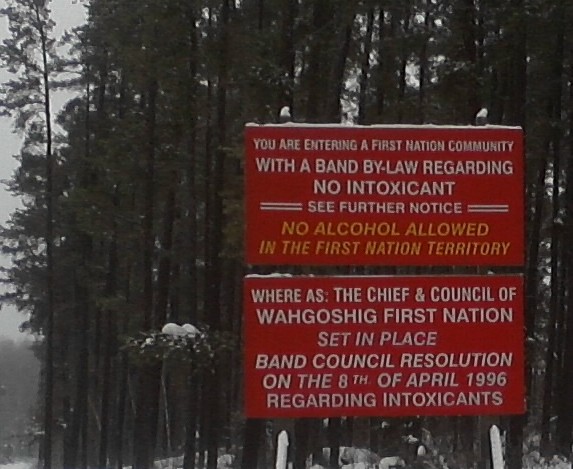
Entering the Wahgoshig First Nations reservation. Is this another country or is it Canada? Photo courtesy of Mark Taliano.
This is what John Ralston Saul does in A Fair Country Telling Truths About Canada. Interestingly, his message resonates with today’s grassroots citizens’ movements (i.e the world-wide Occupy Movement). The underlying message is that if we, as Canadians, find the confidence to be true to ourselves, and to understand who we are, we will be empowered to the benefit of ourselves and the world. Our self-analysis starts with our foundation. We are a nation borne of three independent, yet interconnected “pillars”: Aboriginal, French, and English. Unlike the U.S melting pot, we have Quebec, with its culture and language preserved, a bilingual federal government, as well as Inuit-governed Nunavut, plus Nunavik, and native reserves.
Our nation was the first colony of a European nation that achieved independence without going to war, (nor did we endure a bloody civil war). Our story has been one primarily of interdependencies and negotiations, a “circular” world view which is inclusive in its interdependencies. This atypical, non-monolithic model has always been our distinctive strength, and an example to the world, but we are losing our sense of self, and, in turn, our collective self-esteem.
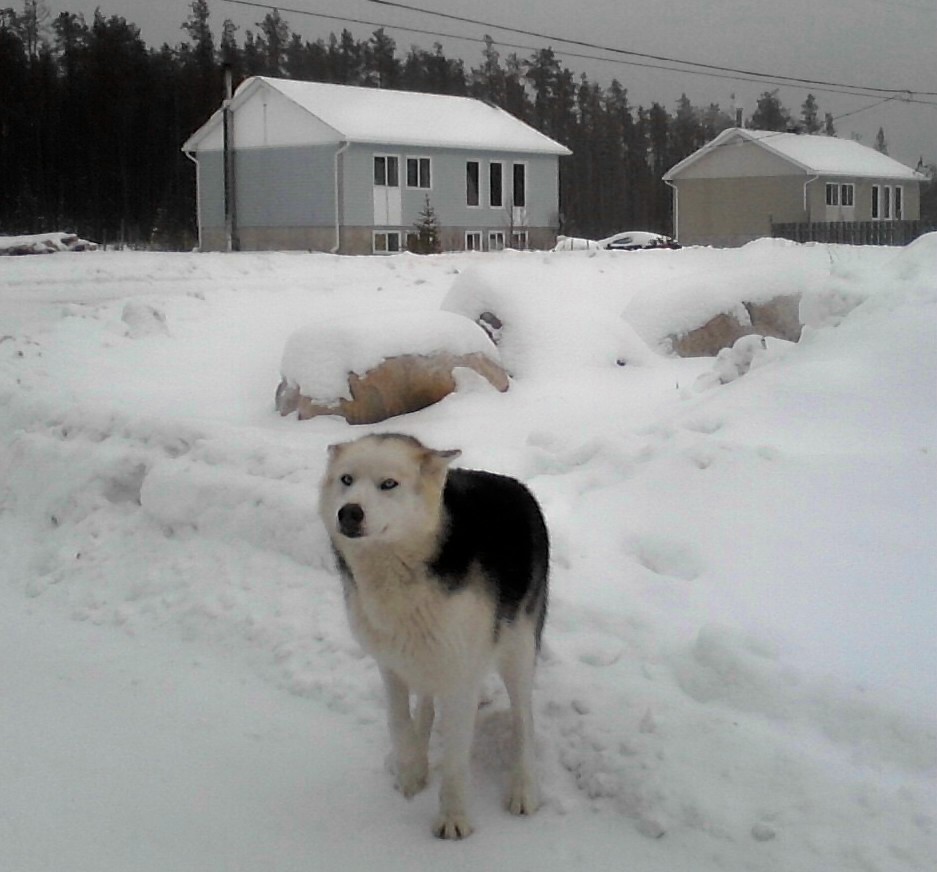
A lone dog at the Native reserve. Photo courtesy of Mark Taliano.
How did our complex, sophisticated society evolve? The initial European interactions with our First Nations was the beginning of our interdependencies. The people of the First Nations knew the roads, which were the rivers, and they were equipped with ingenious survival and trapping acumen. This native superiority in living in a harsh environment, and their key role in developing the fur trade, meant that those European immigrants arriving in this “new” land were “marrying up”, marrying into advantage, when they married a First Nations person. Additionally, and ultimately of transcendent importance, the native peoples introduced their belief systems to the Europeans. Their relationship to nature was, and is, a “circle” of which they consider themselves to be a part. Mohawk Beth Brant: “We do not worship nature. We are part of it.” Such a world-view is different from the Judeo-Christian-Islamic-Fundamentalist traditions which consider man to be the “master” of nature.
Our interdependencies with the First Nations have also included the military domain. Throughout Canada’s history, the First Nations people have done more than their fair share of the fighting. Some examples: During the War of 1812, John Norton’s force of Aboriginal warriors de-stabilized the American position at Queenston Heights, and were therefore instrumental in the war’s outcome. Additionally, many Canadian boundaries were established thanks to our native warriors and guides. At the Battle Of Grand Coteau (1851), for example, the Metis thwarted a Sioux drive northwards. Basically, if it weren’t for our Aboriginal foundation, it is likely that we would currently be part of the United States.
Despite our debt to the Aboriginal “pillar” of our society, Canada has too often lost her sense of “self”, and behaved in a craven fashion. Our treatment of natives in our Residential Schools constitutes a black mark on our history, as is our recent rejection of the Kelowna Accord and our disrespectful treatment of natives at Attawapiskat. (Our first priority upon learning of the plight of the natives at Attawapiskatshould have been to send provisions, not an accountant.) Concurrently, our mistreatment of native communities downstream from the Tar Sands in Alberta is egregious — as is the treatment of our planet in this case.
Fortunately, we have not always erred in our treatment of our citizens. The creation of Nunavut, a territory that is self-governed by the Inuit, is a very progressive step, and it is to everyone’s advantage. Chief Joseph Gosnell: “Once Nunavuthad been created, I often heard the Inuit say,’ Now we are Canadian.’ ” The creation of Nunavut also strengthens Canada’s sovereignty because this vast area was explicitly assigned to Canada’s as part of the 1993 Nunavut Land Claims Agreement. The fact that we have full time, self-governing residents, as well as stronger sovereignty in the north, is especially important today because of the disappearing Arctic sea ice. This global warming effect means that mineral, energy, and navigation rights in the Arctic are becoming increasingly important.
According to John Ralston Saul, our business elites are also suffering from a poor sense of who they are as Canadians. This lack of a sense of national identity translates into a “colonial”, disempowering mindset. Fifty percent of our manufacturing is in foreign hands, while the U.S, Japan, Germany, the U.K, France, Italy, the Netherlands, Norway, Finland, and Sweden have all kept outside ownership of their manufacturing industries to four percent. We are denying our sense of self by being a nation that is “owned” by foreign entities (branch plant economy), rather than by being a nation that “owns” its industries. It is a colonial mind-set borne of short term profit-taking versus long term planning and growth. This dwindling ownership base moves us once again to a resource-based rather than a manufacturing economy, which is typical of third world economies. It is also a driver in the ever-increasing income gap between the majority “have-nots” and the minority “haves”.
What would a transition to a “circular, interdependent” truly Canadian world-view look like? John Raulston Saul says it best:
“When faced with choices between economic theory and poverty, economic theory and housing, economic theory and citizen health, economic theory and taking responsibility for your country, which includes the North, the choice is obvious. Far better to have children at Food Banks and lose control of a large part of your country than to risk upsetting the Department Of Finance economists.”
Canadians at the grassroots level are not oblivious to our current dysfunctions, and our expressions of public discontent have empowered public discussions about important issues: indigenous rights, KYOTO Protocol, Tar Sands, corporate greed, democratic deficits, income disparities etc. Central to each of these issues is a lack of respect and compassion for the 99, not only inCanada, but worldwide.
Hope for the future can sometimes be found in the unlikeliest of places though. In stark contrast to the eviction of Occupiers at New York’s Zurcotti Park, the eviction of protestors fromToronto’s St. James Park involved a “limited impairment of rights”. It was negotiated, peaceful, and respectful – Canadian style. A residue of distrust and hostility was the aftermath of the Zurcotti Park eviction while in the latter case, volunteers re-sodded the park from which they were ultimately evicted – a sign of respect.
Let us hope that in this New Year we continue to re-discover “who” we are, to the benefit of ourselves, and the world.
Mark Taliano is a Niagara resident and a contributing writer to Niagara At Large.
(Niagara At Large invites you to share your views on this post in the space below. Please remember that we only post comments by people willing to share their real names.)
 Niagara At Large
We certainly need more thoughtful dialoque as Mark displays.
LikeLike
Mark is right about the intermarriage of European and native peoples, my grandaughter now living in Florida, through both of her grandmothers can claim to native american ancestry ,my wifes grandmother was half (Shawnee) we believe, as she was born in Western Maryland, and her other grandmother born in Alabama {Chocktaw/Cherokee} and this shows up in her high cheekbones, my grandaughter is now Miss Teen Tampa.and also Miss Teen USA {Brandon} a surburb of Tampa. I often wonder about old pioneer families that have the blood of now lost tribes of native peoples running through their veins. often these families kept quiet about their relatives, as we all know about the “Trail of Tears” and the favorite pastime of the US Army was the genocide of native peoples, just over one century ago.
LikeLike
Excellent article, Mark. Thank you.
LikeLike
As pubisher of Niagara At Large, I don’t usually respond to posts by contributors to this site, but I have to say something about the good post Mark Taliano shared on the sorry conditions our Native Canadians face on reservations.
What I want to say is this. All we kept hearing from our prime minister, Stephen Harper, and from prime ministers before him, Martin and Cretien, is that we are over in Afghanistan, spending tens of millions of our taxdollars and losing some of our young peoples’ lives, trying to make life better for the Afghan people. That is nice, but what about our own Native people? Why are we over there in poppy/heroin land, ruled by one of the most currupt government’s on the planet, when our own Native Canadians are living in third world squalor? When are we going to look after our own Mr. Harper? Doug Draper, Niagara At Large
LikeLike
My sentiments exactly!!!!!
LikeLike
The bad treatment of aboriginals is a sad part of Canadian history. Your point about religion is something I´m trying to accent all the time.
I´m so angry that we are still unable to provide them with equal possibilities and chances of having a good and prosperous life. We owe them much of what now constitutes our national identity as Canadians.
I agree with Mr. Draper that we loose our money in wars abroad while the people who are the living part of Canadian history are dying. It is extremely important to protect and build as many Aboriginal and Inuit art galleries as possible.
LikeLike