Daily Archives: February 23, 2010

Reilly’s Memory To Live On In Bursary For Paramedic Students

By Doug Draper

As the parents of ReillyAnzovino – the Fort Erie teen who died following car crash this December – continue their call for a provincial inquest to determine if Reilly would still be alive today if emergency rooms had not been closed at hospitals in Fort Erie and Niagara Falls, they have joined others in south Niagara in establishing a bursary in her memory.

The bursary, announced this February 22 at a Fort Erie council meeting by the Yellow Shirt Brigade, a citizens group fighting for fair access to emergency and other hospital services in Niagara’s southern tier, will provide financial assistance to deserving students entering Niagara College’s Paramedic Program.

Reilly  died shortly after arriving at the Welland Hospital’s emergency department following a late night accident on a stretch of Hwy. 3 in her hometown of Fort Erie the day after this Christmas.

“We, as a family, would like to take this opportunity to say that having a Bursary fund set up for students wishing to pursue the Paramedic course at Niagara College is a great legacy for our daughter and sister Reilly Kennedy Anzovino,” said Reilly’s parents, Tim Anzovino and Denise Kennedy, and their son Kain Anzovino, in a statement they shared with Niagara At Large. Continue reading
Buffalo Legend Kit Klein Was Among First To Break Ice For Women At Winter Olympics

By Larry Beahan

The Vancouver Winter Olympics are underway but during the 1932 Winter Olympics at Lake Placid, all that Buffalonians could talk about was speed skating and Buffalo’s own Catherine “”Kit” Klein.

Buffalo Olympic champion Kit Klein

Now the Buffalo Sabres tend to be the focus of more attention of local fans than Olympic hockey, while nearby Holiday Valley and Kissing Bridge draw our attention to skiing.

Outdoor ice-skating on the huge wading pool at Buffalo’s Humboldt Park (now Martin Luther King Park) and on Delaware Park Lake used to be a very important part of the Buffalo winter scene.  Every kid had ice skates.

Kit Klein was one of them – a kid who grew up a few blocks from Humboldt Park and loved skating. She was a natural athlete. At School 62 where, she said, phys-ed consisted of opening the window to let in fresh air, she set the 8th grade world record for the broad jump – seven feet and two inches.  She went on to Masten Park High School (now City Honors) where she captained the girls’ basketball and baseball teams. The school still cherishes Kit Klein memorabilia in its museum.

Late in high school, she got serious about skating. If there was no ice in Buffalo she bicycled over the brand new Peace Bridge to practice in a Fort Erie hockey arena. After graduation, she worked full time as a stenographer. She had no trainer but she skated hard.   In 1931, 12,000 spectators gathered in Delaware Park to watch Kit Klein defend her 440 and 660 yard City of Buffalo speed skating championships.

She leapt from there to world fame by winning the gold medal in the 1,500 meters  at the 1932 Lake Placid Winter Olympics. That was the year when women’s speed skating was first introduced as a demonstration Olympic event. In 1933, she won the US national and then the North American women’s speed skating crowns. Continue reading

Why Sharks and Other Creatures Struggling To Survive Matter, And Why We’ve Got To Fight To Save Them Before It’s Too Late

 (Bob Timmons, the Toronto area’s “artist for the ocean” and advocate for all creatures on this planet,  visited Niagara Friday, March 5 to speak on the disgusting practice of hunting down sharks for shark fin soup and other ocean conservation issues.  What follows is  an article Bob Timmons has prepared exclusively for Niagara At Large on the destructive practice we humans have of hunting down the last of this planet’s sharks .)
By Bob Timmons

 Back in 2007, I watched a movie called “Sharkwater” and it exposed me
 to a whole new world that was hidden.

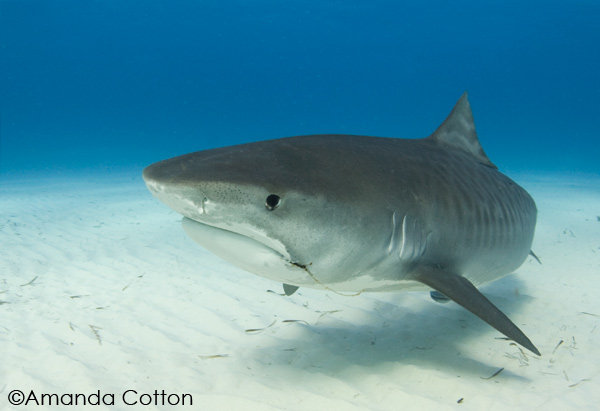
A Tiger Shark, photo courtesy of Amanda Cotton

 This new world was the barbaric shark-fining industry that puts out thousands of miles of long lines to catch sharks, after which they remove their fins and dump the living body back into the ocean to die. Approximately 90 million or more sharks are killed
 in this manner every year.

The most targeted sharks do not have offspring yearly and can take up to 20 to 25years to become sexually mature. At this rate, the sharks are endangered and not sustainable for this type of industry. The fining  industry does not only take one type of shark. They take anything they can get from the endangered whale shark and basking shark, and from more than 200 other
shark species. Continue reading