
“Teachers expressed there was a general lack of respect, with students also not following instructions or caring about the consequences of their behaviour in the classroom.” – Brock Researcher Natalie Spadafora
News from Brock University in St. Catharines, Ontario
Posted November 11th, 2024 on Niagara At Large
Niagara, Ontario – Incivility comes in many forms: texting instead of listening to a teacher, interrupting classmates who are speaking, showing up late to class.

Brock University researcher Natalie Spadafora. photo courtesy of Brock University
Following an unprecedented period of at-home learning due to the COVID-19 pandemic, similar types of disruptive behaviour spiked in Ontario classrooms, says Natalie Spadafora.
The Brock University Postdoctoral Fellow and her team examined the rate of classroom incivility in elementary and high schools both before and after pandemic-related school shutdowns, and saw a significant increase.
Their findings are detailed in the recently published paper “Are child and adolescent students more uncivil after COVID-19?<https://psycnet.apa.org/fulltext/2025-40514-001.html>”
The research team conducted two separate studies with Ontario participants, gathering information from 308 adolescents aged nine to 14 as well as 101 primary educators teaching Grades 1 to 3.
They compared data from fall 2019 to that collected in fall 2022 to gauge the impact the pandemic closures had on the behaviour of young learners.
“Teachers reported that incivility was happening much more frequently in their current classrooms than it did prior to the COVID-19 school closures, and that there was a lack of awareness of expectations in the classroom,” Spadafora says.
Adolescent students also self-reported engaging in significantly higher levels of classroom incivility in the 2021-22 school year, while other variables, such as bullying and friendships, remained relatively the same.
In the retrospective study, 42 per cent of teachers surveyed for the project reported instances of classroom incivility happening daily, compared to only six per cent prior to March 2020. Sixty-eight per cent also rated classroom incivility as “moderately” or “very” serious in the 2021-22 school year, compared to 32 per cent before COVID-19.

A message elementary school kids chalked on the wall of a Niagara, Ontario school in the spring of 2020t, during the first COVID-19 lockdown. New Brock University research shows that many grade-school students did not return to school behaving as kind as they were when they left. File photo by Doug Draper
“Teachers expressed there was a general lack of respect, with students also not following instructions or caring about the consequences of their behaviour in the classroom,” Spadafora says. “Many students were lacking the basic elements underlining classroom civility.”
The pandemic closures, which shut down Ontario schools for about 100 days, meant children were not exposed to a typical school routine, classroom norms and teacher direction in a classroom setting.
The primary years are a fundamental time to establish classroom routines, behaviours and expectations, Spadafora says, adding the impact the interruption to traditional learning has had is now making itself known.
Many teachers indicated that students did not have the opportunity to learn — and educators the chance to reinforce — the “rules” of the classroom that are emphasized as students move through subsequent grades.
“These children missed out on the early days in the classroom where you learn how to be in school,” Spadafora says. “Because of that, behaviours you wouldn’t typically see in Grade 3 are presenting themselves more frequently.”
Teachers called attention to a lack of social skills and self-regulation amongst students, with an increase in children who were not used to being part of a group. This resulted in teachers needing to provide students with more coaching to work kindly and co-operatively with others, Spadafora says.
Nearly all teachers — 95 per cent — reported students’ socio-emotional skills were “lower” or “much lower” than past cohorts.
Spadafora says it’s important to pay attention to these behaviours, as previous research by her team has indicated incivility can be a precursor to bullying.
“If incivility is heightened after the pandemic, and we know it can predict bullying behaviour, we should be intervening more in these lower-level behaviours,” she says.
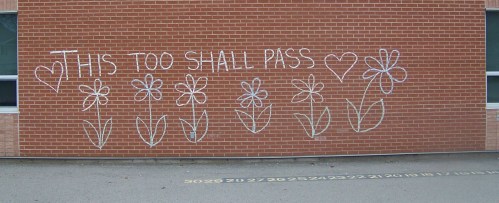
Another of many messages chalked on the walls of elementary schools across Niagara when, due to safety concerns, COVID-19 shut rclassrooms down in favour of home lschooling in 2020. filed photo by Doug Draper
She encourages parents to talk to their children about manners and civility in general.
“It all starts with being a kind, respectful person,” she says. “If you can teach your children that at a really basic level, you’ve laid a good foundation for them to build from as they head into the classroom.”
Spadafora’s team now plans to look at whether the rise in incivility has continued to climb beyond the period surrounding the COVID-19 school closures, with a particular focus on the younger demographic.
NIAGARA AT LARGE Encourages You To Join The Conversation By Sharing Your Views On This Post In The Space Following The Bernie Sanders Quote Below.
“A Politician Thinks Of The Next Election. A Leader Thinks Of The Next Generation.” – Bernie Sanders


Clearly, folks have forgotten or don’t want to admit that schools play a very important role in socializing children and many parents are very quick to voice anti-authoritarian criticisms.
LikeLike