
A Message to Ontario’s Premier – Leave Niagara’s Current System of Municipal Governance Alone!
A Commentary by Doug Draper, journalist, Niagara At Large
UPDATED – Posted January 8th, 2024 on Niagara At Large
For the last 30 or so years of my time working as a journalist in Niagara, I have been hearing the same tired old trope coming from what always seems like a relatively small segment of the population with a big bullhorn.
The trope I am talking about goes like this – “Niagara has too many politicians.” And it almost always comes from individuals and organizations with a long track record of being to the far right when it comes to politics and who often complain about government playing “too big a role” in our lives.

Local municipalities across are Niagara Region the way they are mapped out now, and the way they should stayT.
Little wonder then that Ontario’s current premier Doug Ford – the boss hog of one of the most extremist, right-wing governments the province has ever had and who appears to almost never see a government-funded service he wouldn’t like to privatize – has repeatedly said that he thinks Niagara has too many politicians.
Just to cite a few cases, there Ford was, quoted in a March 2019 report on the St. Catharines-based radio station CKTB (Heart Radio), saying; “Too many politicians is not a good thing and it hurts the community”
There Ford was again that year, captured in a news clip aired by Hamilton-based CHCH-TV, saying; “I’m not a big believer in big government and a lot of politicians. The less politicians the better it is.”
Ontario Premier Doug Ford recently put together the largest (and most costly) cabinet in our province’s history in terms of body siting around the regal table. Yet he has the nerve to tell us at the municipal level that we have “too many politicians.”
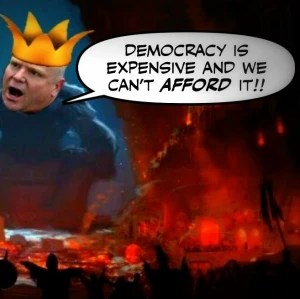
Ontario Premier Doug Ford recently put together the largest (and most costly) cabinet in our province’s history in terms of body siting around the regal table. Yet he has the nerve to tell us at the municipal level that we have “too many politicians.”
More recently, in the spring of year we have just said so long to, an on-line outlet called the Niagara Independent, Ford is reported claiming that in a meeting he had with Niagara Regional Chair Jim Bradley and some of Niagara’s mayors, he said; “I’ll be very transparent. I said: hey, you have too many politicians.”
This “too many politicians” trope is once again making the rounds in letters-to-the-editor sections of mainstream Niagara news outlets as a provincial all-party Standing Committee on Heritage, Infrastructure and Cultural Policy is turning to Niagara and a number of other regions in Ontario with tier systems of municipal governments and inviting as many of us who care to let it know the shape of governance we want in our regions in the future.
The committee is holding a hearing in Niagara this coming Wednesday, January 10th at the Holiday Inn and Suites on Ontario Street from 10 a.m. to noon and 1 p.m. to 6 p.m. and is open to the public.
In these letters and in other venues, the “too many politicians” contingent, is reminding us again and again that Niagara has a whopping 126 municipal politicians (then the number of elected representatives serving on the Regional Council and 12 local municipalities is added up) serving a region of some 490,000 people compared to the City of Toronto with 26 councillors (after Ford cut the number of councillors in half in half within hours of being sworn in as Premier in 2018) serving a population of close to three million.
Filling these seats with elected representatives who swear an oath to represent us is what democracy looks like. Some of them fail us but that is what we have elections for.
We are also being reminded that closer to home, the City of Hamilton, with a population of more than 560,000, is apparently getting by quite nicely with one mayor and 15 councillors.
So why on earth, they say, does Niagara need 126 municipal politicians? Wouldn’t we save a lot of tax money if we got rid of a 100 or so of them?
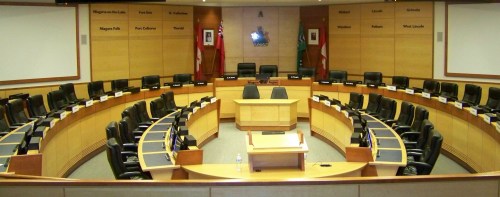
Filling these seats with elected representatives is what democracy looks like.
Since the promise of saving money is a big selling point for having fewer politicians for these ‘too many politicians’ folks, I made a call to the city hall for Thorold, the municipality where I live in Niagara, and asked how much of the city’s total operating budget our mayor and nine councillors cost me and my fellow Thorold citizens.
The figures I was given were not at all surprising because they were much like those I recall getting from other municipalities in the region in years gone by.
I was told that for the total 2023 approved operating budget for the City of Thorold which totals $32.2 million, the total annual payroll of our elected representatives adds up to $203,500.
That adds up to .63 per cent (that is Point Six Three Per Cent) of the total operating budget! And that, fellow Niagara citizens, is hardly even a drop in the bucket.
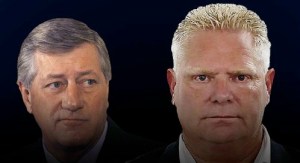
Former Ontario Tory Premier Mike Harris, and his friend and student in the science of reducing government and privatizing services, Doug Ford
Do I think that having 10 people elected from our community to hopefully do their best to represent our interests is worth .63 per cent of the budget? You’re damn right I do!
And I am confident that if you are living in Port Colborne or Fort Erie or St. Catharines or any other municipality in Niagara, the numbers may waver by about one or three percentage points but won’t be much different.
So where are the benefits of cutting the number of politicians through municipal amalgamation, which is what most of the “too-many-politicians” I have encountered over the years want to do?
Former Ontario Tory Premier Mike Harris, and his friend and student in the science of reducing government and privatizing services, Doug Ford
One major report on the topic, prepared in 2015 by the Fraser Institute which, interestingly enough is commonly identified as a conservative or right-wing research group in Canada, concluded that a number of municipalities in Ontario – especially smaller ones – that underwent amalgamation and saw a significant reductions in the number of elected council representatives under the jackboots of Doug Ford’s old friend and then-Tory Premier Mike Harris in the late 1990s and early 2000s, didn’t see any real benefits at all.

One of the images from the Fraser Institute’s 2015 report on municipal amalgamation in Ontario
“Ontario’s push for municipal amalgamation in the 1990s has failed to deliver cost-savings and efficiencies promised for both large and small cities,” concludes the report.
One of the images from the Fraser Institute’s 2015 report on municipal amalgamation in Ontario
“In the late 1990s,” according to one of the statements CBC news reported from an interview at the timewith Lydia Miljan, a Fraser Institute senior fellow and co-author of Municipal Amalgamation in Ontario, “the (Mike Harris) government of the day wanted to consolidate municipal governments in an effort to reduce waste and lower property taxes.
“While that may have been a laudable goal,” added Miljan, “it’s become clear that those benefits never materialized.While you do get rid of some mayors and town councillors, we increased all number of different ways. We increased long-term debt. We increased property taxes. Most notably, park-recreation costs, those things went up as well.”
I feel strongly that what I’m sure is a silent majority of Niagara residents who – especially residents living in municipalities with lower populations like Pelham, Niagara-on-the-Lake, Port Colborne, Wainfleet, Lincoln, West Lincoln and Thorold that are more likely to get swallowed up by larger cities like St. Catharines, Niagara Falls or Welland in any amalgamation scheme – need to speak out NOW.
I have always found it interesting when the topic of amalgamation and cutting the number of politicians in Niagara comes up, it is almost always the mayors and councillors from the larger municipalities that are least likely to disappear in such a deal that are in favour of it. Mayors and councillors from smaller municipalities that are most likely to be swallowed up are almost always against it.
Residents in our region are facing enough challenges in these times without being caught in a game of winners and losers.
When I hear that line by those that we have “too many politicians” it is as if what they are really saying is we have ‘too much democracy’.
What this slashing the number of elected representatives really looks like is an anti-government movement that is not all that far away from the anti-government, anti-democracy drive going on south of the border, in the United States with the Donald Trump crowd right now.
I know that not everyone who may take the time to read this is going to agree with me, but those who do have got to stand up and tell Doug Ford and everyone else who wants to deconstruct the two-tier municipal system we have Niagara now (with its regional government and 12 local municipalities) to back off now.
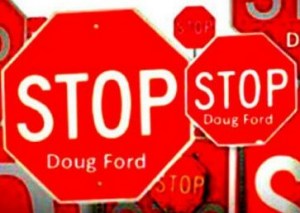 Tell Ford that we don’t need any more help from him and his enablers when it comes to how our governments are working at the municipal level.
To the extent that we have problems with some of our municipal councillors and the decisions they make, we can take care of that in the next municipal election.
We don’t need Doug Ford and his gang coming in to our Niagara region and the local municipalities where we live and do business with a meat axe.
-
Doug Draper, Niagara At Large
Here are a few related links you can click on –
– Amalgamation didn’t help smaller communities, report says | CBC News
Premier says there are too many politicians in Niagara – CHCH
Doug Ford thinks there are too many politicians in Niagara (iheartradio.ca)
https://niagaraindependent.ca/ford-reiterates-belief-that-niagara-has-too-many-politicians-as-province-readies-for-another-regional-review/
NIAGARA AT LARGE Encourages You To Join The Conversation By Sharing Your Views On This Post In The Space Following The Bernie Sanders Quote Below.
“A Politician Thinks Of The Next Election. A Leader Thinks Of The Next Generation.” – Bernie Sanders
 Niagara At Large