

(UPDATE – Since this piece was first posted in the afternoon of this December 14th, a majority on Niagara Region’s budget review committee passed a motion tabled by St. Catharines Regional Councillor Laura Ip to not to increase transit fares for riders through the coming year. No additonal funding was approved for better building Niagara’s transit service however. so the views expressed below still stand – Doug Draper)
“Public transit is vital to communities around the world by providing a fast, affordable and efficient way to get around.” – National Research Council of Canada
“Public transit can increase social equity in our society. … By eliminating the need to own a car, public transit allows people living on lower incomes to direct more of their earnings to essentials such as food, clothing and rent.” – Canadian Health Association for Sustainability & Equity
“If our buses carry more people and directly reduce their own tailpipe emissions, transit’s ability to be part of the climate solution only grows.” – The Canadian Urban Transit Association
“The most powerful tool urban policymakers have to address catastrophic climate change is the humble city bus.” – The Canadian Centre For Policy Alternatives
A Call-Out to All Niagara residents from Doug Draper, reporter/publisher, Niagara At Large
Posted December 14th, 2023 on Niagara At Large
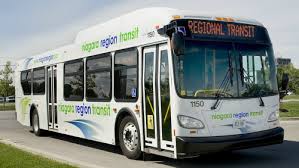 This coming January 1st, 2024 marks the first anniversary of the launch of a new consolidated transit system in Niagara, marking the end of a patchwork of local transit services that fell short of encouraging more people in our region to opt for a bus rather than a car to take them to where they want to go.
For long-time transit supporters in Niagara, the January 1st launch spelled hope that the decades of nickel and diming transit services in this region would finally be over.
There was hope that our regional councillors would invest the resources necessary to attract more transit riders, and to build a system that would play a more significant role in shaping more affordable and healthier communities for generations to come.
Yet less than a year after the launch, many on the regional council are asking Niagara’s transit commission to consider cutting services and raising fares for riders to help drive down what will almost certainly be an overall budget increase for the Region in 2024 that is not much less than this year’s record-high increase of about 7.5 per cent.
At a meeting this past November 30th of the Region’s budget review committee, a total of 16 of the 22 regional councillors in attendance said no to the transit commission’s request for a 7.8 per cent budget increase and to come back with something less.
A 7.8 per cent increase in funding for transit services may seem high, but it is a few drops in the bucket compared to the hundreds of millions of dollars our regional government spends each year on roads, on water and wastewater services, on police and everything else under its jurisdiction.
It could also be argued that the increase the transit commission was asking for will, in the long run, pay dividends compared to the countless millions of our tax dollars spent each year on building and maintaining roads, on the high costing of buying and operating cars, on the cost of traffic collisions and the list goes on.
But this week, the transit commission – apparently seeing that it doesn’t have enough support on the regional council – decided to come back to the Region’s budget review committee as early as this evening of December 14th with a fare hike of 25 cents per ride and a budget increase of 5.57 per cent.
It will barely make a dent in the Region’s overall budget increase but it certainly won’t do anything to build a transit system that will reap more benefits for people in our communities.
It also doesn’t say much for the promise the Region has made to act on the “climate emergency” that the last term of regional council declared in 2021.
If you agree that we need to invest more in public transit in Niagara, I urge you to contact your members of regional councillors and let them know. For contact information, click on the following link – Regional Council Members, 2022 – 2026 – Niagara Region, Ontario
-
Doug Draper, Niagara At Large
Here is more from organizations across Canada advocating for public transit –
“The most powerful tool urban policymakers have to address catastrophic climate change is the humble city bus.
“Canada has significant potential to reduce transportation sector emissions in our cities through modal shift. Over half (55%) of all commutes in a car, truck or van are trips below 10km in length, and fully 1 in 3 (32%) are trips below 5km or less.6 Many of these short trips could be replaced by sustainable modes of transportation, which would have a dramatic impact on reducing GHG emissions.
“The federal government’s intention to move forward with a zero-emissions vehicle mandate is a powerful method of reducing transport emissions, but its climate benefits are notably ‘back-loaded’, as it takes a significant amount of time for new car sales to trickle into dominating the on-road vehicle fleet.
“Shifting travel demand towards sustainable modes is an important tool to reduce transport emissions very quickly, in particular by harnessing the power of the noble bus.” – from a 2022 report by The Canadian Centre For Policy Alternatives
“ Public transit is vital to communities around the world by providing a fast, affordable and efficient way to get around cities. Considering the importance of this mode of transportation, both in terms of the number of users and of vehicles that make up the fleets, reducing the carbon footprint of public transport systems represents a pressing challenge that needs to be tackled.” – The National Research Council of Canada
“The transportation sector represents 24% of Canada’s carbon emissions, with most of these coming from private vehicles.
“Canada’s transit systems can help reduce carbon emissions in many ways. But one thing is clear, the more it can be a part of daily life for more people, the more it will help meet our climate goals.
“If our buses carry more people and directly reduce their own tailpipe emissions, transit’s ability to be part of the climate solution only grows. For this reason, additional federal policy support for operational funding and stimulating the growth of the Canadian heavy-duty ZEV market and manufacturing base is warranted.” – The Canadian Urban Transit Association
“Public transit can increase social equity in our society. About 20-40% of the people in our communities do not drive because of their age, income or ability, or choose not to drive.
“In Canada, data show that newcomers and women who commute to work rely more heavily on public transit. An efficient and reliable public transit system can provide these populations with a more affordable and independent way to access jobs, schools, essential services and recreational opportunities.
“By eliminating the need to own a car, public transit also allows people living on lower incomes to direct more of their earnings to essentials such as food, clothing and rent. About 5% of Canada’s population in its eight largest cities – nearly one million people – are living in lower income households that are located in neighbourhoods with poor access to public transit, putting them at even greater disadvantage.
“Public transit can also be designed to meet the needs of rural or remote communities, senior populations, and those who are physically or mentally unable to drive.” – The Canadian Health Association for Sustainability
To learn more about the Niagara Region’s climate emergency declaration, click on – https://www.niagararegion.ca/culture-and-environment/climate-change/general/default.aspx#:~:text=In%20September%202021%2C%20Niagara%20Regional,to%20climate%20change%20in%20Niagara
NIAGARA AT LARGE Encourages You To Join The Conversation By Sharing Your Views On This Post In The Space Following The Bernie Sanders Quote Below.
“A Politician Thinks Of The Next Election. A Leader Thinks Of The Next Generation.” – Bernie Sanders
 Niagara At Large
If anything the Region should be expanding its service. Public transit should be a provincial responsibility, The Regional Councillors should be demanding that the provincial government cover the costs of public transit.
LikeLike
One of the things that really bothers me about those who make budget decisions is that they always have the capacity and means to drive (and often own several vehicles) and very few have seen the inside of a bus. It is so easy to cut something somebody does not use. How about considering when each cut is made, that those who do not drive have to pay for more taxi, Uber or other expensive services to get around?
Maybe each of those regional councillors on the budget committee can leave their cars at home for a month, and then do everything they do every day or every month, such as function as a regional council, participate in their committees, shop, seek out medical or other services, visit family and friends, which they will find would cost them thousands compared to the costs of driving their own vehicles.
For me, having to pay for expensive services to get around when a bus cannot do so, is paying a disability tax.
Angela Browne
LikeLike