
By John Bacher
Posted February 16th, 2016 on Niagara At Large
Niagara, Ontario – Currently those advocating “bio-diversity offsetting”, claim that it is intended to help farmers, not developers.
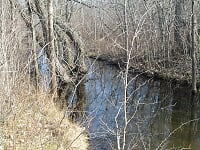
One of the remaining wooded wetland area in Niagara, Ontario. How long will it be spared from destruction for more sprawling development
However, in 2008 this concept was first put forward to assist an urban development proposal in Niagara Falls, Ontario known as “Thundering Waters.”
In November 2015, when Ontario’s provincial government had a public consultation on the review of its wetland policy, the only person who spoke in favour of the province changing the rules to permit such offsets was a developer associated with the same project.
In 2008, the reason why offsetting was proposed was that the Niagara Peninsula Conservation Authority (NPCA) had a policy to protect locally significant wetlands. It was proposed to “offset” the d destruction of a wetland area desired by the developer, by creating a new wetland on a site damaged in the past by spills dumping conducted by the former Ontario Hydro (now Ontario Power Generation).This proposal went nowhere because the wetland that was proposed to be destroyed became protected by being upgraded in its status to provincially significant. Under the current rules, such lands are protected from development and site alteration.
It needs to be understood that the wetland that originally sparked the first proposal for biodiversity offsetting is of great ecological significance. It was identified in a 1983 study of environmentally sensitive areas of the Niagara Region as a core area for protection and named as the Ramsey Road Woodlot.
One of the reasons the area was so identified for protection is that it is a very large block of forest- around 580 acres in size. The connected natural habitats here, which include regenerating hawthorn thickets, are on a scale comparable to those in Short Hills Provincial Park located in the heart of Niagara.
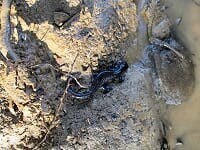
The blue spotted salamander – one of numerous wildlife species dependent on wetland areas for their survivial.
In addition to being one of the largest remaining Carolinian woodland blocks of habitat, the Ramsey Road Woodlot is predominately a swamp forested wetland.
One of the reasons that it was upgraded to its current protected status is that in 2008 towering rare Black Gum trees were discovered.
Another is that the wetland parts of the forest, especially lands south of Oldfield Road, contain vernal (temporary) pools, lined with Pin Oak Trees. These vernal pools provide habitat for another rare species, the Blue-Spotted Salamander. Many of these pools are also habitat for rare buttonbush communities, which provide habitat for a spectacular bird, the Wood Duck.
Although set back in 2008, the Thundering Waters proposal is still alive. It is now going through a Secondary Plan process.
There is a real danger that changes to provincial wetland policy now under consideration will open up development on wetland areas currently protected out of concern for safeguarding the habitats of threatened species of wildlife in Niagara and other regions of the province.
For more information on this issue click on – https://niagaraatlarge.com/2016/02/15/dont-let-conservation-authority-destroy-niagaras-natural-wetlands-3/#more-17413 .
John Bacher has worked on the Greenbelt Review for the Sierra Club of Canada and the Niagara-based citizens group, the Preservation of Agriculture Lands Society. A contributor of posts to Niagara At Large, his most recent book is called ‘Two Billion Trees and Counting – The Legacy of Edmund Zavitz’’.
Now Niagara At Large invites you to join in the conversation by sharing your views on the content of this post.
(For reasons of transparency and promoting civil dialogue, NAL only posts comments from individuals who share their first and last name with their views.)
Visit Niagara At Large at www.niagaraatlarge.com for more news and commentary for and from the greater bi-national Niagara region.
 Niagara At Large
It seems that most of the Regional members are literally owned by the developers which leaves one wondering why our so called media has a closed window when it comes to investigative reporting. Why is there no
disclosure of member election financing and from whom???? RECALL RECALL RECALL is needed badly
LikeLike
There is currently a proposal on Gorham Rd across from wher it meets Dominion. The developer cleared and bulldozed a PSW and now wants to build on it. The NPCA made him create a wetland elsewhere (location not made available to me). The NPCA now has no issue with the proposal on the former PSW! This is an example of offsetting already happening. Bridgewater golf course also got away with something similar. At least they riffled the dam on their property.
LikeLike
If the area was forested developer might have been breaking tree-protection by-law. Public outrage over clear cutting on Oldfield road in 1993 in Ramsey Road forest area was the reason this by-law was developed.
LikeLike