
“In Canada
-
This year, just 5 Canadians have the same wealth as the bottom 30% of Canadians – more than 11 million people. Canada’s top 5 billionaires own $55 billion, while the bottom 30% owns $54.97 billion.
-
The poorest 10% of Canadians only make about $2.30 more per day than they did 25 years ago.”
News from Oxfam Canada on the Growing Wealth Gap in Canada and around the World
Posted January 21st, 2016 on Niagara At Large
Runaway inequality has created a world where 62 people own as much wealth as the poorest half of the world’s population. This figure has fallen from 388 just five years ago, according to an Oxfam report published today ahead of the annual gathering of the world’s financial and political elites in Davos.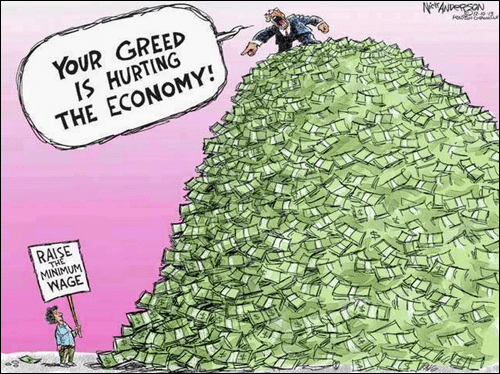
An Economy for the 1%, shows that the wealth of the poorest half of the world’s population has fallen by a trillion dollars since 2010, a drop of 41 per cent. This has occurred despite the global population increasing by around 400 million people during that period. Meanwhile the wealth of the richest 62 has increased by more than half a trillion dollars to $1.76 trillion.
The report also shows how women are disproportionately affected by inequality – of the current ‘62’, 53 are men and just nine are women, and women continue to be dramatically overrepresented in precarious and low wage work.
Although world leaders have increasingly talked about the need to tackle inequality, and in September agreed a global goal to reduce it, the gap between the richest and the rest has widened dramatically in the past 12 months. Oxfam’s prediction, made ahead of last year’s Davos, that the 1% would soon own more than the rest of us, actually came true in 2015 – a year earlier than expected.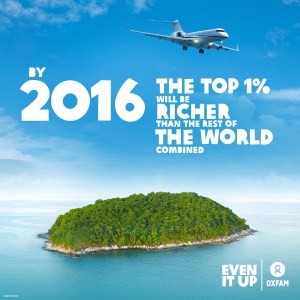
A key trend behind rising inequality is the falling share of national income going to workers. Canada is no exception, where the poorest 10% make only about $2.30 more per day than they did 25 years ago. Meanwhile the wealth of the top 5 billionaires in Canada has risen by $16.9 billion in the past five years alone.
Oxfam is calling for urgent action to tackle the extreme inequality crisis which threatens to undermine the progress towards ending poverty and the advancement of women’s rights.
As a priority, it is calling for an end to the era of tax havens which has seen the increasing use of offshore centres by rich individuals and companies to avoid paying their fair share to society. This has denied governments valuable resources that could be used to tackle poverty and level the playing field between women and men.
Julie Delahanty, Executive Director of Oxfam Canada, said: “Prime Minister Trudeau will take to the world stage in Davos to showcase his new plan for Canada, one that includes tax increases on the wealthiest Canadians and cuts for the middle class. While we commend Canada’s commitment to shared economic prosperity, we urge the Government of Canada not to forget the bottom 10% – whether in Canada or abroad. Those at the bottom, especially women and youth, suffer the most from poverty and currently gain the least from economic growth.”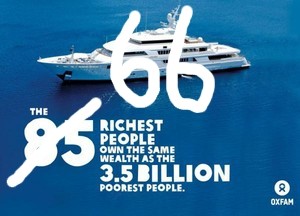
“To truly address extreme poverty, Canada needs to take further actions to work with global leaders to address inequality, including by leading the process to end the era of tax havens and by supporting the economic and social rights of women.”
In 2015, G20 governments agreed on steps to curb tax dodging by multinationals through the Base Erosion and Profit Shifting agreement. However, these measures will not do enough for the poorest countries and largely ignore the problems posed by tax havens.
Globally, it is estimated that a total of $7.6 trillion of individuals’ wealth sits offshore. If tax were paid on the income that this wealth generates, an extra $190 billion would be available to governments every year.
In fact, as much as 30 percent of all African financial wealth is estimated to be held offshore, costing an estimated $14 billion in lost tax revenues every year. This is enough money to pay for healthcare that could save 4 million children’s lives a year, and employ enough teachers to get every African child into school.
Nine out of ten World Economic Forum corporate partners have a presence in at least one tax haven and it is estimated that tax dodging by multinational corporations costs developing countries at least $100 billion every year. Corporate investment in tax havens almost quadrupled between 2000 and 2014.
“Canada itself is losing massive amounts of revenue, but poor countries continue to be hardest hit and have the least say in how tax rules are determined,” said Delahanty.
“In developing countries, the billions lost to tax havens mean that children aren’t going to school or getting life-saving health care. It’s a big concern for these countries, and their voices need to be heard. We hope that Canada will play a leadership role in bringing further reform to international tax rules and that it will champion the equal participation of poor countries and women in these processes.”
Oxfam is calling for action on tax havens to be part of a three-pronged attack on inequality. Action to recover the missing billions lost to tax havens needs to be accompanied by a commitment on the part of governments to invest in healthcare, schools and other vital public services that make such a big difference to the lives of the poorest people.
In order to ensure those in the bottom half are able to live dignified lives, governments should take action to ensure that people are paid a living wage and that women are economically empowered, which would necessitate recognizing the cost of unpaid care work and tackling the pay gap between women and men.
Delahanty added: “How can we trust the trickledown effect when the recent explosion in the wealth of the super-rich has come at the expense of the majority? The bottom line is that hard working people and those living in poverty, especially women, are not feeling the benefits of economic growth – and they should.”
In addition to speaking about our inequality campaign, Oxfam will be present at Davos to press world and business leaders to tackle climate change and act to resolve humanitarian crises including the one in Syria.
- Link to Oxfam’s report: An Economy for 1%
- Given data availability, and to facilitate global comparisons, all data is in USD and in 2005 purchasing power parity.
- Wealth of 1%, 50%, and 99% taken from Credit Suisse Global Wealth Datebook (2013 and 2014) https://www.credit-suisse.com/uk/en/news-and-expertise/research/credit-s…
- The wealth of the richest 62 was calculated using Forbes’ billionaires list http://www.forbes.com
- Annual data taken from list published in March.
- Calculations include negative wealth (i.e. debt). As a robustness check, Oxfam recalculated the share of wealth held by the richest 1 per cent once negative wealth is excluded. It did not change significantly (falling from 50.1 per cent to 49.8 per cent). Negative wealth as a share of total wealth has remained constant over time, such that wealth distribution trends over time are not affected.
In Canada
- This year, just 5 Canadians have the same wealth as the bottom 30% of Canadians – more than 11 million people. Canada’s top 5 billionaires own $55 billion, while the bottom 30% owns $54.97 billion.
- The poorest 10% of Canadians only make about $2.30 more per day than they did 25 years ago.
- The wealth of the 5 richest Canadians has risen by $16.9 billion since 2010, a 44% increase.
- The poorest half of Canada’s population has received just 26% of the total increase in income growth. The top 10% alone received more than that – 29%.
- 56% of the increase in wealth between 2000 and 2015 went to the top 10%. Of the $2447 billion that went to the top 10%, $989 billion went to the top 1% – i.e. 40%.
Globally
- The number of people whose wealth is equal to that of the poorest half of the world’s population since 2010:
- 2010: 388
- 2011: 177
- 2012: 159
- 2013: 92
- 2014: 80
- 2015: 62
About Oxfam Canada – Oxfam Canada is part of a global movement for change made up of 17 Oxfam affiliates working in more than 90 countries to mobilize the power of people against poverty. Women’s rights and overcoming inequality are at the heart of everything we do.
Working with Canadians, our partners and allies around the world, Oxfam Canada strives to empower individuals, communities and organizations to build a world without poverty where all human beings are valued and treated equally – a world where women and girls have control over their lives and enjoy their full human rights.
Our vision is a just world without poverty. We envision a world in which people influence the decisions which affect their lives, enjoy their rights, and live as full citizens in a world where all human beings are valued and treated equally. Our mission is to build lasting solutions to poverty and injustice, with a focus on improving the lives and promoting the rights of women and girls.
We mobilize people and resources in Canada and around the world to change policies, practices, attitudes and behaviours that create inequality and human suffering. We are committed to strengthening a global movement in support of human rights and gender justice on a healthy planet.
For more on Oxfam Canada and its work, visit the organization’s website at www.oxfam.ca/
NOW IT IS YOUR TURN. Niagara At Large encourages you to share your views on this post. A reminder that we only post comments by individuals who share their first and last name with them.
Visit Niagara At Large at www.niagaraatlarge.com for more news and commentary for and from the greater bi-national Niagara region.
 Niagara At Large
As our economy worsens, and as we wonder what charities to support, and which not to, Oxfam stands out, for me. They do very practical things in parts of the world hit by tsunamis, earthquakes, etc. They build latrines, shelters, make water available. The basic necessities. A fan and donor to Oxfam, for these reasons.
Life is not getting easier for any of us, but least of all for those impoverished by environmental elements and civil strife.
LikeLike
The cartoon says it all.
As is implied in the article, while women are disproportionately among the poorest and suffer most from pay inequality, they are also usually the caregivers. That results in an avalanche of poverty down to the children and elderly.
Governments need to get serious with the wealthy hoarders and tax them instead of ignoring and even covering up their misdeeds. They should close the loopholes (which were designed by, perpetuated by and benefit the rich) and throw those crooks in jail for tax evasion. Meanwhile they track down every last dime that the average person owes. We’re much easier targets.
LikeLike
In Switzerland a young man was indicted for disclosing the names of thousands of rich tax evaders and he did so by furnishing tape records to a foreign treasury. What did Canada do if anything ?????
LikeLike