
News from the Council of Canadians – a national citizens organization
Ottawa, Ontario, November, 2015 -What will Justin Trudeau do about the Trans-Pacific Partnership (TPP) once he becomes prime minister on November 4th?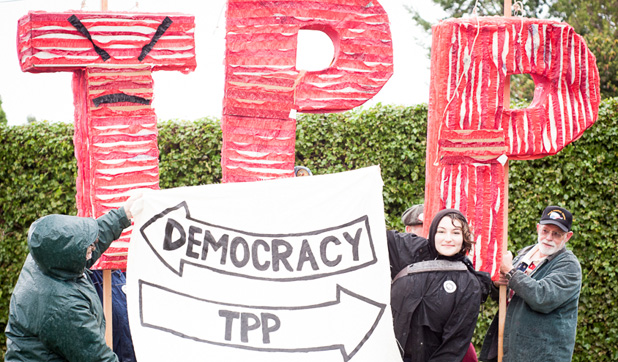
It’s clear that the deal does not have strong public support in Canada. An EKOS poll released today found that the deal is opposed by 38 per cent of Canadians and supported by 41 per cent. The poll also found that 31 per cent of Canadians think the TPP will be harmful, while 33 per cent believe it will be good for the economy.
Just two weeks before the election, Trudeau promised “a full and open public debate” on the Trans-Pacific Partnership and highlighted the imperative to “defend Canadian interests during the TPP’s ratification process – which includes defending supply management, our auto sector, and Canadian manufacturers across the country.”
Stuart Trew and Scott Sinclair from the Canadian Centre for Policy Alternatives write, “Obviously, a public review is badly needed. The TPP was concluded in the dying days of a ‘caretaker’ government desperate to shake up a faltering campaign. …Constitutional experts held that this maneuvering could only pass muster if a new federal government was genuinely able to reverse the Conservatives’ death-bed commitments. But history, and U.S. insistence that the deal must be accepted ‘as negotiated’, force us to temper our expectations about whether a meaningful process is likely.”
And they argue, “An agreement that purports to set binding rules for regulating commerce in the 21st century certainly deserves public hearings, across the country.
Trudeau has invited the provinces to join him in Paris for this year’s international climate talks. He could equally invite them to help him co-ordinate national consultations on the TPP. …[Trudeau could also inform] TPP partner countries Canada cannot be bound by the agreement as negotiated, and that public input could result in Canadian demands for changes. His resolve can only be strengthened by the U.S. insistence that it can still force changes in Canada’s implementation of its TPP commitments.”
The Council of Canadians is opposed to the Trans-Pacific Partnership because of its investor-state dispute settlement provision that allows corporations to sue governments for public interest legislation that affects future profits. We have also raised concerns about the impact of the TPP on dairy farmers, auto parts workers and its extended patent provision that profits transnational bio-pharmaceutical corporations. We are concerned about reports that the TPP would mean more foreign workers, exploitation and suppressed wages in Canada. And we are just about to launch a petition calling on Trudeau to reject the TPP on the grounds it would allow milk produced with Bovine Growth Hormone into Canada.
We support the call for public hearings that would result in these substantive changes (and more) to the TPP.
In terms of timelines, the Globe and Mail‘s national business correspondent Barrie McKenna has reported, “A vote in [the US] Congress may not happen until next April, when the race to succeed [President Barack] Obama as president is in full swing.”
The next US president will be elected on November 8, 2016 and sworn into office on January 20, 2017. That will be key to this whole process too. Democratic front-runner Hillary Clinton has already expressed her opposition to the TPP, while Republican Jeb Bush has stated, “This is a great deal for America. It would strengthen our ties to our allies throughout the Pacific region, including our close allies and partners in Australia, Mexico and Japan.”
Further reading Barlow & Moist call on Trudeau to reject the Trans-Pacific Partnership (October 2015 blog) The investor-state dispute settlement provision in the Trans-Pacific Partnership (October 2015 blog) Trans-Pacific Partnership would mean more temporary foreign workers (October 2015 blog) TPP: profits before patients (October 2015 blog by Michael Butler) Council of Canadians opposes the entry of BGH milk into Canada through the Trans-Pacific Partnership (October 2015 blog)
Founded in 1985, the Council of Canadians is Canada’s leading social action organization, mobilizing a network of 60 chapters across the country.
Through our campaigns we advocate for clean water, fair trade, green energy, public health care, and a vibrant democracy. We educate and empower people to hold our governments and corporations accountable.
Learn more about the Council of Canadians and its advocacy work by clicking on its website at – http://canadians.org/ .
Visit Niagara At Large at www.niagaraatlarge.com for more news and commentary for and from the greater bi-national Niagara region.
(NOW IT IS YOUR TURN. Niagara At Large encourages you to share your views on this post. A reminder that we only post comments by individuals who share their first and last name with them.)
 Niagara At Large
Hopefully Trudeau will listen to Canadians _ unlike our wonderful fantastic Premier why doesn’t give a dam about the consequences of her decisions – subway for Scarborough rather than the LRT recommended by Metrolinx (oh I forgot that was to get Toronto votes) sale of Hydro One is giving profits that could benefit Ontario to private interests. TPP.is allowing multi national corporations to use the courts to overrule governments. Look at the court actions already underway as a result of NAFTA and other trade agreements.
LikeLike
Hopefully Trudeau will listen to Canadians _ unlike our wonderful fantastic Premier who.doesn’t give a dam about the consequences of her decisions – subway for Scarborough rather than the LRT recommended by Metrolinx (oh I forgot that was to get Toronto votes) sale of Hydro One is giving profits that could benefit Ontario to private interests. TPP.is allowing multi national corporations to use the courts to overrule governments. Look at the court actions already underway as a result of NAFTA and other trade agreements.
LikeLike