
News from the Toronto-based public interest group the Ontario Health Coalition
April 23rd, 2015 – For the fourth consecutive year Ontario’s hospitals will suffer real-dollar budget cuts according to today’s Ontario Budget.
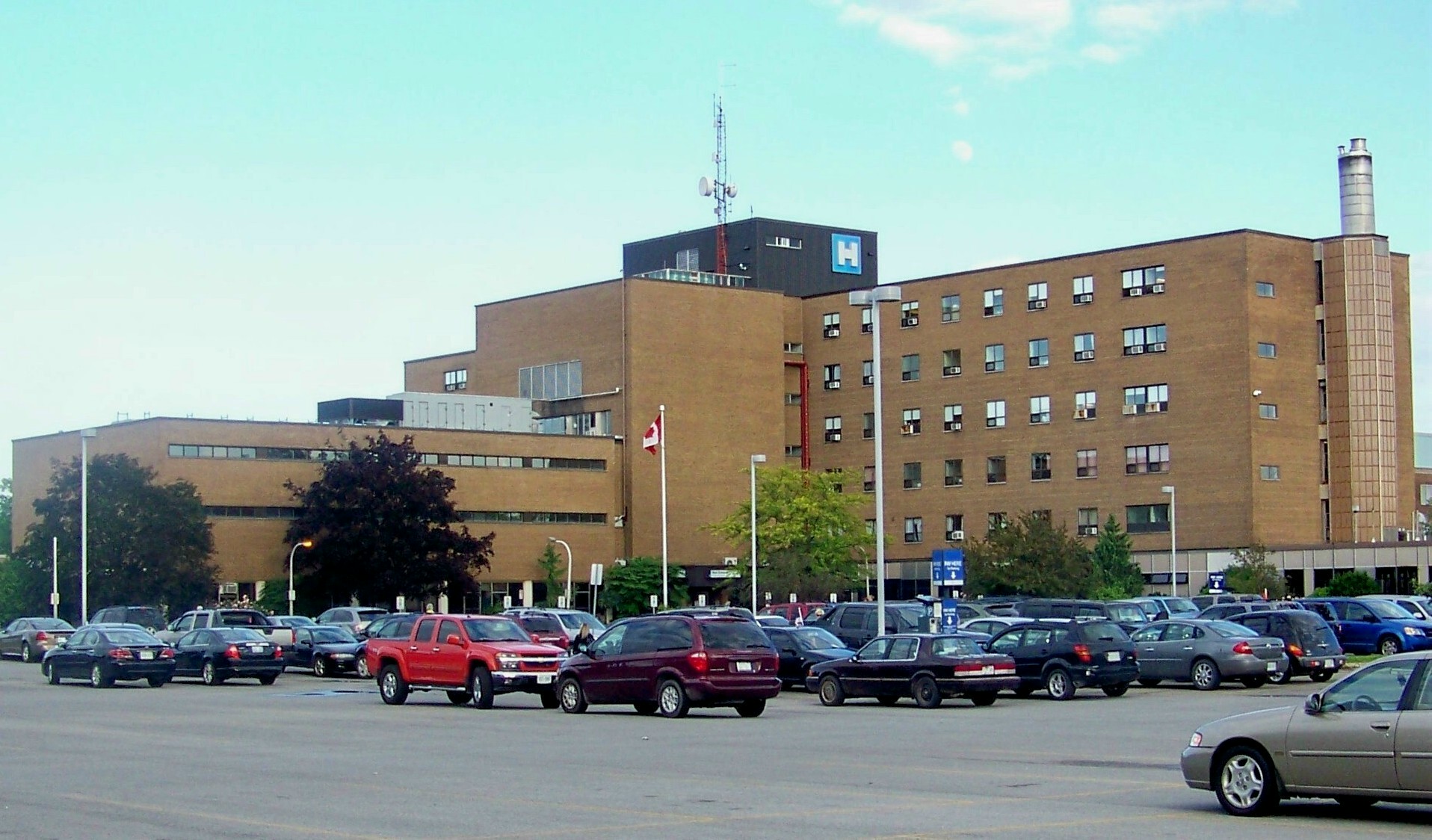
The Welland Hospital in the southern half of Niagara, Ontario. Will it survive.
This is the longest unbroken period of real-dollar public hospital cuts in Ontario’s history. Already, Ontario has cut hospital beds more drastically than virtually anywhere else in Canada, or the industrialized world. Maternity units, entire wards, even entire hospitals are threatened with closure.
Despite all rhetoric and false claims, these are not services that are being replaced in community care. The hospital cuts are resulting in accelerated privatization, hardship for patients and unsafe hospital overcrowding that now ranks among the worst in the developed world.
While the government has openly announced its plans to privatize Ontario Hydro, the real-dollar cuts across all public services and health care also mean damaging – and potentially irreversible – cuts, closures and privatization of needed health care and other social services.
Although this trend is often characterized as though it is a necessity, in truth, almost no jurisdiction in Canada or the developed world has cut public hospital care to the extent that the current Ontario government has. Ontario has dropped to last among all provinces in public hospital funding per capita, and is also last – both per capita and as a percentage of our economic output (GDP) in overall health care funding. These facts underline that these are choices, not necessities, and they can and should be changed.
“Virtually every service cut from our local public hospitals is being privatized,” warned Natalie Mehra, Ontario Health Coalition Executive Director. “For patients, it means spending days on stretchers in hospital hallways because there are no beds, cancelled surgeries, long travel distances to access care and more user fees as care is cut from our local hospitals.”
Key health care budget items:
Overall health care funding will increase below the rate of inflation. This means real dollar cuts (1.3% overall health care increase).
0% increase for public hospitals. This means that hospital funding again will not keep pace with inflation, hospitals will be pushed into deficits and will see real dollar cuts.
2% increase for long-term care homes to go to nursing, personal support and programs. However, there is nothing in the budget to address the needs of more than 20,000 people on wait lists for long-term care homes across the province. Indeed waits will worsen as hospital cuts push patients out without care in place.
5% increase over three years for home care and community care.
Analysis:
Ontario’s government still refuses to listen to the pleas of Ontarians to stop the devastating cuts to our local public hospitals.
The government and their spokespeople continue to falsely claim that this is “transformation,” denying the reality that it is cuts and privatization.
Improved funding for long-term care at approximately the rate of inflation is welcome but should be attached to improved care standards to ensure the funding goes to care.
According to the most recent figures publicly available, home care funding has not kept pace with offloading of hospital patients. As of 2014, home care funding per client was still below 2002 levels. Improved funding may help to bring home care budgets back up to levels a decade or more ago.
While the public is told that it must accept ongoing and worsening cuts to our local public hospitals and huge waits for long-term care; for-profit multinational financiers, banks, and service privatizers involved in P3 privatization will be cheering as the province ramps up funding for its extraordinarily expensive P3 program, siphoning money from care and services to for-profit consortia involved in promoting these schemes.
The budget contains $100 billion over 10 years in infrastructure, much of which will be privatized P3s unless public interest groups are able to stop them and ensure that our infrastructure is built publicly.
For more information from and about the Ontario Health Coalition click on http://www.ontariohealthcoalition.ca/ .
(Niagara At Large invites you to share your views on this post in the space below.)
 Niagara At Large
The so-called partnership is the government method of privatization of health care in Ontario. The government,, through the LHINs, endorses the numerous clinics claiming to provide the services at a lower cost than that provided through the hospitals. Because the funds are no longer directed to the hospitals they are being forced to cut services and are eventually forced to close.Theses clinics, which should be classified as private, take the funds that should be going to the hospitals.
For example, the government might be paying the required funds of $25.00 an hour and the worker paid $15.00 an hour. The $10.00 difference between what the clinic is paid and what the worker is paid is referred to as overhead expense _ it stays with the clinic. Were this service provided through the hospital, the difference would go to maintaining the hospital.
LikeLike