
A Brief by Niagara At Large publisher Doug Draper
There are certain images we all have burned in to our brain around events that have stirred or shocked us at some point, earlier in our lives.
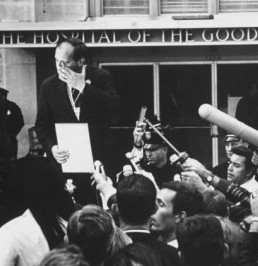
Frank Mankiewicz wipes away tears as he announces the death of Robert Kennedy in June, 1968
For me, one of those images was of a person named Frank Mankiewicz, a press secretary for U.S. Senator Robert Kennedy, who was running for president, getting up on a car in front of a hospital in Los Angeles in June of 1968 and announcing to the world that Kennedy had died from wounds he was suffering from an assassin’s bullets.
The image of Frank Mankiewicz, wiping tears from his eyes as he made that statement, marked the death of what many of us hoped would lead to a more progressive era in U.S. politics at that time – an era with a leader with the passion, intelligence and determination to end the War in Vietnam and advocate for environmental protection and for victims of poverty and racism
Frank Mankiewicz, who died late this October at age 90, was far more than that image. He was an accomplished journalist who went on, in the 1970s and 80s, to build his country’ National Public Radio in to a world-class public broadcasting system as its president. His father wrote Citizen Kane and hung around with the likes of Orson Welles. F. Scott Fitzgerald and the Marx Brothers.
But for better or worse, for a few generations of us who came of age in the last half f the 20th Century, he may forever be remembered as the person who had to tell the world the sad and shocking news of Robert Kennedy’s death.
(NOW IT IS YOUR TURN. Niagara At Large encourages you to share your views on this post. A reminder that we only post comments by individuals who share their first and last name with them.)
 Niagara At Large
Years ago, I briefly met Robert Kennedy when he spoke at the University of Buffalo when he was running for senator from New York. Although many of us were still reeling from the assassination of his brother, President John F. Kennedy, (who I also saw when he was running for president), we were hopeful for Bobby. He was elected to the US Senate in 1964. (At that time, I couldn’t even vote for Kennedy; the voting age was 21. Yet we worked to see him elected as we had worked to elect JFK.) Many of us knew that eventually Bobby would run for president to complete the dreams of my generation among others.
That year, 1968, saw the assassination of Martin Luther King. The US was in turmoil over that as well as the escalation in Viet Nam in which many of my contemporaries were sent off to fight in another country’s not-so-civil war.
The day that Bobby’s death was announced was a day that I came to Canada to “open up” our cottage in Bay Beach. I brought along our family cleaning lady to help. She was African-American and we spent most of the day talking about and sharing our shock and grief over the deaths of MLK and RFK. That day still haunts my memories, just as the day JFK was killed and the day in September that my father, a fire chief, died in the line of duty.
These memories will remain with me forever; they formed me into what I am today.
LikeLike