
By Dr. Randy Malamud, Regents’ Professor of English at Georgia State University and chair of the department
 (A Brief Note from Niagara At Large – With the September 27 screening of Blackfish in Niagara, Ontario in support of four individuals sued by Marineland, NAL has received permission to post this insightful piece featured on the independent news and commentary site TruthOut this September 28. We thank Randy for granting that permission and hope its posting here enriches the discussion and debate around capturing and keeping marine mammals in captivity for reasons of commercial proft and amusement.)
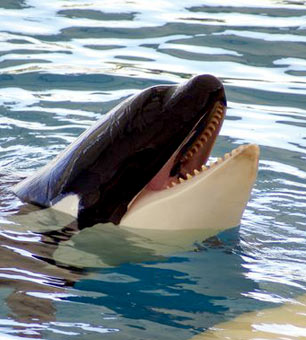
In Blackfish, Gabriella Cowperthwaite’s sleeper hit documentary about a tragedy at Orlando’s SeaWorld, audiences are tempted (or at least I was) to empathize with Tilikum, the orca who killed his trainer Dawn Brancheau during a 2010 performance. The whale had been abused for decades in the service of mindless human entertainment masquerading as environmental education. (“SeaWorld artfully combines education and entertainment in a way that connects people to the sea and sea life like nowhere else,” their webpage boasts.)
I felt a kind of poetic justice in the whale’s eventual revolt against the handler, who must have epitomized, for him, the humiliating institutions of captive animal displays where he had had the misfortune to spend his life.
He was a “killer whale,” and he killed – what part of this was unexpected?
To continue reading this commentary by Randy Malamud please click on http://truth-out.org/opinion/item/18954-a-tale-of-a-whale , then after you have read this piece return to Niagara At Large at www.niagaratlarge.com and leave your views on Randy’s commentary here so we can keep the discussion on this issue going.


Animals in captivity are generally better off than those that are not. It is a life of preying on and being preyed upon. Surviving nature – own your own. People today have it too good to know what it is like to have nothing and be totally on their own. In the animal kingdom there is no constant shelter, no help, nowhere to go. Life is survival of the fittest. Only those that can will survive.
LikeLike
Animals in captivity are better off???? Are people in prisons or mental wards better off because they have constant shelter??? In fact whales in captivity are shorter lived, so they are hardly better off … what is wrong with living as one is meant to live?…. in the oceans – going about their own business. Places like Seaworld or Marineland make ‘slaves’ of animals and this is patently wrong.
LikeLike
I did watch the premier of this film locally and while it was well done the message was not as clear as it could be. On the other hand Malamud’s analysis reads too much human behaviour into the whale. The whale is precisely not what we want him or her to be. At the same time any conception of a “wild” animal is a human construct. Only a prolonged non invasive study of these, our fellow beings, in their natural habitat (sic) can give us insight into their behaviour, which appears to be highly socialized. An attack on one is an attack on all.
LikeLike