
By Doug Draper, Niagara At Large
In a letter to top U.S. environment officials, Ontario’s environment minister has urged them not to take a dangerous chemical waste dump near the brink of the Niagara River gorge off of their ‘National Priority List’ where it would continue to remain an object of close scrutiny.
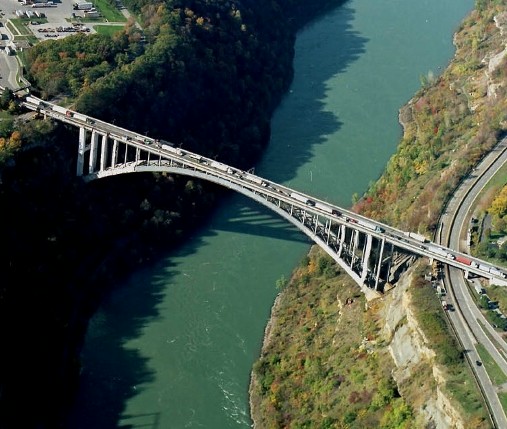
The Hyde Park dump is located just outside the lower right corner of this photo of the Queenston-Lewiston Bridge, near the brink of the Niagara River Gorge. When it was leaking, full blast, through the cracked bedrock to the river below, its poisons spread throughout Lake Ontario and helped almost destroy a healthy fishery in the lake. Two countries – Germany and Japan – once stopped purchasing fish products from Lake Ontario due to the high concentrations of chemicals in the fish flesh, associated with this dump.
“Ontario continues to oppose deletion of the site from the NPL,” said Ontario Environment Minister Jim Bradley in a letter he transmitted this September 19th to U.S. Environmental Protection Agency Administrator Gina McCarthy and EPA’s Mew York emergency and remedial response division director Walter Mugdan in response to plans to possibly de-list the Hyde Park chemical dump in Niagara County, New York from EPA’s decades-old Superfund Site program.
“We are concerned about the potential for failure of the aging remedial infrastructure at the site and the lack of clarity around the party or parties responsible for perpetual maintenance of the remedial works.
Bradley is commenting on a Hyde Park dump identified in the late 1970s and early 1980s as one of the most dangerous hazardous waste site in all of North America. Operated by the former Hooker Chemical Company (later Occidental Corp.), this site is a tomb for some 80,000 tonnes of some of the most lethal chemical wastes ever generated by industry, including a mix of chlorobenzenes, mirex and a member of the dioxin family that was the most lethal ingredient in the Vietnam War-era defoliant Agent Orange. When the Hyde Park dump was leaking through cracked bedrock above the Niagara Gorge to the river below, these chemicals were detected in fish throughout Lake Ontario and in the flesh of beluga whales in the lower St. Lawrence River in concentrations high enough to classify carcasses of these whales as hazardous waste under Canadian and American law.
Following lawsuits filed against Hooker and its Occidental parent company in the late 1970s, a case for cleaning up the Hyde Park site went to federal courts in Buffalo and the courts finally ruled that the dump’s payload of poison could be surrounded with infrastructure for arresting the leakage rather than excavated and destroyed, which is what environmental groups on both side of the Canada/U.S. border fought for.
Now here we are, more than 30 years later, and the man-made pumps and drains and other infrastructure constructed around this dangerous landfill is reaching the end of its effective life, according to information shared by some of engineers that built it at past public meetings. And now the EPA is looking at de-listing Hyde Park – one of the continent’s worst chemical dumps – from priority attention!
This is the second letter Bradley has sent to EPA officials in the past year, asking the United States not to de-list a chemical dump that experts of chemical wastes in both countries agree will remain as dangerous as radioactive waste in the ground for hundreds of years.
Here, and now I repeat, a response to the possible de-listing of Hyde Park that I received about a year ago from Dr. Doug Hallett, a former Environment Canada hazardous chemical experts who tracked the spread of Hyde Park’s dioxin and other poisons through Lake Ontario and down the St. Lawrence River.
“So help me God, you can’t delist this site,” Hallett told Niagara At Large at the time. ”It wouldn’t take a great deal of disturbance, such as increased seismic activity or some man-made event, to release a chunk of that waste to Lake Ontario. ..; And if a couple of shovels full of that waste got into the lake, it would contaminate the water supplies around Lake Ontario for millions of people.”
So that is where we are. Let’s hope that some of our American neighbours join the call to keep this dangerous site on the U.S. National Priority List, and here at NAL, we will certainly be seeking a response to Bradley’s latest letter from the EPA.
We at NAL will most certainly keep you in the loop on this one. Only the future health of our lower Great Lakes and the St. Lawrence River system downstream is at stake.
(Niagara At Large invites you to share your views on this post below. Remember that we only post comments from individuals who also share their first and last names.)
 Niagara At Large
This is horrific! Considering the consequences, where are the feds? Why has Bradley only sent TWO letters (if that is accurate)?
Just askin…….
LikeLike
A young reporter cut his eye teeth covering the Hyde Park dump also covered the big pipe that now spews toxic chemicals into Lake Ontario. That young and passionate reporters name, was Doug Draper.that was 25 years ago.working for the St Catharines Standard, when it was a real newspaper.
LikeLike
Dr. Ian Brindle of Brock University gave a public lecture last year about toxic chemicals that he isolated from samples taken from Hyde Park
LikeLike