
Submitted by the Ontario Clean Air Alliance
(If we can get past the diehard climate change deniers and flat earth society, Niagara At Large is posting this piece because it appears we need to move foreword and deal with the causes and impacts of severe weather and climate change.)
Watching streets fill with water and the lights blink out across the city, you have to wonder – are we really prepared for the coming climate storm?
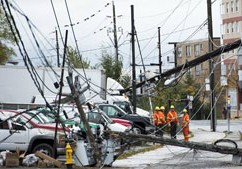
Downed Toronto area hydro lines from the Hurricane Sandy storm that swept through much of the northeastern United States and regions in Ontario, Quebec and Atlantic provinces in October, 2012.
More than 170,000 Toronto and Mississauga residents lost power for anything from a few hours to a day or more after Monday night’s torrential downpour. This was largely a result of the province’s continued reliance on a highly centralized electricity system that, for example, routes power from distant nuclear stations into Toronto via just two major connection points. If one of these points goes down – such as the damaged Manby Transformer Station in the city’s west end this week – big areas of the city can quickly find themselves sitting in the dark.
Thanks to climate change, storms are going to get stronger and more frequent. We could build dykes around our transformer stations, or we could adopt a smarter, more decentralized approach to electricity production and distribution. More rooftop solar (pv and thermal), more geothermal (to curb the power demand from air conditioning), more combined heat and power, especially in condos, hospitals and office towers so that elevators, lights and incubators continue to operate when the grid goes down.
By boosting the city’s ability to generate its own power, we become much less dependent on tenuous long-distance transmission lines and a tiny handful of transformer stations. Toronto can meet just 13% of its peak day electricity needs from local sources while New York City is required to meet 80% of its power needs from local sources. Toronto can and must do better.
The second thing we need to do is increase our ability to reduce demand in critical periods. On Tuesday, Toronto Hydro used both the peaksaver program, which dials back demand from air conditioners, pool pumps and water heaters, and commercial demand reduction measures to reduce the pressure on an over-extended system. These measures helped keep the lights on for at least some Torontonians, but we could do a lot better: peaksaver participation rates remain frankly pathetic seven years after the program was introduced, and commercial demand reduction still has lots of untapped potential. If we had stronger demand reduction programs, we wouldn’t have to worry about huge spikes in demand on hot summer days and we would be better prepared for emergency situations as well. We could also avoid the high cost of a new gas pipeline.
Monday was an important lesson about the fragility of our current centralized electricity system. We can continue to try to patch up the existing system or we can start to address its big underlying flaws. With severe storm warnings becoming a near weekly occurrence, we better get going on the latter.
The Ontario Clean Air Alliance (OCAA) is a coalition of individuals and approximately 90 organizations (health and environmental organizations, faith communities, municipalities, utilities, unions and corporations) that represent over six million Ontarians. We were established in 1997 to achieve the phase-out of Ontario’s dirty coal-fired power plants and to move Ontario towards a renewable electricity future.
You can visit the Ontario Clean Air Alliance’s website for more information by clicking on http://www.cleanairalliance.org/ .
(Niagara At Large invites you to join in the conversation by sharing your views on the content of this post below. For reasons of transparency and promoting civil dialogue, NAL only posts comments from individuals who share their first and last name with their views.)
 Niagara At Large
A huge step in the right direction would be for the government to name the underlying cause, which is man-made global warming. It’s hard to treat the disease if we can’t diagnose it first.
LikeLike