
By Doug Draper
The Great Lakes and the tens-of-millions of people living around them in Ontario, New York and several other U.S. states have lost an old friend.
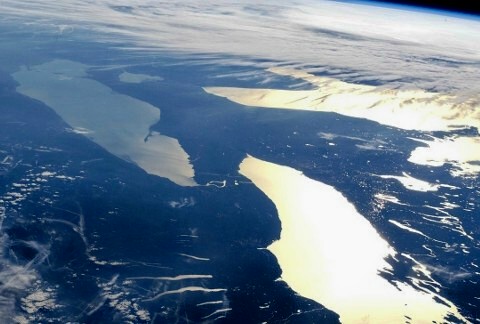
Our Lower Great Lakes from space. Click on this and you will find our Greater Niagara Region. Who will be a watchdog for these vital waterbodies now?
Great Lakes United – a binational coalition of public and private groups with headquarters in Buffalo, New York and Montreal Quebec – is no more. Niagara At Large has received word that its board has decided to pack the three decade old group in, apparently because it could no longer count on financial and whatever other support it needed to survive.
That is sad news for those of us with an interested in protecting the health of these vital freshwater bodies, just as it may be good news for some governments and vital polluters, because in its heyday, some two decades ago, Great Lakes United played a significant role in raising public awareness about threats to the lakes and in keeping governments on both sides of the Canada/U.S. border on their toes. Great Lakes United was born in the early 1980s, in what was still the heyday of a then modern-day environmental movement still full of the energy and optimism coming out of the first Earth Day that countless hundreds of millions of people around the world observed in the spring of 1970. At a time when pollutants spewing into the Great Lakes from industries and sewage treatment plants were literally threatening to render their waters undrinkable and unswimmable, and their bounty of fish inedible, the idea of a coalition of hundreds of Canadian and American environmental groups, not to mention angler, recreational and labour groups, and local municipalities and First Nation peoples’, coming together to pressure federal, provincial and state governments to take action drew widespread public support.
On the 10th anniversary of Great Lakes United, or what many came to know more informally as GLU, one of its then-field coordinators, Bruce Kershner, said this; “Great Lakes United is more than an organization, more than a movement. … It is a family. A family that leads by example and seeks higher ground. And it makes the courageous journey from values to action.”
The GLU logo one last time
Unfortunately, and as a full-time environment reporter for many years, I watched too many citizen-led, activist organizations go from a beginning where they are working out of someone’s house for little or nothing, to growing to a point where there are offices and staff that require funding from a wide range of public and private sources. Then come the concerns over saying or doing something that may turn off some of these financial supporters. So compromises are made and the sharp messages that need to get out there to trigger the kind of action needed to address the environmental threats that are out there get watered down to a point they barely inspire a yawn from the media and public at large.
After I left my job as a reporter at the St. Catharines Standard, where for most of my 19 years there I covered environmental issues, I worked as communications consultant for Great Lakes United for about a year or so in 2002 and 2003, and I believed I was seeing this good group getting into a mindset where it was so worried about what its funders thought, it was afraid to be as courageous in its calls for more environmental protection than it was two decades earlier.
At one point during my short time with GLU, and this is just one of a number of examples, a then-senior member of the group dressed me down for using a headline in one of the organization’s headline that read; ‘Bush Declares War On Environment’. Everyone in and outside the group agreed that the headline was an accurate reflection of the article submitted to the newsletter by a Washington, D.C.-based environmentalist that detailed steps the Bush/Cheney administration was taking to rip the teeth out of environmental laws and programs.
The same the guy dressing me down insisted that I should not have used that headline because it could turn off funders that are also Bush or Republican Party supporters. All I could conclude at the time was that if it gets to a point where you are afraid to say that a government that is gutting environmental programs is gutting environmental programs, then what further purpose is there in having the environmental group. The staff might just as well go apply for a job with a government agency, where they would probably make more money.
Suffice to say I quite that job but stupidly went back to working for a corporate owned newspaper, which also turned out to be a disaster if a reporter wants to avoid becoming a prostitute for corporate chain advertisers.
That’s not to say that there aren’t wonderful, dedicated people in Great Lakes United that continued to do everything they could, right up to the end, to raise public awareness about current threats, including invasive species destroying the foodchain for native fish and other species, lower water levels in some areas of the lakes, sewer pollution recharging oxygen smothering, stinking algae pollution to a more shallow water body like Lake Erie, and pressing governments on both sides of the border to negotiate a Great Lakes Water Quality Agreement that has more teeth in it.
There were some of those people in that group there, right up to the end, which is why the slow death of Great Lakes United – a group that began with 1960s activist Abbie Hoffman attending a founding meeting in Michigan – is so sad.
There are other groups in Canada and the United States that raise concerns about the Great Lakes which, after all, are the largest repository of the freshwater needed to keep us alive on this plant. But Great Lakes United began as the grand plan to have a coalition of groups throughout the Canada/U.S. Great Lakes Basin, that was dedicated to speaking for those waters and all of the wildlife and humans that depend on the health of them for their health and welfare.
For that reason, the death of Great Lakes United is a true tragedy, although I wonder how many of us who turn on a tap in the Great Lakes Basin and assume that water will be safe to drink and use to boil food and bath in will know what they are losing here. I kind of doubt most corporate-owned newspapers or governments and their polluting industrial friends will tell you that.
(Niagara At Large invites you to join in the conversation by sharing your views on the content of this post below. For reasons of transparency and promoting civil dialogue, NAL only posts comments from individuals who share their first and last name with their views.)
 Niagara At Large
This is absolutely a time to mourn. I remember when my Mother told me long ago that I could no longer swim in Lake Erie. I was so sad and thought this could not happen. I believed we`d lost something so great forever. However, when I moved back to this area and found that my children could enjoy splashing around in Lake Erie how happy I was that it had been cleaned up and was as good as new! I wonder who will make sure it stays that way now for my grandchildren.
LikeLike
The dissolution of the” Great Lakes United” is possibly the worst thing to happen at a pivotal time ,as the the Lakes, are under attack by many sources, the research and effort that they did, in getting out the word, was invaluable, the blue/green algae will reappear this year and cause havoc to our health,and could cause many deaths, This year alone 174 Manatee died , after coming into contact with the stuff, The algae can cause E-Coli and breed bio-toxins, that if inhaled will cause death.The Manatee live in the swamps and everglades of Florida, In Ohio, several years ago, some deaths were attributed to Blue/Green algae, tons of the stuff was removed from Waverly Beach in Fort Erie, nobody was wearing any protective garb, also another looming threat is the Asian Carp that could leap the electric barrier on the Chicago River, into the Lake, say goodbye to any more fishing in the great Lakes.We have lost a very good source of vital information, on our lakes , without the GLU.
LikeLike