
By Doug Draper
Countless hundreds, if not thousands of former Ontario Hydro workers, including possibly many who live and worked here in the greater Niagara region, were exposed to unsafe levels of one of the world’s most toxic chemicals a potentially lethal dioxin-related agent known as 2,4,5-T until use of the chemical was ultimately banned in the province in 1980.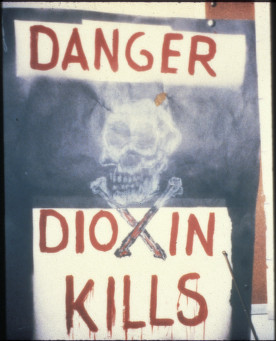
This chemical – deployed for wiping out plant life in a powerful Vietnam War-era defoliant Agent Orange – was sprayed here in Niagara and elsewhere across Ontario to kill back vegetation on Ontario Hydro properties. It was sometimes sprayed, according to a report released this June 13 by an expert paneal reporting to the province’s Ministry of Natural Resources, in concentrations hundreds of times above what scientists would now consider safe levels.
That means that there were likely former Ontario Hydro workers and possibly others here in the greater Niagara region exposed to unsafe levels of this chemical. And if that is the case, Niagara At Large would like to hear from you or members of your family for the purposes of letting you share your story on this site. If you are one who was exposed to this poison, email Niagara At Large at drapers@vaxxine.com .
In a conference call Niagara At Large participated in with Ontario Conservative leader Tim Hudak this June 13, we asked about this. Hudak responded that he had not yet had time to read the full report, although he knew it was coming down. However, he added, that if the evidence shows former Ontario Hydro workers and possibly others were exposed to unsafe levels of Agent Orange related chemicals, then the province should give some consideration to compensating them and ensuring they receive full benefits for any health effects.
I was a young reporter, working for the late and sometimes great independent St. Catharines Standard in the late 1970s and early 1980s when people on the Ontario side of the Niagara River were beginning to learn, to their horror, that large volumes of one of the deadliest form of dioxin were buried in monster dumpsites on the American side of the river.
What we also learned at that time was that dumps like the Love Canal, Hyde Park, S-Area and others used by dioxin producers like the Occidental (former Hooker) Chemical Corporation in Niagara County, New York, were leaking dioxin and a witch’s brew of other nasty chemicals into the Niagara River and Lake Ontario, threatening the health of a rich fishery and drinking water supplies for millions of Canadian and American citizens.
These dumps were later “secured,” as the U.S. courts and other agencies in the country would tell us, with “containment systems” constructed around them. But the poisons are still buried there – chemicals that can remain as lethal as they were the day they were produced for hundreds of years – and these so-called containment systems are beginning to break down, and Niagara At Large will get back to the threat that the breaking down of these systems pose to tens of millions of present and future generations in and around the lower Great Lakes and the St. Lawrence River watershed soon.
But the point now is the excessive levels of 2,4,5-T related dioxins some of our fellow citizens were exposed to while Ontario Hydro lands were sprayed with this poison in the middle half of the last century. And we all should ask what condition those lands are in now, since the chemical has a capacity not to break down for many decades, if not hundreds of years to come.
Niagara At Large is now posting some information immediately below on the media release on this important subject issued today. Following all of that, please share your views or any other information some of you may be able to provide on the use and abuse of this chemical.
Fact-Finding Panel Releases 2,4,5-T Report
June 13, 2013 11:00 a.m.
Ministry of Natural Resources
The Ontario Independent Fact-Finding Panel on Herbicide 2,4,5-T has released its report. The report, and the 4,747 government records provided to the panel, are publicly available at: ontario.ca/245T.
In 2011, Ontario established the panel to determine where, when and how 2,4,5-T (2,4,5-Trichlorophenoxyacetic acid) herbicide was used in the province in the 1950s, 1960s and 1970s for weed or brush control by government ministries and agencies, and whether exposure may have potential health impacts.
The Ontario government established a dedicated phone line for the public at 1-888-338-3364 as well as a dedicated Workplace Safety and Insurance Board (WSIB) line at 1-800-387-0750 for Ontario workers who have concerns about possible workplace exposure.
Quick Facts
- Ontario is the first Canadian jurisdiction to launch a government-wide review of the use of 2,4,5-T.
- Ontario took early action and suspended the use of 2,4,5-T in 1979 and banned it in 1980. The federal government deregistered the product in 1985.
- The fact-finding panel was led by Dr. Leonard Ritter, executive director of the Canadian Network of Toxicology Centres and Professor Emeritus of Toxicology at the University of Guelph.
- The WSIB is reviewing the report as part of its work to adjudicate claims from workers who believe that their medical conditions were caused by workplace exposure to herbicides, like 2,4,5-T.
Quotes
I am pleased to present the panel’s report to the Ontario government. In addition to the expertise that each panel member brought to the team, the findings are based on two years of research that examined more than 4,700 Ontario government records, the development of exposure models and a review of health-related literature from jurisdictions across the world. I am confident that these findings will provide a solid foundation to help us better understand the effects of 2,4,5-T usage by the Ontario government. I applaud the Ontario government for being the first jurisdiction in Canada to undertake such a comprehensive, science-based study.”
Dr. Leonard Ritter
Chair, Ontario Independent Fact-Finding Panel on Herbicide 2,4,5-T
What were the panel’s findings?
Based on some of the exposure assessment scenarios, exposure substantially exceeded safe thresholds in some subgroups of the Ontario population.
These scenarios modelled occupational exposures where Ontario Hydro, MNR, and MTO workers were repeatedly exposed, over long periods, to the mid and highest levels of TCDD. Such scenarios would represent workers who were involved in mixing, loading, and applying herbicides and were exposed regularly to TCDD-contaminated 2,4,5-T for long periods. However, the toxicological reference values (TRVs) used to predict safe thresholds of exposure are required by regulatory policy to err on the side of safety. Thus, even when exposure estimates exceed safe threshold levels, a wide margin of safety is incorporated into the estimates and adverse health effects may not occur. The risk assessment only indicates that acceptable margins of safety have been exceeded for certain occupationally exposed groups, and that their health could have been affected.
Bystander exposures, defined by the panel as being of a brief nature and not from personal direct use of the herbicide, exceeded a safe threshold only in the case of Ontario Hydro and MNR and only for the highest TCDD exposure scenario, and the safe threshold was only marginally exceeded. No other bystander exposures were found to exceed the safe threshold. None of the bystander exposures to 2,4,5-T for Ontario Hydro, MNR, and MTO exceeded what was considered to be a safe threshold of exposure. The panel concluded that the risk of developing a disease due to bystander exposure to 2,4,5-T/TCDD would be very low.
It is important to note that the panel conducted a population-level assessment, which characterizes risk for groups of individuals. Such assessments, however, cannot be used to determine whether or not an exposed individual will actually develop a disease or adverse health event from exposure to 2,4,5-T or TCDD.
(Niagara At Large invites you to join in the conversation by sharing your views on the content of this post below. For reasons of transparency and promoting civil dialogue, NAL only posts comments from individuals who share their first and last name with their views.)
 Niagara At Large
This is an issue of major importance — I hope that this article gets wide distribution.
LikeLike
Lets not forget this article only deals with provincial agencies. Records of federal agencies in Ontario need scrutiny and there is the fact tere are federal dumpsites in Ontario that are not public information. I can think of one in particular right in Niagara.
LikeLike
My father was exposed, similarly to Ontario Hydro Foresters, working on federally controlled airports in Ontario. He has been very ill with phocular Non-Hodgkin lymphoma. Looking for some guidance.
LikeLike