
By Doug Draper
A total of nine memorial services were held across Niagara, Ontario this past Sunday, April 28, to remember all those who have died in in the workplace in Niagara, across Canada and in other regions of the world.

The monument for dead and injured workers at Niagara, Ontario’s regional headquarters.
As much as working conditions may have improved on this continent, workers in Ontario are dying at a rate of about one per day and in Canada, they are dying at a rate of about four per day, said Bruce Allen, a Niagara Regional Labour Council representative and long-time executive member of the Canadian Auto Workers, Local 199, at one of those memorial services at Niagara’s regional government headquarters this April 28.
That is far too many workplace deaths when they are preventable, he said.
On a positive note, said Allen, what began in Canada about two decades ago as a ‘National Day of Mourning’ for workers killed and injured on the job is now being observed in the United States and many other countries around the world.
It is only fitting that the day has turned international, said Allen, given some of the horrible workplace disasters of the past few weeks, including the collapse of a garment plant in Bangladesh that has killed hundreds of workers there, and an explosion at a fertilizer plant in West, Texas, that has killed and injured more than 200 people there.
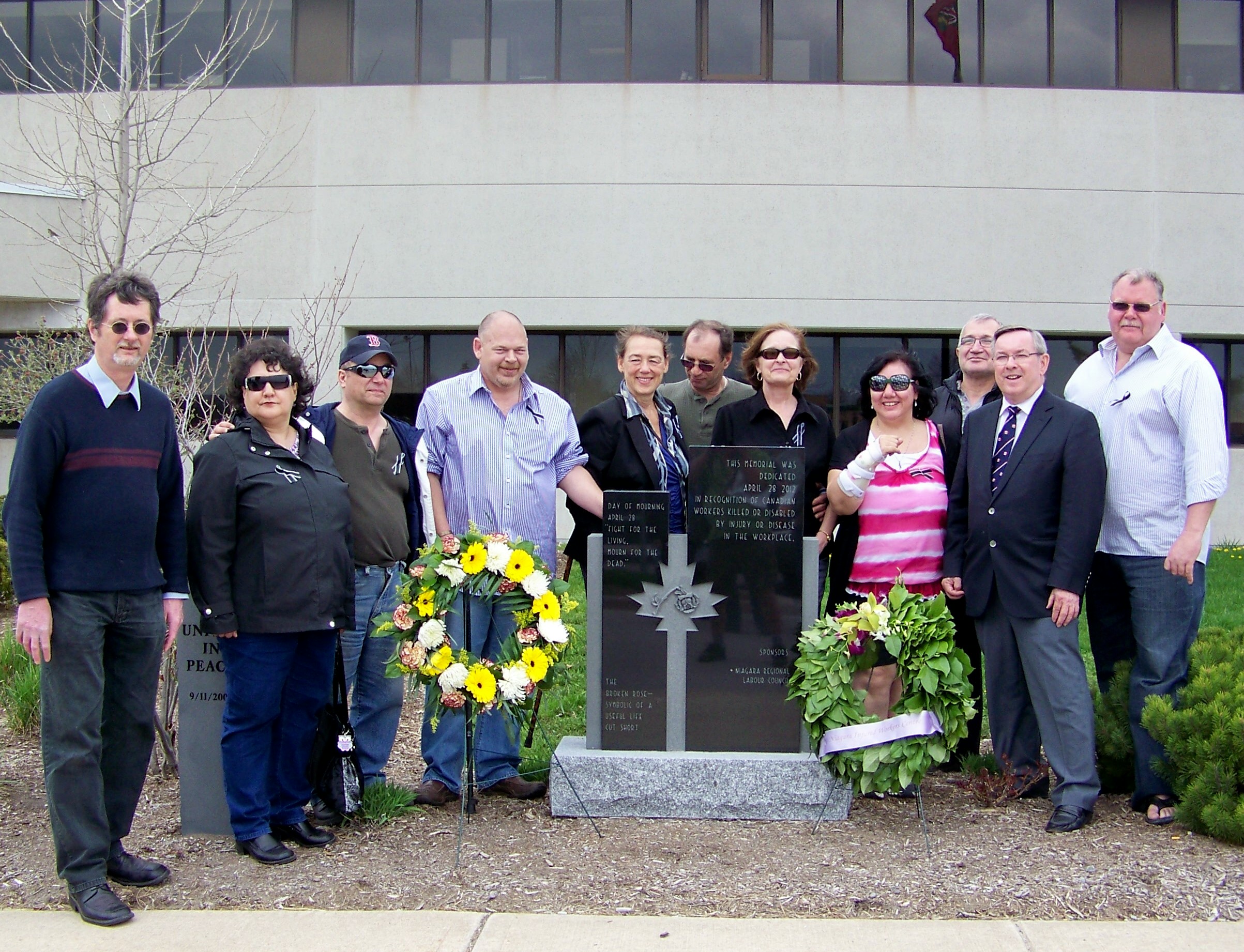
At a memorial event for workers at Niagara, Ontario’s regional government headquarters, photo includes Bruce Allen at left, Will Noiles, fourth in from left, a few labour respresentatives from the Hamilton area and second from right, St. Catharines MPP and Ontario cabinet minister Jim Bradley. Photo by Doug Draper
Allen noted that despite the fact that the Texas fertilizer plant explosion resulted in the death of at least 14 people and came after more than two decades of non-inspection from federal occupation and health regulators, it did not receive anywhere near the attention the bombing incident did at the Boston marathon which, in the latter case, has been called an act of terrorism. “It speaks volumes,” Allen said, that corporate neglect around workplace safety still receives less attention from the mainstream media.
Will Noiles, representing Niagara’s Injured Workers Centre, said “everyone who goes to work each day should expect that they are going to go home safe and sound.” He said that “this day” should also be about all the rest of us “standing up” for conditions that ensure that workers who are still with us can do that.
Jim Bradley, the veteran Liberal MPP for the riding of St. Catharines, Ontario and the environment minister in the current government of Kathleen Wynne, was the only provincial MPP to speak at this ceremony, although he did mention Peter Kormos, the former NDP MPP for the Welland Riding who died this March and who Bradley said was one of the greatest friends of working people.
“Thanks to Peter, who was always at these events each year,” said Bradley, who had attended one earlier in the day below the Skyway bridge in St. Catharines where, 20 years ago, a number of workers fell to their deaths when a scaffold failed them.
Bradley said thanks are also owed to Labour Councils across Ontario for continuing to bring the concerns of workers around health and safety to government’s attention.
(Niagara At Large invites you to join in the conversation by sharing your views on the content of this post below. For reasons of transparency and promoting civil dialogue, NAL only posts comments from individuals who share their first and last name with their views.)
 Niagara At Large
Don’t forget people who aren’t killed “accidentally” like the nurses who went to work knowing they would be caring for SARS patients with the disticnt possiblility of contracting a deadly disease. Several died. Nurses are also victims of physical abuse by patients and families on a daily basis. I’ve known some to have concussions and broken limbs.
We also need to remember first responders…police, fire and paramedics who go toward danger when others run away.
LikeLike
What about the 612 children that have died in Foster care in the last five years? No public investigation of a system that failed these children. http://protectingcanadianchildren.ca/brochures/ONbrochureprint.pdf
LikeLike
OK. I know I will get negative replies. Fair Game. I can take it.
This is about labourers, men (mostly) who worked as carpenters, drillers, any kind of physically hard work to build canals, industries, etc. in earlier centuries. That’s what I believe these memorials address. The other issues raised are worthy ones and worthy questions indeed, but the focus here, if I read NAL correctly, is on labourers, “first responders”. Let’s find another time for the issues raised by the other respondents.
LikeLike
Gee Gail, I guess nursing isn’t physical enough. Tell that to my two back surgeries. I do understand what you are saying but nursing is hard, physical labour too.
LikeLike
Hey, I said I could take it, and yes, my nursing sisters tell me this too. My comments are not about broadly speaking physical jobs (you will not believe this, but mine, seen as sedentary, was not at all sedentary, just so’s you know.) It was about this memorial, specifically. Let’s agree to disagree on this small point, and keep in touch, and on track. Gail
LikeLike