
“Bangladesh, Bangladesh. Where so many people are dying fast. And it sure looks like a mess. I’ve never seen such distress. Now won’t you lend your hand and understand?” Relieve the people of Bangladesh.” –
The lyrics from a song by George Harrison, 1971.
Want A Bargain? Want To Buy Cheap? Is It Worth The Disaster In Bangladesh? – Let’s Please Not Say So. Down With These Sweat Shops. Shop For Made In Canada. Shop For Made In the U.S.A. Shop Independent And Local!
A Commentary by Doug Draper
Turning on the television news this third week of April to images of bodies – dead and alive – being pulled from the rubble of a garment factory in Bangladesh while relatives screamed in grief nearby was heart-wrenching.
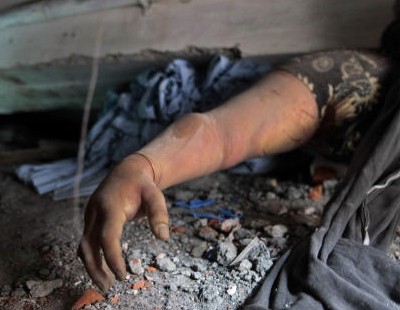
The hand and arm of this crushed Bangladesh garmet worker are there for the rest of us to see, if we choose to. I think of the young women who died in the Triangle Shirtwaste garment factory in New York City 102 years ago in similar slum conditions. When will it end? Is our craving for cheap goods worth all these lives?
The circumstances behind this disaster were disgusting and possible even criminal, and our hands aren’t clean either.
The poor people in that building, which they and those who ran the sweat shop inside knew was full structural cracks to a point of being dangerous, produced clothing many of us go out and buy in big box discount stores – with hardly a thought given to the conditions those who made the shirt or pair of pants we got for a quite a deal live and work in, until possibly this week.
This disaster – this horrid illustration of the conditions many people in under-developed countries have to work in so that we can get a so-called bargain and corporate retailers and their shareholders can super-size their already maximized profits, should bring it all home for us that that as “cheap” as those clothes seem to be, they come at a price, up to and including the deaths of those all but chained to benches, for 20 cents an hour, to make them.
And as much as we may try, we as the consumers of these products cannot just wash our hands and say it is none of our responsibility or concern.
This post is not to make us feel guilty over the reported deaths now of more than 260 garment workers in Bangladesh, making clothing for wages that often amount to less than $40 a month. for Loblaw’s Joe Fresh stores and other corporate chains that choose to exploit cheaper labour in conditions like this rather than pay people decent wages in safe working conditions to produce their clothing and other consumer goods.
It is to make us all finally give more than a second thought to what we are doing – and many of us, including this scribe has needed this jolt too – when we buy this stuff at bargain-basement prices without giving much thought to what the true cost is to workers there and to working families in Canada and the United States who have seen their livelihoods lost to corporations moving their manufacturing operations to the lowest cost sweatshops they can find, overseas.
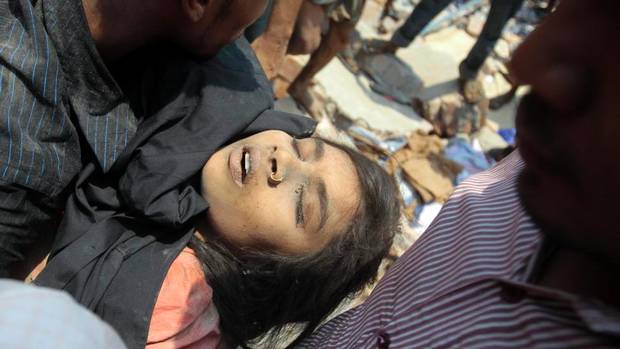
A dead woman pulled from the Bangladesh sweatshop in honour of cheap goodshere.Thank you Loblaws, etc.
If anything redeeming comes out of this horrid disaster, it should be to drive us all, as consumers in Canada and the United States, to give more thought to where the cheapest of goods in discount big box venues like Wal-Mart, Target and others are coming from, and what awful working conditions so many have to endure to produce them.
Is it really worth what we thing we are saving at the cost of good manufacutinrg jobs here and the awful exploitation of people in in countries like Bangladesh who are all but chained to machines at the risk of losing a job that pays them 20 cents an hour.
The nightmare for this factory of people in Bangladesh and their families – only one of countless many more in underdeveloped countries across the world – should have us all demanding that big corporation chains like Loblaws, Wal-Mart, Giant Tiger, Target, Payless Shoes and others show more accountability for the working conditions of those who make their products. Rather than simply boycotting these stores, which I am tempted to say let’s do it at the expense of whatever employment there may be for the poor people in countries like Bangladesh, we should be demanding that these retailers insist on better wages and working conditions for these people, or not do business there.
It may cost us, as Canadian and American consumers, a little bit more for clothing and the other cheap crap we purchase from these big corporate chain stores, but it might make life a little more liveable for the poor people who are making them.
Then again, I will go back to first principles. If you can purchase anything still made in Canada or the United States from a local, independently owned store, do it first, even if it costs a little more money. I have tried it and have found that that shirt I bought for a little more money, make in Canada or the U.S.A. in an independent store, last a lot longer than the crap I purchased at a discount store that was only good for use as a rag go wash my car after about 10 to 15 washings.
Think about it. The lives of foreign workers are at stake and so are the jobs of Canadian and U.S. workers. If we think we are getting a deal purchasing a product manufactured in an overseas sweatshop, think about the cost to them and to all of us, including decent paying jobs vital to the health of our economies at home, in Canada and the United States.
(Niagara At Large invites you to join in the conversation by sharing your views on the content of this post below. For reasons of transparency and promoting civil dialogue, NAL only posts comments from individuals who share their first and last name with their views.)
 Niagara At Large
It’s the equivalent of the Triangle Shirtwaist factory fire (Google it)- but in Asia.
Over the last 40 years the price of clothing has been the same or even lower – our cheap clothes (wash them once and most look like a rag afterwards) are based on starvation wages and dangerous working conditions in the Third World.
Clothes made in NA used to have labels that proudly announced “union made”. Perhaps it’s too late to go back to that, but how about a “fair working conditions and fair wages”. Apparently only an extra $5 on a pair of pants means a tolerable job for someone in the Third World.
LikeLike
I refuse to feel any guilt about this disaster. It is a tragedy that so many lives have been lost, and yes, I feel that pain.
But to blame Canadians (or Americans) because they want to buy lower cost items is a little misleading.
Why does the government of Bangladesh allow such shoddy construction? Why does the government of Bangladesh allow such callous factory owners to exploit these workers?
Why does the government of Bangladesh allow the factory owners to basically lock the workers into the buildings?
Oh … is it because the government of Bangladesh is corrupt? Is it because the government of Bangladesh cares less for its people than the people of Canada do?
I live on my pension and have to watch every penny. If I can buy a T-shirt, such as I did today at Walmart for $7, as opposed to close to $20 for one at another store, your damn right I am going buy it at Walmart. And no, I don’t feel guilty about it. That extra $13 makes a difference in how much I have to spend on food and shelter.
If you really, truly care about the working conditions in Bangladesh, take it up with the government of Bangladesh!
LikeLike
Our failure at home to address a growing income disparity requires cheap goods from elsewhere. We have responsibility for our own failures when we ask others who are even more desparate to make up for our deficiencies. It can never be said that our choices are without consequence.
LikeLike
The grave violation of human rights which is the result of unregulated capitalism could be mitigated somewhat if our governments took control of the retail market from mostly foreign monopolies and ensured fair trade rather than free trade practices. Remember the NAFTA sidebar agreements. Whatever happened to them?
LikeLike
When I grew up quality was revered . Ofcourse it cost more but it would last and you were considerate with it’s care and maintenance . Now everything is throw away and the whole world looks the same . These big box stores are just warehouses to distribute cheap rubbish from who Knows where . We have lost the artisans and the indavidual shops that used to make shopping an adventure , Now it is just a chore ! We stopped drinking and driving . We stopped most people from smoking . Maybe we can get people to appreciate Quality again !
LikeLike