
A Submission by Karl Dockstader
(Just a little foreword from Niagara At Large – While we are fighting over wind and solar energy and where these facilities should go, rapidly developing nations like China and India are moving forward with newer wind and solar technology that could blow us away, and win the future on safe, boundless energy production. U.S. Barack Obama once said that those countries that does the best job of making renewable energy alternatives work will be the leaders iofthe 21st century. So far this tar sands nation of Canada is not looking like much of a contender.)
Toronto Convention Center, January 4th. Energy Minister Chris Bentley addressed a crowd of solar industry professionals, entrepreneurs and advocates yesterday and announced that 200 MW of Feed in Tariff(FIT) and microFIT contracts would be awarded starting December 14th.
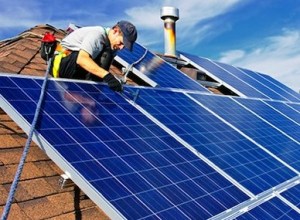
Solar panels being installed on a residential rooftop in somewhere U.S.A.
This announcement is bittersweet as it has taken the entire calendar year to roll out the program that has become politically embattled due to PC opposition. It is also unclear what role FIT will continue to play in the provinces long term energy plan.
At the Canadian Solar Industry Association conference 2012 yesterday optimism amongst vendors was scarce. The future of FIT, despite it’s resounding success in countries like Germany, has become tangled into the unusually contentious relationship between exiting Premier Dalton McGuinty and PC leader Tim Hudak.
MicroFIT and FIT pay property owners an incentivized rate to invest in solar and provide energy for the grid. In Ontario there is a 60% Canadian content requirement designed to be a stimulus to the economy. In Niagara this has led to Ontario Solar Manufacturing setting up shop in Welland, and the rise of many solar installation companies and contributed to the creation of a Renewable Energy Technologist program at Niagara College.
Opponents have been led to believe that these FIT contracts will contribute to rising energy costs. Alternative programs include Net Metering, a scheme started in the United States that allows an energy consumer to balance the energy they take from the grid by energy they put back into the grid. Without an incentive to use Canadian components it is unclear if growth can continue in the Ontario solar manufacturing sector.
This Canadian quota was starting to come into question with World Trade Organization opposition that classified it as potentially protectionist in nature.
The FIT window opening up is good news for now for solar installers who have been waiting all year for some movement on a project backlog.
For more details keep checking back to Renew Niagara’s Energy for updates.
Niagara At Large welcomes Karl Dockstader as a contrrbutor to posts on our independent news and commentary site. Click on the ‘contributor’ link on NAL’s home page to find out how you can become a contributor of news and commentary too.
Karl Dockstader is a Niagara resident and Niagara College student studying renewable energy alternatives. He also works with Niagara Research, a partner of the college that is involved in applied research for addressing community issues, and which also has a partnership with one or more companies with interests in solar energy.
(Niagara At Large invites you to share your views on this post. Please Note that Niagara At Large only posts comments by individuals who also share their first and last names.)
 Niagara At Large
For several years solar and other energy options have been available for us but unfortunately we have’nt all jumped at the opportunities offered by the mostly small companies that provided this “hope for our planet” chance. It is a shame that a lot of those small companies have gone out of business waiting for us to wake up. Here’s another chance with the incentive being not just what’s best for our planet but what will appeal to the wallet too!
LikeLike
WTO opposition can go fly a kite as far as I’m concerned. The innovators will win the future in this industry, but we’re too bogged down in Tar Dirt.
LikeLike
Sadly, it seems to me that Canada was way too late out of the starting gate on solar. How the heck do small solar manufacturers possibly compete when big American-based companies have gone under due to China dumping their cheaper solar markets onto the international market? When the much-touted Green Energy Act came, I think that I was far from alone in thinking that we were going to move towards a renewable-energy future. No such luck. The administration of the FIT program saw contracts awarded to the big players from outside Canada, who rushed into to get their approvals signed so that their shareholders could make big bucks of the big subsidies. In the meantime, micro-FIT languished…So excuse me if I find it hard to swallow anything Chris Bentley, or anyone else from the McGuinty cabinet, for that matter, has to say on the subject…I think that Ontario residents would be much more inclined to pay higher costs for power that was also directly benefitting the Ontario economy and Ontario’s small businesses. So far, that’s doesn’t seem to be the case.
LikeLike
It’s comforting to see the support this post is getting, because if you listen to the rhetoric, apparently everyone hates PV and it’s a terrible idea. The public, it seems, is not quite so easily fooled.
The article hits the nail on the head. Worldwide PV and wind are the two fastest growing power sources. Coal, new nuclear, gas, all of them put together are less than wind and solar. It’s all the impressive when you consider all the stories of a new coal station a week in China.
So what’s the fastest growing power source in Ontario? Gas plants. We still have 5 GW or so of undeveloped hydro, the same amount of PV capacity on commercial rooftops (otherwise dead space), and lots of wind left. And we’re arguing over how much nuclear we need?
We need to get with the program. If FIT has problems, fine, fix them.
LikeLike
Innovative Germany has the right priorities. Look at how their energy prices have dropped.
LikeLike