
(A brief foreword from Niagara At Large publisher Doug Draper – The following commentary by John Bacher speaks to an example of where Niagara regional government once again fails us as a region. In the case documented below, instead of adhering to progressive planning principles around growing residential and business growth toward the southern tier of Niagara, where there is plenty of land ready to go within the existing urban boundaries, the regional council bows to parochial pressures to expand onto lands that should be protected as gifts to this region’s green and agricultural heritage.
In the specific case of West Lincoln, instead of the regional council collectively saying we will pool resources from across Niagara to sustain this municipal member as a valuable food belt, it has essentially said to hell with that. So much easier to go back to the old days of approving more urban, regardless of the consequences for Niagara’s future as a rich tapestry of urban and rural communities, and regardless of the consequences for, in this case, a magnificent Twenty Mile Creek/Balls Falls watershed we should all strive to protect and preserve for present and future generations.)
By John Bacher
For the past three years, there have been closed door meetings between Niagara’s regional government and the Township of West Lincoln – one of 12 local municipalities in Niagara, Ontario – over proposed amendments to the Niagara Regional Official Plan that came about because of the adoption by the provincial government’s Growth Plan in 2005.
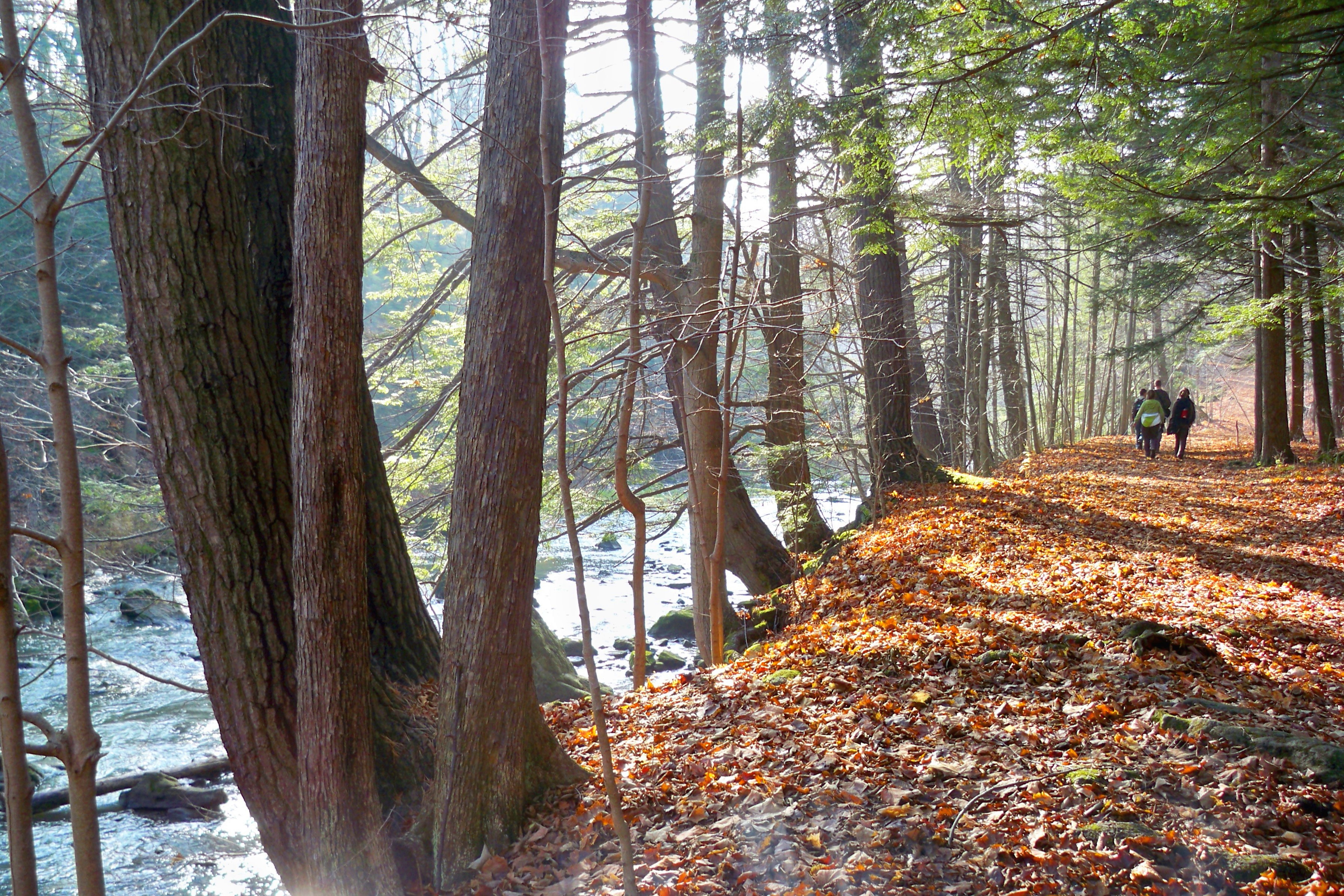
A popular trail along the below Balls Falls in the Twenty Mile Creek watershed. What will the impact of more urban expansion be on this natural treasure? Photo courtesy of the fine photography of Dan Wilson.
The Growth Plan is aimed at curtailing urban sprawl in parts of Ontario experiencing growth pressures and one of its basic principles was to place urban boundary expansion approvals in the hands of regional governments, and not lower-tier municipalities.
Together the Niagara regional government’s planning department and a called Dillon Consulting Limited examined if Niagara had any justification for an urban boundary expansion. It was concluded that since there was a 41-year supply of residential land across the entirety of the Niagara region that no such urban boundary expansions could be justified. Together they prepared an official plan amendment text that would not permit any urban boundary expansions within the next five year planning framework.
The Dillon report, which followed extensive public meetings and consultations was a good effort to protect the prime Class One to Three agricultural lands that are not safeguarded by the provincially established Greenbelt below the face of the Niagara Escarpment.. Some of these lands in Niagara Falls have excellent climate conditions for grape growing, while those of West Lincoln havegood soils for a host of valuable food-producing crops.
The Dillon report’s attempt to save prime land in both West Lincoln and Niagara Falls created an uproar of opposition from members of Niagara’ land development industry. Hundreds from that industry demonstrated in front of Niagara’s regional government headquarters. It was suggested by them that lands currently zoned for residential purposes in Port Colborne and Fort Erie be down zoned to agricultural to permit urban zoning expansions in West Lincoln and Niagara Falls.
While not down zoning urban land within boundaries, Niagara’s regional council took away provisions to restrain urban boundary expansions by a series of motions from the region’s planning department’s proposed amendment. Of these, the most audacious was a “notwithstanding” clause, to permit boundary expansions irrespective of needs criteria.
In response to the “notwithstanding” clause and other loopholes to facilitate possible urban boundary expansions, both the provincial government and the Preservation of Agricultural Lands Society, (PALS) filed appeals to the Ontario Municipal Board. (OMB). At the same time, numerous landowners throughout Niagara made their own OMB appeals against the possibility that the Growth Plan would shut the door on turning their rural lands into subdivisions.
During the past three years, PALS heard nothing directly from the municipal governments or the province about the behind scenes meeting. Usually reliable sources however, let PALS know that the province was holding firm, swatting down the municipalities’ arguments “like flies”.
Behind the scenes it was indicated that a major concern of the province was water pollution from the proposed boundary expansions in the West Lincoln community of Smithville and Niagara Falls. The Twenty Mile Creek is a very fragile ecosystem, being dry much of the year accept for a few refugia pools where fish seek refuge. Pollution from more development in an enlarged urban boundary area in West Lincoln could overwhelm Twenty Mile Creek, sending raw sewage over Balls Falls.
Similar threats from expansions in Niagara Falls pose a threat to Shriners and Ten Mile Creeks. Shriners’ Creek is highly polluted from discharges within the current approved urban boundaries. It was found to be a health threat to investigators sent there by the Niagara Peninsula Conservation Authority. Its conservation area on Shriners Creek is now closed to the public. Veteran ecologist Mike Dickman presented documentation of high E-Coli counts in Shriners Creek to Niagara Regional Council. The headwaters of Ten Mile Creek, which is free of such pollution, is in an area proposed for an urban boundary expansion.
Bare details to a deal between the province and the Niagara Region emerged at a meeting of the Integrated Community Planning Committee this past October 17th. These were disclosed at a Public Meeting held under the Planning Act to consider Regional Plan Amendment 3-2012.
The report from the Niagara Region Planning Department this October 17th indicated that the housekeeping amendments to the Niagara Regional Plan put forward were required by the province. This was as a result of the “approval of the Minutes of Settlement for the Sustainable Community policies.” To expedite this process, it was recommended by the Department that a policy be inserted that would allow changes” to occur during Office Consolidation without requiring an amendment.
In response to an inquiry from the public at the Public Meeting on Niagara Regional Plan Amendment 3-3012, it was revealed that the “Minutes of Settlement” were as a result of the negotiations between the province and municipalities concerning the Growth Plan. It was indicated that the content of this agreement would be revealed when the OMB holds its hearing on the Growth Plan conformity amendments.
It is impossible to say now who came out on top in the secret meetings that produced the Minutes of Settlement. One cause of concern, however, is that after the existence of these minutes was revealed, public meetings in Niagara Falls are taking place on two urban boundary expansions in the Ten Mile and Shriners Creek watersheds.
John Bacher is a Niagara resident and longtime member of the Niagara-based citizens group, Preservation of Agricultural Lands Society.
(Niagara At Large invites you to share your views on this post below. NOTE that NAL only posts comments from individuals who also share their first and last names.)
 Niagara At Large
Reblogged this on and commented:
Please note that these are not necessarily the views of Climate Action Niagara (CAN)
LikeLike
For those of us who live in the cities, like myself who lives near downtown Niagara Falls, it is often overlooked how protecting the invasion of development on the green spaces of Niagara can hinder inner city development. When I visit Crescent Park in Fort Erie and see the constant flow of for sale signs, yet head out to the neighbourhoods surrounding the Niagara Square and see constant development I have to ask the obvious question? Why don’t our elected officials work on breathing life into our older neighbourhoods, from which the average person benefits, instead of allowing developers to sprawl across green spaces and reap profits that don’t really get re-invested into the economy?
LikeLike
Quite right Karl what is the sense building new infrastructure when citizens have already paid for the existing infrastructure. If we built within the existing boundary and because of the broadened tax base wouldn’t it lend itself to lower taxes for all While preserving our hinterlands and our seperate identities amongst Niagara’s 12 communities!
LikeLike
Back in the early 1970s, the NDP, led by Dave Barrett formed the government in BC, taking over from the Social Credit party (fore-runner of today’s federal Conservatives). One of the first things the NDP enacted as goververnment was the “Agricultural Land Reserve” – ALR for short. The developers, farmers, etc screamed blue-bloody-murder, but it went through. Interestingly, it is still in effect today, protecting agricultural land from being paved over.
There have been several changes in government in BC since that time, both right and left, but the ALR has been left in place.
Perhaps, after the next provincial election, when we have an NDP government (and remember, I am a small-c conservative) Andrea Horwath and her crew can do a better job than Bob Rae did and bring in some progressive legislation.
LikeLike
Sounds like gov. crap. I’m having a problem with the property / New building on the corner of Moyer and Creek rd. Water shed property on Welland River. Been watching riverfront being destroyed ,backfilling a boat launch installed and a massive construction building .Reapplying for a building permit on Jan 31 after being turned down last year. Extreamly disappointed in all gov. responces although prompt.Save the land my a…
LikeLike