
A Commentary by Doug Draper
I think I am beginning to understand why Cogeco TV – Cable 10 in Niagara, Ontario just to make clear for those of us who are or are not on cable on the Ontario side of the Niagara River– would rather carry local hockey games or anything else, up to and including a festival on potted plants on a Thursday night than carry Niagara regional council meetings live.
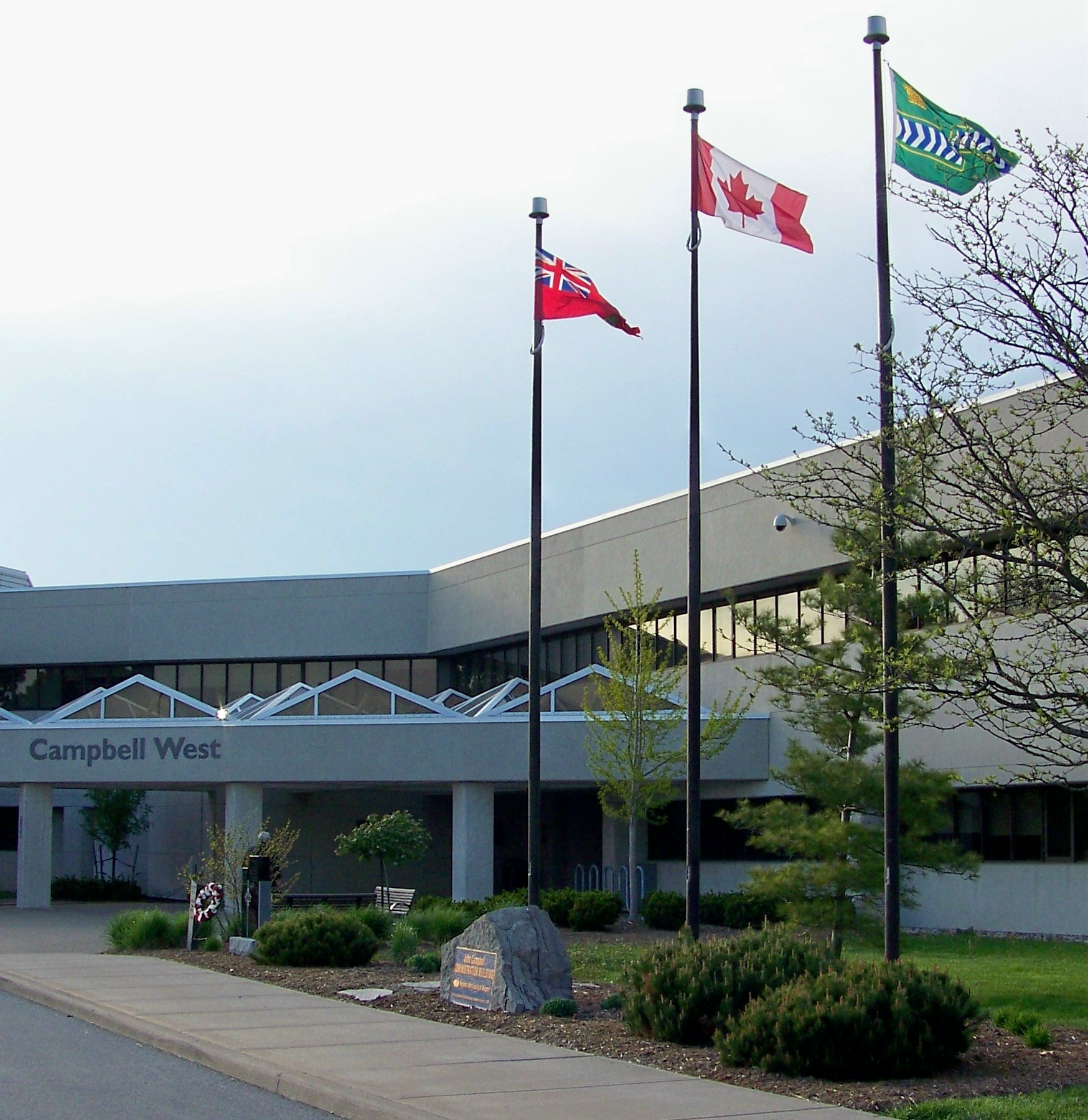
Niagara Regional Headquarters. Maybe we ought to yank the elected councillors out of there and run this place as a business.
Covering these council meetings, the way they are going these days, is like covering something that swings back and forth between an Alice in Wonderland Mad Hatter show (and that, sad to say, is the most interesting part) and watching paint,, which is the television equivalent of dead air. So let me apologies for any complaints I’ve maid in the past about Cogeco not carrying this dysfunctional, moribund group of political partisans and obsessive-compulsive parochialists live.
Those now sitting on Niagara regional council should also feel grateful that their council sessions are not carried live. For if they were, I am sure more people than are out there across Niagara today would be in favour of scrapping regional government. And this council should be aware, if they aren’t already, that there are a good many people out there who have little or no knowledge of regional government or what it contributes to Niagara by way of services or building economic opportunities across the region, and would therefore not know or care enough about the regional council if there was a move to abolish it in favour of, let’s say, the 12 local municipalities in Niagara operating regional services like waste management and water and sewage treatment as a utility.
At a recent session regional councillors held on the matter of governance reform in Niagara, Debbie Zimmerman, a Grimsby regional councillor and former Niagara regional chair, and one of those I continue to have a good deal of respect for, said words to the effect that ‘we (meaning regional representatives collectively) are our own worst enemy.
Debbie Zimmerman is right. If all this regional council can do is take an opportunity to do some serious reform around the way Niagara is governed at the municipal level and reduce it to something like ‘all we are going to look for the remainder of this term of council is the way we communicate to people about the services we deliver,’ why should this regional council, as a collective and regardless of how much respect we may have for some of its members, be taken seriously? There are serious questions and concerns that have been raised by members of Niagara’s business community and others about the status quo and how it is possibly holding this region back in terms of attracting more business and jobs for a population that is more job-deprived than most other regions in Canada. But all we end up with, over and over again, is directly elected councillors and mayors on this regional council that are more in to the parochial interests of the local municipalities they represent than they are into building a prosperous future for all of Niagara.
All of Niagara seems to mean little to far too many of those now sitting on Niagara, who bristle any time talk turns to an economic development agency or a transit system or water and wastewater services, not to mention planning, that serves the best interest of all Niagara residents.
I have been covering regional politics in Niagara for three decades now and this is the worst I have seen at the regional level, and I say that reluctantly because Gary Burroughs is a good, honest person who seems to have all the best intentions in the world when it comes to advancing the interests of all of us – residents and businesses – across Niagara.
Something has come off the rails or as Bob Dylan once put it; ‘Something’s going on here, and we don’t know what it is, do we Mister Jones.’
If Niagara’s regional council can’t make up its mind what is going on and address it effectively for people across the region, then maybe it is time to abolish it as an elected entity and put together a board to run its services as a public utility.
(Niagara At Large invites you to share your views on this post. NOTE that we only post comments by individuals that also share their first and last names.)
 Niagara At Large
We in Fort Erie have to watch the reruns very closely to catch a glimpse of our two representatives on Regional Council before they bail out on the meetings early. Yeah, they stick around long enough for roll call, but they depart soon after. So much for the $30K they each earn from the taxpayers. It gets embarrassing when a vote is taken and the Fort Erie representatives are seldom there to vote. Of course, we still get remarks from Hizzoner against any type of regionalization of services. Not on his watch will Fort Erie enter the Twenty-First Century!
LikeLike
Very good Mr. Daper. One has to wonder how so many good people can go in the wrong direction – as with the FIT program and Industrial Wind Turbines. Is this a case of uninformed idealistic action or noble cause corruption.?
ed
LikeLike
Well Doug, I’ve said it before, and I will say it again, and again, and yet again if necessary (and it would seem that it is!).
Replace these bloated windbags with a PUC (public utilities commssion) that would operate police, water, sewer and other shared services on a cost basis. Establish a Provincial services office to administer health and welfare programs (which are funded -directly or indirectly- mainly by the province and not our property tax rates)
It pays to remember the real purpose of regional government – to establish another layer of politicians and bureaucrats between the people and the provincial government – the better to distance themselves with, my dear!
It is now, and has always been, an unnecessary political organ. The appendix of our political body so to speak.
I am certainly glad to see you may be abandoning the clarion call of One Niagara at least – what a disaster that would be.
LikeLike
The region offices are very nice, with multi-storey vaulted cielings, atriums, marble, stainless steel and smoked glass.
I guess its only tax payer hard earned income that pays for the inflated capital and operating costs that result from these types of features. Plenty of that itsn’t there.
I wish my business could afford those kind of features. They obviously have been very very busy…..
I would be very happy to see this level of redundant government axed. We need less government not more….
Just sayin…
LikeLike
Doug reading this article I think you hit on all the important points. I’ve often wondered about the Niagara Region’s tendency toward self marketing and promotion. Why should a government ever need to market itself? It’s very much on par with the Harper Government “Economic Action Plan” ad campaign that gets drilled into us endlessly night after night on television.
I think the Niagara Region needs to be taken for what it is; a collection of distinct communities with different geographies and economic interests. We also can’t assume that throwing the 12 municipalities together as a government was the best organizational structure to be using in the Niagara Region.
I would agree that Debbie Zimmerman deserves a lot of respect, but if there’s concern that councilors come to the region headquarters mainly looking out for the interests of their local municipalities; and if things are dysfunctional at the Niagara region despite having many good quality people working there..These would be indicators to me that too many things are getting decided at the regional level. I’m very much in agreement with Tom above, the Regional government worked best when it functioned as a facilitator of services in the region.
I don’t think the problem’s that the municipalities are interfering with regional government. I think the problem is that the regional government is interfering with the municipalities ability to govern themselves.
LikeLike
Every couple of years there is this feeling that we could do something Niagara-wide. In the prosperous portion of the 20th century the regional government was formed to help Niagara do more. The early years saw the development of more park spaces with lottery funding and the growth of industry and residents. Early 70s political ideologies that worked in the early 70s under the guidance of great thinkers.
Something went wrong. Since that era the regional government has been frequently used to slow development or hijack the development process from businesses and local municipalities.
There are some good programs and assets that can exist after the regional government is wound down. Youth dental services can be adopted by cities, but it would be better to push this system to the province since every major city, region, and county offers some variation.
Thankfully most of the Chambers and United Way offices are not following this current unification feeling, because it is very difficult to de-amalgamate an entity when areas like Thorold or Wainfleet get ignored in favour of St.C or Niagara Falls. Smaller entities can adopt better strategies. A food centre in the downtown is great for a city – cost is rent. Whereas a foodbank may have to be on wheels to deliver to rural victims of poverty – cost is gas and hardware. When it comes down to cuts our rural communities experiences stunted development when we consolidate. Even though they benefit from larger funding networks in urban areas.
LikeLike
It has to be cheaper. It weakens municipalities, and has a tendency to adopt ever increasing programs for itself. Just saying.
LikeLike
Well, I certainly don;t want to return to the days of hick towns, even though this entire region runs and has an attitude like a hick town. I’d like to live in a more urbanized setting. if I had a preference, would prefer to regionalize all services and communities can retain borough status with their local community councils.
LikeLike