
– Decision Leaves Millions Of Canadians And Americans Vulnerable, Once Again, To Hyde Park Dump’s Lethal Bite
By Doug Draper
It was and still is one of the most dangerous toxic waste dumps in all of North America, and it is located above the fractured bedrock near the brink of the Niagara River gorge in Niagara County, New York – upstream from drinking water supplies for tens-of-millions of Canadians Americans living along and around Lake Ontario and St. Lawrence River.
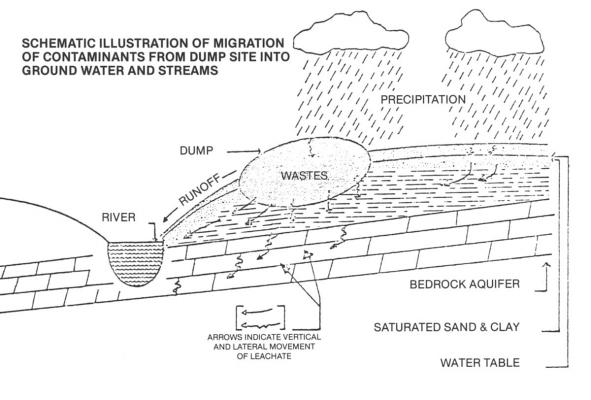
A diagram of the Hyde Park dump above the Niagara River gorge in Niagara County, New York and the fractured rock that can deliver its poison to the river and Lake Ontario.
It is the Hyde Park dump – a graveyard for the deadliest strain of dioxin (used as an ingredient in the killer defoliant employed during the Vietnam War, and 80,000 tonnes of other industrial poisons produced by the Hooker Chemical Company (later Occidental Chemical) in Niagara Falls, New York – and the chemicals still remain buried there.
This dump full of chemical poisons – four times the volume that destroyed a neighbourhood called Love Canal in Niagara Falls, New York during the 1970s – is still siting on the brink of the Niagara River gorge, thanks to a U.S. court decision that opted for “containing” rather than removing and destroying them. The court decision made things a lot cheaper for Occidental and its petroleum company parent, but called for building barrier walls, wells and other containment structures around this massive dump that, according to U.S. environmental officials at the time, only had an effective lifespan of 30 to 40 years before they had to be replaced. And that was 30 years ago!
To put it bluntly, the chemicals in this dump have already proven capable of turning the quality of water and the ecology for fish and other life forms in Lake Ontario upside down and could do so again if the containment structures break down and these poisons begin to ooze their way to the Niagara River again.
And now the U.S. Environmental Protection Agency – usually a pretty damn good government body compared to so many others around the world on environmental matters – has decided to remove Hyde Park from its list of priority ‘Superfund’ sites, apparently because the short-lived containment structures Occidental was ordered to build around this site have fortunately held back the poisons over the past 30 years like sticking a thumb in a leaking dam.
This is a shocking decision – one that would have the U.S. government loosen its regulatory grip on a dump that, according to many chemical experts, contain substances capable of remaining as dangerous as radioactive wastes for hundreds of years before breaking down.
This September 18, the Toronto,Ontario-based Canadian Environmental Law Association and the Buffalo, New York-based Great Lakes United (a coalition of public interest organizatinos through the Great Lakes basin) issued a media release opposing the U.S. government decision and pressing for it to be turned around.
Niagara At Large is posting this media release below.
Date: September 18, 2012
BI-NATIONAL GREAT LAKES CITIZEN COALITION CALLS ON US AGENCY NOT TO REMOVE NIAGARA-AREA HAZARDOUS WASTE SITE FROM SUPERFUND PRIORITY LIST
Toronto – A Canadian-United States coalition of environmental groups has called on the Environmental Protection Agency of the United States (EPA) not to remove from the agency’s list of priority Superfund sites, a 60-year old hazardous waste dump that has been a source of contamination to the Niagara River and Lake Ontario.
Great Lakes United (GLU), a bi-national coalition of approximately 100 Great Lakes-based environmental organizations, was responding to an EPA notice issued late last month, in which the agency announced its intention to delete the Hyde Park landfill, in Niagara, New York from the Superfund National Priority List (NPL) of the most seriously contaminated sites in the United States.
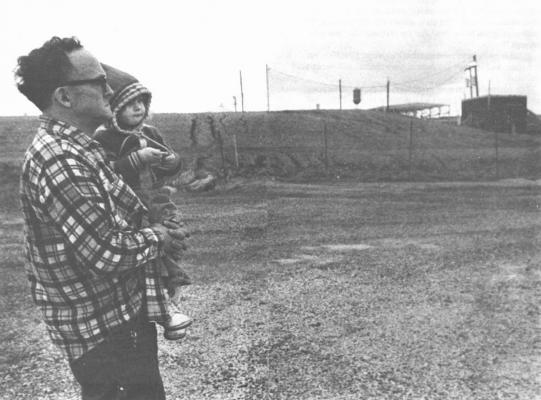
An old file photo of Fred Armagost and a grand-daughter with the Hyde Park dump looming in the background. Armagost gave this reporter, Doug Draper, a tour of the poisoned lands around the Hyde Park site in 1980 and shortly before his family was forced to abandon their home. In this photo, Armagost is overlooking a creek, called Bloody Run, that washed dioxin and other toxins from the dump down the face of the gorge to the Niagara River and Lake Ontario. If and when the cleanup structures built around this dump break down, could these poisons beging flushing their way to our shared American-Canadian waters again?
Hyde Park received approximately 80,000 tons (160,000 pounds) of hazardous waste between 1953 and 1975, including chemicals such as PCBs, pesticides, Mirex (a flame retardant), and trichlorophenol (TCP), a breakdown product of which is dioxin, one of the deadliest substances known. Hyde Park was the site that Hooker Chemical (now known as Occidental Chemical Corporation) commenced dumping in when another of the company’s sites, the Love Canal, was sold. Hyde Park was added to the NPL by EPA in 1983 and has been the subject of remedial action over the last few decades.
“The wastes are still there, they are still hazardous and, because of the remedial method chosen by EPA (hydraulic containment of contaminated water), they will require robust environmental management essentially forever”, said John Jackson, Great Lakes United Interim Executive Director. “Keeping Hyde Park on the NPL reminds everyone of the continuing vigilance that is necessary at this site in order to protect human health and the environment on both sides of the border”, Mr. Jackson added.
“EPA says that water contamination at Hyde Park is now being contained, but GLU questions whether delisting Hyde Park from the Superfund NPL is prudent”, said Joseph F. Castrilli, a CELA lawyer representing Great Lakes United. “Delisting Hyde Park from the NPL serves no one’s interests and may hamper future EPA remedial efforts at the site”, Mr. Castrilli stated.
– 30 –
Background Information:
CELA Letter on Behalf of GLU to EPA dated September 18, 2012:
< http://www.cela.ca/publications/letter-us-epa >
(Niagara At Large invites you to share your views on this post below. Remember that we only post comments from individuals who also share their first and last names.)
 Niagara At Large
Doug, it’s great to see that you’re still dogging this issue. The CELA/Great Lakes United report shows that toxics are still with us, in spite of a media that has forgotten the importance of the environment to our future.
LikeLike