
A Brief Comment by Doug Draper and George Carlin
The interesting commentary that Gary Screaton Page shared with Niagara At Large on Lynden Dorval, the teacher from Alberta who has been suspended by his school board, for daring to give students who turn in no work a “zero,” made me think of a few thoughts American satirist George Carlin left shortly before his untimely death in 2008.
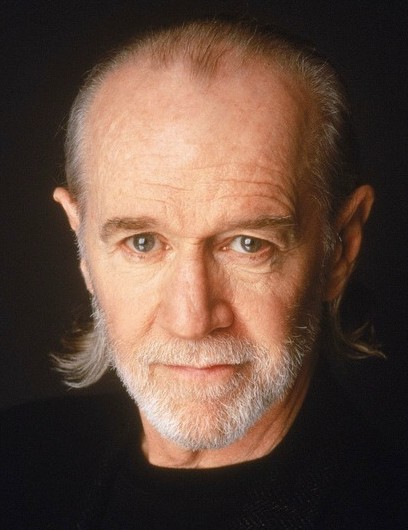
The late American satirist George Carlin
This movement, driven on by quacks and charlatans like Dr. Wayne Dyer (a popular motivational speaker for aging YUPPIEs on PBS), also wants to believe that ‘every child is special’, even if they are just an ordinary kid who would like to go out and the backyard and play with a stick. All children are “exceptional.” And even, as Carlin pointed out, if they aren’t doing all that well at learning in school, they are aren’t called “slow” or even “developmentally challenged” any more. They are called “minimally exceptional.”
It is against this tide of political correctness and supposedly “progressive” self-esteem doctrine that teacher Lynden Dorval had the audacity to assign a “zero” grade to a student that failed to turn in an assignment.
If George Carlin was still with us, he could have a field day with this insanity. I can imagine saying something along the lines of what he said on an HBO show four years ago, which NAL is sharing with you below. We also invited you to share your comments on this issue and if you haven’t had a chance to read it yet, please check out Gary Screaton Page’s post on this which you can find two posts below this one on Niagara At Large at www.niagaraatlarge.com .
Now here is a bit of George Carlin’s wit, slightly cleaned up, on the subject.
“In today’s America, no child ever loses. There are no losers anymore. Everyone’s a winner. No matter what the game or sport or competition, everybody wins. Everybody wins, everybody gets a trophy, no one is a loser. No child these days ever gets to hear those all-important, character building words: “You lost, Bobby!”
“They miss out on that. You know what they tell a kid who lost these days? “You were the last winner.” A lot of these kids never get to hear the truth about themselves until they’re in their twenties. When their boss calls them in and says “Bobby, clean the shit out of your desk and get the f— out of here, you’re a loser.” – George Carlin, from his last HBO show ‘It’s Bad for Ya’, performed shortly before his death.


George said it like it is. Not all kids are the sharpest tools in the shed. So what? The secret is doing the best you can with what you’re given. … Encourage children, yes, but be realistic and let them learn from their failures. When they go out into the world from beneath their helicopter parents there will be a very rude awakening.
I’m no Einstein, Hawking or Sagan but I’ve always worked hard to achieve whatever I could and I’ve failed at a lot of things too. The point is to try, to enjoy and be proud of what you do accomplish. I guess that makes me minimally exceptional too!
LikeLike
Doug, as you often are, right on! George Carlin’s remarks, while edgy, are nonetheless on the mark.
Teachers who have read my many contributions to the Educational Courier when it was still around will know I am a great believer in what even very young students can do. I’m also a strong supporter of building a child’s self-esteem. Doing so does not mean giving kids a free ride, however. Rather, at least in part, building self-esteem in children consists in teaching them that one must earn one’s way to feel self-worth. Of course we all sometimes need a hand up: a helping hand that teaches us how to do for ourselves rather than doing for us.
There are only four reasons children do not learn. Some truly cannot (e.g., cannot run a marathon because one has no working legs). So, we don’t ask them. But even without working legs some have “trekked” around the world! Consider Rick Hansen and Terry Fox. Some think they cannot. We need to help them discover they can, can do in part, and help them discover what they can do best. Consider Helen Keller.
Some others don’t know how, so we teach them.
Those that are most challenging are those that have given up. One way to teach a child to give up early is to do for them what they have the potential to do for themselves; or give them credit for doing it poorly, or, even worse, not at all. Being rewarded for mediocrity, never made anyone feel good about themselves. For an example of what people can do in the face of great odds, just check out Sean Stephenson on the internet (http://www.apbspeakers.com/speaker/sean-stephenson). He is a man of courage and a model of what is possible even in the face of great odds.
I for one am very appreciative of the teachers who failed me in grade ten, after being slid through in grade nine. They made me take seven years to finish high school because I wouldn’t work at it. I now have an earned Ph.D. and am about to receive an Honorary Ph.D. I have written several books and won a $10,000 scholarship. I offer this not to boast–although I’m sure some will argue that matter. Rather, I want to thank those teachers who would not let me get away with mediocrity. Without them I’d still be unable to read and write.
I still say, “Three cheers for teachers like Lynden Dorval!”
LikeLike
I love listening to George Carlin, Bill Hicks and Lewis Black.
I love listening to Wayne Dyer.
LikeLike
In a paper entitled “An Alternative Philosophy of Education” which I wrote for The Educational Courier some years ago, I reiterated a lesson I learned years earlier from a source I now no longer recall. From the start, we are all motivated to learn at least something. Perhaps, to start with, it is only motivation to learn to get food or attention. We also learn early that not all we do leads to success. Failures are a fact of life. In fact, some of the most successful people (e.g. Thomas Edison, Abraham Lincoln, Babe Ruth) failed many times before they had successes that made all the difference. Nevertheless, they persevered.
I have learned that children fail to learn for only four reasons:
First, they can’t. I mean really can’t. So we don’t ask them to. Instead we give them something else to learn. Even so be careful, people without legs have been known to outrun those that had them all along. Second, they think can’t. Then, help them learn that they can if they do so in smaller steps perhaps. Third, they don’t know how. Here’s the no brainer! Teach them, or help them discover how.
Fourth, learning how is no longer worth it. Give a child a pass for doing nothing, that child learns nothing except how to coast and to expect others will do for them. Give a child little hope, or little experience of some success, you will “cripple” that child emotionally and intellectually. However, let him try and if it so happens, fail, then let him try again, and again, encouraging him as he does, he will get past this worst of all reasons for not learning: giving up because it is not worth it.
Too often we waste enormous amounts of time teaching kids things they will never need or use. Our questions are not as important as their own. However, give a child the opportunity to learn the answer or solution to his own big questions and that child will learn as much as it takes to find the answer.
I once mentioned to a teacher of mind that to me Africa and South American were once attached. That grade 5 teacher suggested I was dull thinking that continents moved. How much more interesting and exciting her classes might have been if she had simply asked me, “How could we find out?” Note the “we” by the way. Imagine the amount of learning that could have followed on that response!
Schools are still often the last places significant learning takes place. Cheer mightily for the teachers that make classrooms exciting and challenging. Fortunately, in our Region we have many of them. I can assure you, they don’t do it by giving a pass when a failure is warranted. Failure is a fact of life; it is not the end of life!!
LikeLike