
A Brief Comment by Doug Draper
During my many years as an environment reporter, I have had the opportunity to interview David Suzuki and cover his addresses on a number of occasions. I was also part of a small group who joined him for dinner once at a conference of environmental journalists in Michigan and I have one of his books with note he wrote in it, thanking me for my efforts in raising public awareness about issues in the Great Lakes.
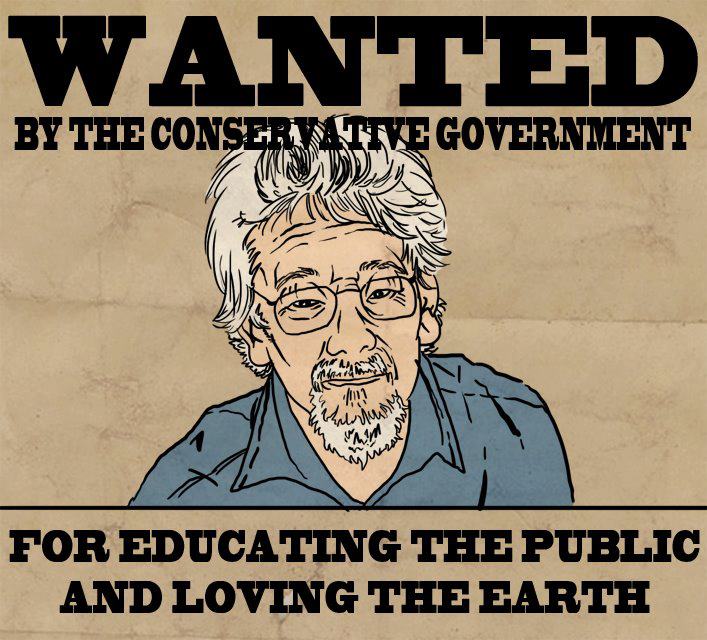
This poster, created by unknown others and now circulating across Canada and the world on Facebook, just about says it all about how environmentalists are regarded in ‘Harperland’. Most unfortunately, it is a sign of our times.
That is not to say I always agree with David Suzuki or appreciatethe way he, who has never suffered those who challenged him lightly, dress down some of his detractors. Yet he has more often been gracious with others and in my view, there is no doubting his deep and abiding belief that we, as a human species, have to do a better job of balancing our exploits with earth-friendly stewardship.
What most Canadians and our fellow travelers on this planet should be disturbed by is how much the country’s current Harper regime and its core supporters have worked to vilify environmental leaders like David Suzuki, as depicted in the poster depicted here and now making the rounds on Facebook.
David Suzuki, a native Canadian whose earliest memories include seeing he and his family, and tens-of thousands of other Canadians of Japanese ancestry being rounded up and locked in internment camps during the Second World War, is the target of a Harper government that loathes anyone or anything that stands for environmental protection, and is doing its best to put him away in virtual internment camp by marginalizing him with brands like ‘fear-mongerer’, ‘extremist’ and ‘self-serving opportunist’.
I am betting that there is still enough intelligence and decency in the DNA of this nation that history will be a better judge of who, from these dark times for environmentalism in Canada, most fits those labels.
(Niagara At Large invites our readers who care to share their names to share their views on this post.)
 Niagara At Large
Only a fascist-leaning government would operate as ours does: (legislation that is not evidence-based (omnibus “budget” bill, environmental legislation, crime bill) using police (G-20 abuses) and CRA (targetting environmental oranizations) as “arms of the government”, suppressing liberties, silencing information streams, attacking core Canadian values, and on and on.
LikeLike
Well over the top, Mark. I’m amazed that Doug didn’t censor you.
That’s like saying, “Only a Stalinist-leaning person would call a government fascist-leaning.”
I’ve had doubts about some of the methods and goals of Every government since I started voting at age 21, but I’ve Never called them names, no matter how much I disagreed with them.
LikeLike
While I don’t agree with Suzuki and his methods, I do not doubt his sincerity. And while I don’t agree with Harper and his methods, I do doubt his sincerity!
Suzuki isn’t beyond bending facts to suit his hypothesis. Harper will do more than bend facts – he will distort them completely to back his political beliefs and lack of social conscience.
LikeLike
Same comment to you Will, as to Mark.
I’ve disagreed with Some of the policies of Every government since I started voting at age 21, but I’ve Never doubted their sincerity nor accused them of having no social conscience, no matter how much I disagreed with them.
Here’s another opinion about Harper, researched and presented with respect:
PAUL WELLS on THE HARPER DECADE:
Q & A with Paul Wells about “The Harper Decade”, an e-book released by Maclean’s
by macleans.ca on Tuesday, March 20, 2012 1:54pm – 55 Comments
http://www2.macleans.ca/2012/03/20/paul-wells-on-the-harper-decade/stephen-harper-37/
On this day ten years ago, Stephen Harper was elected to head the Canadian Alliance. In the decade since, he has methodically made his way to the forefront of Canadian politics, uniting the Conservative Party of Canada, becoming Prime Minister, and winning a majority government in the last election.
On the anniversary of what it’s now clear was a portentous day in Canadian history, Maclean’s is releasing a special e-book: The Harper Decade, in PDF and Kindle format and The Maclean’s iPad app by the magazine’s Political Editor, Paul Wells. We asked Wells to share his insight about Prime Minister Harper and this crucial period in the Canadian political scene.
Q: Why “The Harper Decade?” What does that mean? When did it begin?
A: Tuesday, March 20 is the 10th anniversary of Stephen Harper’s election as leader of the Canadian Alliance in 2002. Of course he’d been in politics before, but starting in 2002 we get the beginning of a sustained effort by Harper to dominate Canadian politics. So far it’s worked. This e-book is an attempt to take stock of the man, his political style and policies, and his effect on the country.
Q: What makes this Prime Minister unique? Has there been another PM like him?
A: Every successful prime minister is different from the others. What’s most striking about Harper is the long ascent. With his predecessors, especially the Progressive Conservatives — Mulroney and Diefenbaker — the first flush of overwhelming popularity was never matched afterward. With Harper it’s been a crescendo: every time he goes back to the voters, he wins a slightly larger share of the vote. There was never any such thing as Harpermania. Instead, so far, there has been Harper solidity.
Q: How does Stephen Harper measure up to Canada’s great Prime Ministers?
A: Stephen Harper can’t yet compare to, say, Macdonald, Laurier or Trudeau for the impact he’s had on the country. He hasn’t even matched the grand failures (Meech) and bold successes (GST) of Brian Mulroney.
[LW> He omitted Free trade with the USA]
The times are different and he was defending a weak hand. But he has survived until now – he can hope to compete with the really significant prime ministers. He’s conscious of the comparison, too: before Christmas he gave an interview to CTV where he sought to minimize the accomplishments of previous majority PMs, because now he’s competing in their league. I believe he is already a significant prime minister, for the way he’s changed federalism, foreign policy and the behaviour of the electorate. And at least three years still lie ahead.
Q: Who is Stephen Harper, the man? Do we even know him at all, on the basis of his public persona?
A: Face to face, with people like me whom he knows but not well, he is unfailingly pleasant to chat with, engaged, curious about everything the other person brings to a conversation. I’ve heard stories about personal generosity that would surprise his detractors and maybe even some fans. But the private Harper is pretty close to the public Harper: focussed on results, unsentimental, willing to abandon an associate at the moment they cease to be an asset. Alone.
Q: When did Stephen Harper become a game-changing Canadian politician?
A: I think the coalition crisis after the 2008 election was the most important week in Canadian politics since the 1995 [LW> 1992?] Quebec referendum. On both sides you had people who would do everything for power, although neither side would admit to such a stark framing of things because they all told themselves they had the higher interests of the nation at heart. It was a brutal collision of competing camps. And Harper, who started from a position of weakness, won big. When public support was everything, more Canadians backed him than the other guys. He has pushed the advantage he won that week ever since.
Q: Will the Harper Decade become a Harper Era?
A: Beats me. In June of 2005 — seven months before the Conservatives defeated the Liberals — William Johnson published a book called “Stephen Harper and the Future of Canada.” I remember people making fun of the title, because what could Harper ever be the future of? Politics is full of surprise. I’ve tried to ensure my writing reflects that. But here’s one thing I like to remind people: On the day of the next federal election, assuming the government follows the fixed election-date law, Harper will still be three years younger than Jean Chrétien was when Chrétien won the first of his three majorities.
Q: What kind of insight do you think Canadians really need to hear about Stephen Harper?
A: How eerily patient he is. Just about everything he has accomplished was a long shot when he set out to do it. He didn’t let that stop him. A lot gets written about the ideological tension between Harper and the press gallery, and there’s something to that. But to me the real mismatch is one of tempo: we’re all on Twitter and we forget Monday by the time Thursday rolls around, and we’re trying to cover this guy who just keeps plugging away, long after attention spans have been exhausted, if he thinks the result will be worth it.
Q: Why an e-book?
A: At Maclean’s everyone tries to think past the day we’re writing, past the week we’ll be on the newsstands, to say something that will last about the subjects we cover. So it’s just handy, after a while, to gather up all of our writing on a given subject and present it in a way that encourages further reflection. Technology makes that easier than it used to be, and I hope e-books in various formats will become a regular part of the work we do.
LikeLike
To Lorne White:
I grew up under a Social Credit government in British Columbia many years ago. What we are seeing today from Ottawa is the same sort of thing – business and its wants take priority over anything else.
You can be an apologist for Harper all you want.
The fact of the matter is that he cares more for what the money people want than for what individual Canadians want and need.
LikeLike
I agree with Will and Mark. Furthermore, I have doubts about the honesty of our recent election results. Additionally, with a less than 50% share of the popular vote, a “sincere” government would not limit debate on major issues as Harper has done, and they would be open to discussion on important issues rather than ramming things through Parliament in a secretive manner. His MPs may as well wear muzzles and questions from the press are limited or ignored by Harper. A “sincere” government would not condemn those with interests, environmental or otherwise, in contradiction with their own. Government is about cooperation, not autocratic rule.
When fiascos such as the fighter jet farce, abuses of power by Ministers such as MacKay (outright lies re the jets, personal use of military planes), the XL pipeline and proroguing of Parliament to maintain power occur, their sincerity must be just a wee bit questionable. Members of his party can commit acts that should require investigation but, as long as they are in keeping with the party line, things get swept under the rug. Not like this is exclusive to Harper, but he has perfected it. For that I must give him credit.
Harper is a wanna-be Republican clone with NO concern or respect for the public he is SUPPOSED to represent and is strictly in the “honourable?” profession of politics in order to enrich the business sector and relegate the common people, environment, social programmes and Canadian values to the dust bin.
LikeLike