
By Doug Draper
Ontario’s government needs to be doing more to reduce greenhouse gases and prepare residents and businesses in the province for the impacts of climate change, says Ontario Environmental Commissioner Gord Miller.

Environmental Commissioner of Ontario Gord Miller
“Climate change is one of the defining issues of our age and it is already having an impact on our lives,” said Miller this March 7 as he released a report at Queen’s Park called ‘Climate Ready, Ontario’s Adaption Strategy and Action Plan, 2011-2014.
The report, which shares none of the doubts a legion of deniers out there do that climate change is a real thing that is being driven significantly by human activies, stresses that climate change is already producing a higher frequency of extreme and damaging weather, from high winds and ice storms to flooding rains followed by pro-longed periods of drought, that is translating into hundreds of millions of dollars of damage and insurance losses. Just one flooding rainstorm in Hamilton – lasting only two hours in July of 2009 – caused between $200 and $300 million in destruction to homes and other property.
In Niagara, said Miller in an interview with CBC following the report’s release, increasing temperatures could disturb the colder weather conditions necessary to sustain a lucrative ice-wind industry. A possible lowering of water levels in the Welland Canal and other parts of the Great Lakes could cost the shipping industry large sums of money as ships are not able to take on as much cargo without running the risk of scrapping bottom.
Climate change also threatens thousands of tourism and recreation jobs, and hundreds of millions of dollars in revenue from the tourist industry in Niagara and other regions of the province.
Miller, who was scientist with the Ontario Ministry of Environment before being appointed environment commissioner 12 years ago, notes in the report (which interestingly enough was released on an afternoon of near record high temperatures for this time of year) that “while the climate has naturally fluctuated throughout Earth’s history, the current rate and magnitude of change is unprecedented.”
“For the past 150 years,” Miller continues, “trillions of tonnes of carbon dioxide and other greenhouse gases (GHGs) have been released into the atmosphere largely as a result of the burning of fossil fuels and other human activities.We are now experiencing the effects of this rapid release of carbon and will need to contend with these impacts well into the future. Higher temperatures, along with an increase in the frequency and severity of intense weather events such as ice storms, heavy rains, heat waves, droughts and wind storms, are all projected for Ontario Research co-ordinated by the Applied Research and Development Branch of the Ministry of Natural Resources (MNR) is providing a much clearer sense of how climate change is affecting Ontario now and how these impacts will intensify over the next 30 years and beyond.”
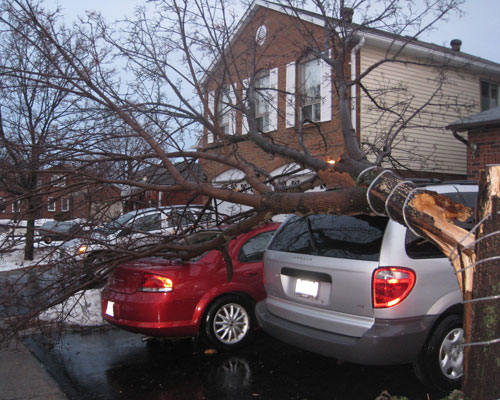
Damage caused by one of the more frequent number of severe wind storms that have swept across Ontario in recent times.
“As temperatures increase across the province, warmer climate conditions will expand northward.2 Not all the indigenous plants and animals traditionally suited for cooler conditions may be capable of adapting to such change. While some species may thrive, others will not, and certain rare or endangered species may be lost altogether. The ecological repercussions and impacts on Ontario’s biodiversity are expected to be significant and permanent.”
On the adaption side, Miller concludes that the provincial government is making some progress.
“The government is facing challenges in developing plans to further reduce the emission of greenhouse gases,” he says, “but is doing a lot better with its strategy to adapt to climate change. We need actions to both reduce emissions and adapt to the changes – they are complementary.”
The Commissioner’s report says the government must improve its strategic plan by prioritizing the actions that are needed, setting specific targets and timelines, identifying dedicated funding, and outlining the responsibilities of key government ministries.
“For example, despite the importance of our energy distribution and transmission system,” says Miller, “the Climate Ready Plan released in 2011 does not identify any actions to be taken by the Ministry of Energy. This concerns me because scientists are predicting an increase in devastating ice storms, like the one that toppled power lines and transmission towers and caused blackouts in 1998. And the long-term decline in Great Lakes water levels could reduce electricity generation capacity by more than 1,100 megawatts.”
Miller adds that the province must take the lead in helping local communities and municipalities adapt to climate change. “I was pleased that Ontario funded a Community Adaptation Initiative and, with the federal government, a Regional Adaptation Collaborative. Unfortunately money for both programs runs out this month.”
“I understand the Ontario government faces fiscal challenges right now,” says the Environmental Commissioner. “But the costs of adjusting to climate change in the future will only continue to increase if we don’t take action now. The government itself has indicated that the cost of extreme weather events could rise to $5.66 billion per year by mid-century.”
The report also discusses strategies for addressing climate change including carbon taxes, additional measures to promote water conservation, urban planning that reduces dependence on cars and changes to building codes that ensure buildings are more energy efficent.
You can read the whole report by clicking on http://www.eco.on.ca/uploads/Reports-special/2012-Adaptation/Ready-for-Change-bookmarked.pdf .
Watch Ontario’s Environment Commissioner discuss the report by clicking on http://www.youtube.com/watch?v=lWdqwj8HR8A&feature=player_embedded .
(Niagara At Large invites you to share your views on this post in the comment boxes below. Please remember that NAL does not post anonymous comments or comments by people using pseudonyms. Only comments attached to real names are posted on this site.)
 Niagara At Large
One change that would help with preparing for climate change and adapting for it , would be to revue The Ontario Drainage Act. This 120 year old Act dredges existing,living creeks and turns them into drainage ditches . Not only do we lose their buffering and filtering effect but now because these former creeks are now ditches we have to use heavy equipment to maintain them! This Act should be rewritten to revere our creeks and not destroy them.
LikeLike
I’ve read Gordon Miller’s assessment and am concerned he avoids putting a price tag on mitigating the impacts of climate change. While recognizing that man has and is impacting climate to a degree (no pun intended), I remain skeptical of the catastrophic projections outlined in this report.
Source material for footnote (1.) Climate Change Projections for Ontario (CCRR) 2007. When viewing that report for climate projection for Southern Ontario 1970-2040 it shows a possible increase of 1-2 deg. C.. That is footnoted with the following:
“This map is intended for the purposes of illustration and discussion only. It shows one of a range of possible future
projections of Ontario’s climate. Predictions of future climate may vary from those shown here due to uncertainty in the rate of global release of greenhouse gases due to human activity, unknown or inaccurately quantified feedback responses releasing/absorbing greenhouse gases from land and water ecosystems, and shortcomings associated with climate modelling. Do not rely on this map for legal administrative purposes. This map may contain cartographic errors or omissions”.
With that sweeping disclaimer, I submit we have much more work to do to ascertain levels of climate change to separate full blown alarmism to a more realistic approach based on actual observation.
A recent paper by Professor Gordon Hughes from the University of Edinburgh analyses the cost of wind energy in the UK. Ontario has adapted many of the UK’s policies in Ontario’s Green Energy Act. I think it is worth a read (see link to story and report) http://www.energychoices.co.uk/news/wind-power-more-expensive-than-burning-fossil-fuels-says-report-080312.html
There is much work to be done.
LikeLike
Is Mr. Levick right? Should we wait for more data before doing something about climate change? Are people like Environmental Commissioner Gord Miller an extremist or scaremonger.
I would like to hear from more of you out there. There must be a few people who feel we should err on the side of caution and take action. – NAL publisher Doug Draper.
LikeLike
I think we need to have the conversation by separating the science from the ideology.
LikeLike
Any government that ignores or minimizes the impact of climate change has its head up its ***. Our federal government meets those criterion.
LikeLike