
By Mark Taliano
“The price of oil and quality of freedom invariably travel in opposite directions.As the price of crude oil climbs higher in an oil-dominated country, poor or rich, secular or Muslim, the country’s citizens will, over time, experience less free speech, declining freedom of the press, and a steady erosion of the rule of law. Neither Texans nor Canadians are exempt… It is the ‘axiom of our age’.”
– The ‘First Law of Petropolitics’ as outlined by New York Times columnist Thomas Freidman.
In his book ‘ Tar Sands: Dirty Oil and the Future’, Andrew Nikiforuk delineates the failings of Canada’s Tar Sands industry in the province of Alberta. What follows is an abridged synopsis of the book and its message. It is an important message to consider at a time when this country’s addiction to short term oil profits is compromising who we are as a nation.
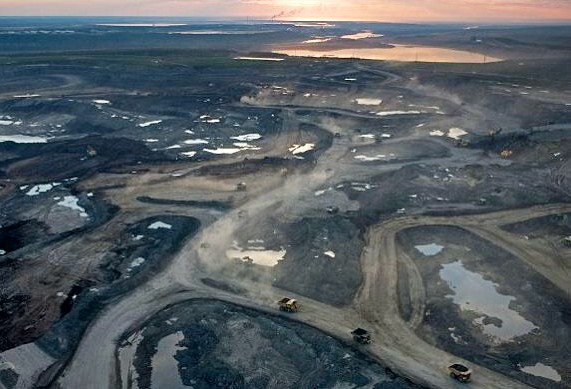
Canada's tar sands leave scorched earth where forests and clear waters once were
Canada’s headlong rush into the exploitation of the planet’s dirtiest oil is testament to the above axiom, in the same way that we are an icon of how not to exploit what could be a liberating resource.
Instead of transparently controlling and regulating this hydrocarbon as a base for a future low carbon economy, we are being controlled by its siren songs, much as a heroin addict is controlled by the illusory promises of his captor.
Just as the costs of a poorly regulated stock market are huge (witness the crash of 2008), so too are the costs of a poorly regulated petro carbon industry. In the case of the tar sands, however, the costs are much higher. Over time, fiscal economies can find their footing, but the multi-pronged assaults of the tar sands, and the ensuing corruption, won’t heal so easily, if ever.
The physical characteristics of the industry look something like this. First, the resource is not oil. It does not flow of its own accord. It much more approximates a thick, black sand. Transforming this “bitumen” to oil is extremely energy and resource intensive. If the sand is first strip mined, it must then be liquefied using steaming water. If the extraction is by the more difficult in situmethod, a mine must first be drilled, then steam pushed into the bottom, to melt the tar. Either way, it is energy intensive. Unlike the oil that is extracted fromIraq’s killing fields, each barrel of bitumen requires three barrels of water from the Athabaska river. 90% of this water ends up in the world’s largest impoundments of toxic wastes, otherwise known as the “tailings ponds”.

Anti-tar sands pipeline rally on Ottawa's Parliament Hill last September. Photo courtesy of Mark Taliano.
Alberta Environment prevaricates that the “ponds” (even though they’re the size of 150 Lake Louises) contain only stable dispersions of bitumen, clay, and water, “and so are safe”. Natural Resources Canada, however, offers this more comprehensive assessment: salt, phenols, benzene, cyanide, heavy metals (such as arsenic), and dozens of other cancer makers can be found in the “ponds”. Minnows last about 96 hours in the ponds, cute Buffle Head ducks drown by the thousands, and most “ponds” contain enough dissolved chloride and sulfate to exceed guidelines to protect aquatic life by three or four times. Ammonia exceeds the U.S Environmental Protection Agency’s standards for surface water by more than 60%, and Polycyclic Aromatic Hydrocarbons (PAH) and Naphthenic acids, some elements of which contain human carcinogens, leak into the Athabaska river by as much as eighteen gallons a second.
Communities downstream of the leaking “ponds”, such as Fort Chipewyan, have a 30% increase in their cancer rates. It’s unlikely that you’ll see visitors toFortChip. drinking anything other than bottled water. If the water was flowing the other way, towardsFort McMurray, it’s certain that the water quality testing would be taken more seriously.
Each day, the tar sands industry burns enough natural gas to heat six million homes. And each day, it contributes untold amounts of green house gases to the atmosphere. A barrel of bitumen produces three times as many green-house gases as a barrel of conventional oil.
Air monitoring, conducted by the Fort Air Partnership and Environment Canada is also third rate, with one expert, Donald Blake, explaining that the energy audits “reeked of cover-up and sleight of hand”.
The development regulations governing this industry are as corrupt as the health regulations. The Energy Resources Conservation Board, largely funded by industry, approves almost all development applications submitted by industry (over 95% in 2006). Typically, the board will assess a project’s environmental impact in these words: the project “is not likely to cause significant adverse environmental effects.” The reality is quite different.
When the tar is gone, and the energy companies have left (after a perfunctory “clean-up”), the real costs of “cleaning up” externalities will be left to the public (private profits, externalized losses), and even then it will be an impossible task. Water deficits, coupled with increased average temperatures, will preclude the restoration of many areas to the filtering marshlands that previously existed. That being said, estimates are that an adequate clean up would still cost about two decades worth of royalties.
Some wishfully argue that technological advances will fix everything. Unfortunately, they’re wrong. When energy companies find ways to decrease amounts of C02 produced per barrel of oil, they wipe out those savings by ramping up more oil production, thereby increasing the C02 produced. Economists refer to the phenomenon as the Khazzoom Brooks Postulate. It applies to cars and airplanes as well. Cars are more efficient, but we drive more cars. Airplanes burn 40% less fuel, but the industry has grown by 150%.
There’s even talk of building nuclear reactors to heat the tar, but reducing total energy consumption (and therefore limiting tar sands exploitation) is the only answer. Unfortunately, the governments ofAlbertaandCanadadon’t accept this reality. AndCanadais already the world’s eighth largest emitter of GHG’s.
The economics of the tar sands are also a mess. An average house inFort McMurraycosts about $600,000.00, wages are high, and taxes are low. But theAlbertagovernment is still running a deficit of about $8 billion (2009). Worse yet, the resultant high petro dollar is crippling manufacturing for the rest of the country. One reason given by the London ON Caterpillar plant for its shameful relocation to the U.S was the high Canadian dollar.
The tar sands give new meaning to the phrase “Open for Business”. A 2007 panel, measuring the government’s share of industry oil revenues collected through royalties, found that of ten governments selling oil,Albertaranked last. Venezuelawas first at 89%, whileAlbertacollected a mere 39% of industry oil revenues. To add insult to injury, the federal government is still subsidizing the tar sands. The tar sands are more like an unregulated third world “energy supermarket” than the “energy superpower” being touted by Prime Minister Harper.

Photo courtesy of Mark Taliano
One day, (hopefully sooner rather than later), extraction of tar sands will stop, and large swaths of the province may well look like a barren moonscape. It was with this in mind that in 1976, formerAlbertapremier Peter Lougheed set up the Heritage Fund, where 30% of non-renewable resource revenue would be dedicated. Unfortunately, subsequent governments stopped contributing to it, and Premier Klein used it as a poorly managed slush fund.
Norway was smarter. They took Lougheed’s idea, set it up with stricter rules, and mandated that 94% of oil revenues would go to the fund. Since 1990,Norway’s fund boasts a healthy balance of $330 billion. The balance ofAlberta’s Heritage Fund is a mere $14 billion.
What, then, is an alternate narrative that might transform this dismal situation into something approaching progressivity? Here are some ideas theCanadashould be considering, and debating (without closure) instead of plunging headlong into further high speed resource exploitation.
Cap production. It should not be dictated by a “laissez faire” market approach.
End fossil fuel subsidies, and divert those funds to alternate energy projects.
Implement a carbon tax, with a 100 percent dividend. (All proceeds to be returned to the public).
Re-establish a Sovereign Fund for petroleum revenues, and increase royalties.
Work towards energy sustainability by decreasing energy imports to Quebec and Atlantic Canada.
Re-localize food production, and buy locally.
Fund a national passenger railway system.
Orient rural and urban planning to low-carbon alternatives such as walkable communities.
Conserve. Introduce a regulatory plan to plugging “fugitive emissions”.
Be proactive. Don’t wait for the government to act. “Power down.”
Re-negotiate NAFTA . It is an impediment to sustainability , not only for Canada, but also for the U.S
Former Alberta Premier Peter Lougheed’s advice should be re-considered:
“Slow down; behave like a resource owner, as opposed to a free market anarchist; charge higher royalties; save for the future, and develop only one project at a time so that environmental liabilities can be addressed in a proactive manner.”
Additionally, we would do well to consider Bishop Bouchard’s (diocese of St.Paul, Alberta) advice:
He argued that the project should not be allowed to expand until the “integrity of the Athabaska watershed can be ‘safeguarded,’ the treaty rights of the aboriginal people have been honoured, and the country has developed a plan for alternate energy resources.”
Addendum:
In January, 2012, President Obama rejected a permit to allow the construction of the Keystone XL pipeline, which would transfer tar sands bitumen from northernAlbertato Gulf coast refineries.
More recently, U.S Republicans are trying again to force approval of Keystone XL through a pipeline provision in a Highway Bill.
Mark Taliano is a resident of Niagara, Ontario and regular contributor of news and commentary to Niagara At Large.
(Niagara At Large invites you to share your views on this post in the comment boxes below. Please remember that NAL does not post anonymous comments or comments by people using pseudonyms. Only comments attached to real names work here.)
 Niagara At Large
The George W.Bush administration waged a war on Iraq and the promise was a secure source of oil. Haliburton a company once headed by Dick Cheney stood to gain a lot of business on this deal, among other things they own a company that makes drill bits and oil derricks the huge cost in waging a war and all those no bid contracts will be a drag on the US economy for a whole generation, American soldiers and their families paid a price in blood and mutilated veterans, The whole situation is brutal and was an uneeded distraction in the so called “war on terror”.Osama Bin Laden hung out in Afghanistan and Pakistan not Iraq.Our children will pay the price, if the Tar Sands pollute and poison our country.We have to be pro-active not reactive on this chapter of Canada’s energy dillemna.
LikeLike
Mark I agree that it is a dismal situation regarding Tar Sands Oil . One thing Mr. Nikiforuk did not touch on was the fact that they are looking to extract methane gas from the upper watersheds of 3 rivers in the Northern B.C., one being the Skeena . These were some of the last PRISTENE ecosystems in all of Canada. To rape these sacred watersheds in Northern B.C. to provide power to extract crude from Alberta Tar Sands seems ludicrous, Destroy 3 ecosystems so you can provide the power to Destroy one . I do have my reservations about Nuclear , but they all evaporate when I think of the demise of these Rivers.
LikeLike
John,
Thanks for the comment and information. Angela Bischoff, of Ontario Clean Air Alliance has plenty of nuclear information that may be of interest to you.
Mark
LikeLike
Mark I read what she had to say ,nothing really new . But I must point out on the cost there were many many factors for the cost over runs. One of the main ones was Government Interferance starting and stopping these projects while bowing to usually uninformed Public opinion. The logistics of gearing a project of this size and complexity up or down are truly enormous. But that is what happened time and again. The second reason is the shear amont of regulation that must be conformed to by the Skilled Trades in building a Nuclear Plant . Needed no doubt, but in a lot of cases over kill can lead to mini empires that can lead to lost production without the added security. Mark I do believe that there many Megawatts to be rung out of Industry, in other words energy from pollution. Maybe we can talk about that in the future .
LikeLike
Sounds interesting.
LikeLike
Unethical Propoganda:
LikeLike
David Suzuki:
http://www.theglobeandmail.com/news/video/video-david-suzuki-says-the-oil-sands-are-riches-we-cant-afford/article2400334/?from=2401854
LikeLike
Great article but there is also another point in case to be looked at as well. With 90% of Alberta’s power coming from the burning of coal and Natural; gas, the massive power plants needed to run these facilities needed to extract and refine bitumen spew almost as much carbon and other toxins into the air as the refinement facilities themselves. Also it is also quite extensively more expensive to refine into a finished usable product. The use of catalysts in the coker towers are extremely expensive and are required to be changed out more often than conventional crude. These catalysts also produce their own environmental nightmares as once used they are very toxic with contaminants from the extraction and refinement processes and extremely reactive to oxygen (They burst into flames when mixed with oxygen from the environment). These catalysts are trucked to Medicine Hat to the only legally regulated disposal site in Alberta. Disposal of these catalysts is also done in a less than optimal environment as they are dumped into open pits and covered once the catalyst is processed.
LikeLike