
NAL transit struggling
A Commentary by Doug Draper
I know I’m not the only one who has seen Niagara Region transit buses running up and down the roads and highways between Welland, Niagara Falls and St. Catharines with hardly any passengers in them.
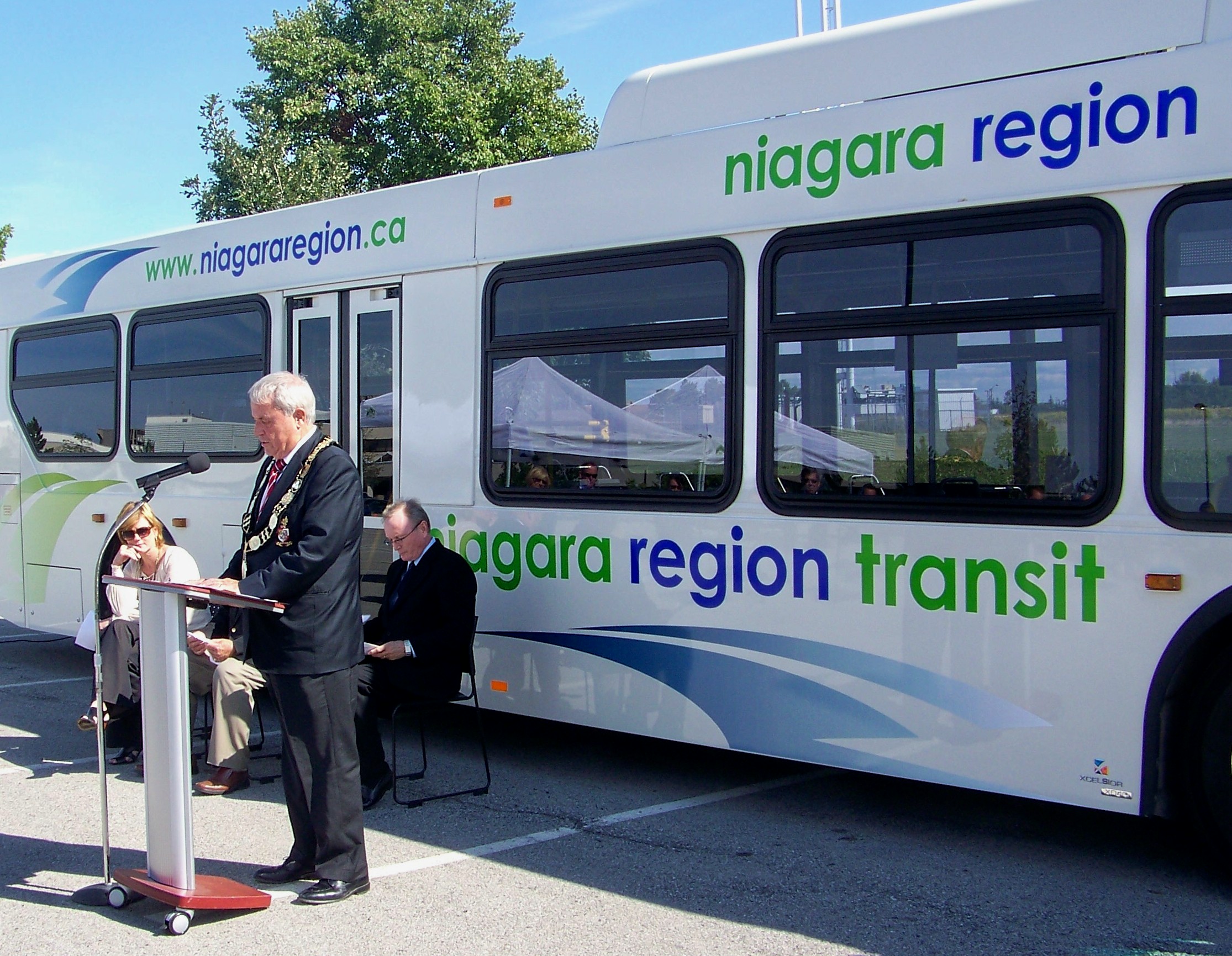
Niagara regional chairman Gary Burroughs speals at official launcing of Niagara Region Transit last September. Photo by Doug Draper
I’ve heard people making snide remarks about the near-empty buses with “Niagara Region Transit” stamped on the side of them for more than three months now. And as much as I have been a long-time advocate for a regional transit system, I don’t think I’ve ever seen more than a half a dozen passengers on one of these busses, even going in an out of a place as busy as the Pen Centre shopping mall during the height of the Christmas shopping season.
Usually the number of passengers I see on these buses is no more like two or three, and that is sad because it is already starting to make some of the people who never favoured this regional service in the first play say pull the plug on it.
The number of those wanting Niagara’s regional regional government to park the eight buses it paid $3.7 million for and leave transit services to the local municipalities probably won’t grow any smaller when word gets around about the ridership figures for the first four months since Niagara Region Transit was officially launched at the beginning of last September.
Those figures, tabled at a regional committee meeting this January 31, show a total ridership for those first four months of 17,667 – far short of the 63,000 the Region hoped for. No surprise then that the money coming in from fares during the same period totaled about half of $143,000 projected.
So what is the Region to do about a transit service that fell so short of projections in the first four months of a two year pilot run for the service? Should it pack the service in or roll on in the hope that ridership will improve in the months ahead? Is the Region doing enough marketing to let people know the service is around?
How about that $5 per one-way trip fair (including connections onto local buses) that is expected to go to $6 per one-way trip in March? Is the fare too high? Would more people use the service if the fare was reduced? Would discounted monthly passes help?
And how about the convenience of the service. Do the Region’s bus make enough stops frequently enough across the region to convince people to favour a bus over a car to get around?
Is it possible that Niagara residents are so married to their cars that a regional bus service would never attract enough riders to be economically viable?
What do you think?
Niagara At Large invites you to share your views and your ideas of what can be done to make a regional transit system work in Niagara in the comment boxes below. Please remember that we only post comments on this site by those willing to share their real first and last name with their views.
 Niagara At Large
Regarding Regional Transit it should be stressed that more time is needed to build up ridership. In this regards there has been nothing like this since 1959 when the Canadian National Railway got out of public transit in Niagara. Correcting the mistakes of 52 years cannot be done in a few months. I am sure all who have used the service are very grateful for it- try cycling from St. Catharines to Welland if you don’t believe me!
LikeLike
I would like to know where these regional councilors get their projections from. Maybe they should start designing this region for something OTHER than the automobile? Cars work well for some people, but they do not work for everybody. If I have to pay for highways, traffic lights, parking lots and other automobile infrastructure I will never use or benefit from, I then DEMAND that I have my own transportation to get to places I want to go. Regional councilors don’t understand that if you do not drive and there is no regional bus, the next city like Welland or Niagara Falls might as well be on the moon, as it is so expensive to get to. We have to stop being a GM town,. GM does not own this region. We need to serve everybody, not just part of the population.
LikeLike
This is a tough one!
I like many others don’t use public transportation because it does not take you to the bowels of your destination and if I want to visit someone in a subdivision in Niagara Falls that means a long walk to and from the nearest bus stop.
Besides I would not know which where to go to find a bus or which bus to take. Also changing plans on the way would be a big problem.
LikeLike
What is the schedule? Where are the pick up and drop off points? How many times a day does it go? I understand it`s supposed to be better than “the Hub”, where transit used to pick people up at the bus terminal then stop at Brock then continue on to Niagara College but only on a very very limited schedule and it took forever. The new bus schedule and routes of the new Regional Transit have not been advertized well at all which deters people from trying it for the first time. If people would just try it for the first time to see what its all about there would be greater chance of getting people to use it regularily. It`s a vital service, the region has to give the pilot project a fair chance of suceeding, but people also have to actually get out there and ride it!
Here`s a link for the schedule etc.: http://www.niagararegion.ca/transit/default.aspx
LikeLike
Susan, I used the “hub” once. It took me two hours from the nearest bus stop to my home to my destination and because of the scheduling, I would either be 1.5 hours early, or 20 minutes late. I never used it again, as I was EXHAUSTED after that one trip, I could not even stay awake. Never used it again. The same trip is 20 minutes by car.
LikeLike
I think that the biggest mistake the region made was by starting out with full size buses. They should have started with smaller, mini-buses. Had they done so, the optics wouldn’t be as bad as they are right now.
As ridership increased on any particular route, larger buses could then be brought in while the mini-buses might then be used to either open up new routes or provide some kind of feeder service into the main routes.
They also should have also played a role in overseeing the initiation of a share taxi (or jitney) network system in the first phase of establishing the regional transit. (See http://www.enotes.com/topic/Share_taxi ) This would encourage the establishment of a public/private partnership component to more flexible multi-modal system. Such a network could also provide a kind of feeder system into the larger municipal and regional transit systems. As it is, the region may well explore the feasibility of integrating share taxi systems into the next major phase of the transit system (if it survives the present controversy ):
LikeLike
A shared taxi system would not work for me, as I have to get to my destination by a particular time and I don’t want to have to wait until enough people fill the seats before we can go. Also, if I take a taxi, I prefer to be by myself and not share in close quarters random individuals that might be rowdy, loud and difficult to deal with.
We need to advertise the buses better. Give people free rides for a day. Give people coupons from different businesses if they ride the bus that day. Make it public. Make it worthwhile. Do it by attraction. I might have to go to the region to show them HOW to promote this service properly, as it is not being promoted in a very effective way at this time. I am wondering if the region has set this up to fail because they didn’t want it to begin with, that they want people to continue in their car-dominant ways until this place is so destroyed by pollution and literally, such a gap in wealth between those that drive and those that don’t, that it will be too late to do anything.
Also, if the region does decide to scrap this system, how will the people that currently use it get to their destinations? It is a LONG walk for me to get to Welland from St. Catharines. And $70 – $80 in cab fare for each trip is not financially viable and I know drivers don’t pay more than about $5 -$10 for the same trip.
The main problem is these transit systems, whether local or regional, are planned by people who drive and never use the bus. They also don’t have much of a clue as to what is a good number showing and what isn’t. I think council pulled a number out of the air that they expected would use the service, as part of their deliberate attempt to make it look like it is failing. The numbers ARE increasing every month and will continue to do so as more people become more confident of the service.
LikeLike
If anything regional transit needs to be increased and promoted far more. You need to put in place ‘alternatives’ so the choices are there for people not to drive.
Regional transit has also made mistakes. A few weeks ago the Standard had a piece on someone who uses the buses, but also rides a bike. The return bus didn’t have a bike rack so he was forced to leave it overnight.
There are some European rail routes that run near empty on a regular basis, but they would never get rid of them as cars are not the be all and end all in Europe. Of course for many in Europe, a car is consider “alternative” transport, not like us over here who view walking, cycling or transit as an alternative.
@John Bacher, although I believe a stretch of the canal trail is closed right now, I probably would never go to Welland without it, so I’m quite grateful for it!
I love taking the trail from St. Catharines to Welland. Pretty well 97% away from vehicles, with the exception of the odd crossing, it makes for an extremely safe and enjoyable ride!
I just wish the region somehow created a similar pathway from St. Catharines to Niagara Falls. It’s a nice ride out there, but the roads aren’t the best for cycling on. They’re either too busy (with **FAST** moving traffic) or you have quieter roads that are lined with potholes.
Also if you want to keep young people, pushing other methods of transport aside isn’t the best idea.
I know of a few people who left the region for larger urban areas (Toronto, Montreal & Hamilton) as they didn’t want to own a car nor rely on it to get around.
I’ve never had any real issues getting around the city (St. Catharines) on a bike. I actually find it super easy & fast, however getting from city to city is more difficult, or at least a bit more dangerous.
LikeLike
I have said so many times — including on this site — that demand for regional transit is too small to sustain it. Which of course means spendthrift bureaucrats and politicians will blow our money on it.
If sufficient demand existed, some enterprising individual would have bought decent used cars, and began transporting region residents from city to city. Or have set up a daily car rental scheme.
Since an inter-regional car rental scheme or private transportation system does not exist, then demand doesn’t exist.
Private enterprise is ALWAYS ahead of bloated, plodding governments, except when locked by legislation.
LikeLike
I enjoy cycling via the canal trail when there is lot’s of time- however, usally to save a half and hour or so, I go to Welland by bicycle via Merritville highway. Although this is faster, it is far less pleasant.
I had the good fortune of testing the regional bus service because of a consultation on Niagara being the culture capital of Canada that was held in the morning in Welland. It look me only a half an hour to get from the St. Catharines transit terminal to the downtown Welland terminal. When I had to use the Brock Hub in the past this journey was an hour and a half trip. The same as travelling on bus to Toronto!
LikeLike
There is already that service. It’s called taxis and it costs a fortune. I should not pay any more per kilometer of travel than drivers do and should have a way to get around the region without putting a second mortgage on my home. Chappelle, your assessment of “demand” is inaccurate. They thought there was no demand in Durham and it works very well now. They though there was no demand in Hamilton and look at it now. It starts slow and eventually builds. It takes sometimes a couple of years to bring it up to an ‘acceptable’ way. And wnhat expertise do YOU have with respect to transit planning, other than the fact you never use it?
LikeLike
Angela, I think you really hit the nail on the head with your first comment. Our cities are beautiful, with big wide streets and I would imagine 80% of people have their houses. We pay the price for this when you realize you can’t get anywhere without a car.
LikeLike
I’m involved with a group that has been “celebrating and supporting” the Regional Transit system by arranging group meetings on the bus. Much like Brock’s Conversation Cafes, we’ve been using the “official” monthly meetings to have themed community discussions. The last meeting I attended, in January, involved about ten people and a lively discussion on social innovation that continued at a local cafe after the two hour ride. If you’re interested in what we’re up to, check out the blog: http://meetingsonthebus.tumblr.com
The whole idea behind the initiative is to encourage people to use the bus – BUT it also serves as an invitation to our established community leaders to be more innovative in their support of Regional Transit. It is fairly obvious that the system is not serving as many people as it could. So the question is – where is the Region’s response? Aside from Bernie and Angela, who is talking about making changes or tweaking the system to make it more effective? Who is actually asking people what they need from the system? The opportunity to provide feedback via the Region’s website is nice, http://www.niagararegion.ca/transit/customerservice.aspx, but I wonder if it’s enough.
LikeLike
Great comments here. I suspect that every one of the politicians who oppose the regional bus system is privileged enough to own one or more (likely more than one) vehicle. What abut the needs of others who don’t have a vehicle? Who is listening to their voice? I have spoken to a number of passengers on the regional bus who were overjoyed that they could now travel between cities. Should those of us who own cars take this away from them?
We need more time for ridership to grow, and we’ve seen evidence that it is growing. In fact it has doubled in the last couple of months. The regional bus is also proving to be more profitable as a model than anticipated – Though ridership was only 28% of the forecast, the revenue it brought in was actually 50% of the forecast. That means if we double current ridership, we should be close to meeting the revenue forecast. Wait a minute, that sounds like a good thing, doesn’t it?
Of course, there are still challenges to the regional system, including limited advertising, and limited service. Anyone who thinks that a new public service should be profitable from the beginning clearly has public services confused with the private sector, and clearly doesn’t understand private sector startups either. The bus system works like the internet – the more pervasive it becomes, the more self-reinforcing it is. If the internet was fragmented like Niagara’s bus system, it wouldn’t work well either. We need to support the regional bus until it reaches its tipping point.
The main argument that we need to create an effective public transportation system in Niagara is that there isn’t a well-functioning economic region in the world that doesn’t have a robust public transformation system. So the important question isn’t whether or not to have this system, but how can we make it work.
LikeLike
Kudos to the comments from Jeff and Melissa. Regional councilors are by no means experts on what are good numbers for a fledgling regional transit system that has been barely on the road for a few months.
I am giving you an example of our community’s car bias. In St. Catharines, where I live, they recently opened a new multi-level parking garage. For the first month, anybody was allowed to park there for free. The downtown itself has dates and times of days, as well as holiday periods, where people can park on the street for free. I can’t remember the last time, apart from New Year’s Eve, where bus riders were allowed to ride for free. Or do councillors only care about those that drive?
LikeLike