
By John Bacher
A recent cartoon published in The St. Catharines Standard – a newspaper which is now part of the Conservative Party leaning Sun Media empire – portrayed soldiers standing on guard during the War of 1812. They were instructed by their commander to stand firm, since if the Americans succeeded in winning, Canada would be turned into a National Park.
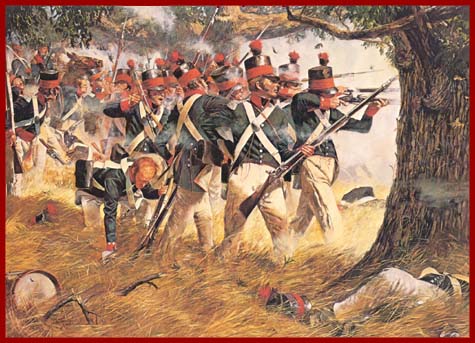
American troops stand firm during War of 1812 battle.
Following his encounter with the Native Americans of the plains, Catlin wrote the words which still resonate with Canadians who, in these dark times that try the soul, still dare to identify themselves as environmentalists. He urged that “some great protecting policy of government” serve to preserve its “pristine beauty and wildness (as) a magnificent park.” Such a “A Nation’s Park”, for Catlin would allow the world to see “for ages to come, the native Indians in classic attire, galloping his wild horse, with sinewy bow, and shield and lance, amid the fleeting herds of elk and buffaloes.”
Following Catlin’s 1832 vision, many years went by before diluted variants of his vision gained significant popular support. It was not until June 30, 1864 that American President Abraham Lincoln signed the law that protected the Yosemite Valley as a park. Here however, park protection was quite poor as the park was administered initially by the State of California.
The evolution of anything recognizable as a U.S. National Park system was a slow struggle. It was not until 1890 that effective protection was obtained from the domestic livestock whose grazing threatened to kill young trees in Yosemite, through legislation championed by pioneer American environmentalist John Muir. The federal law had the U.S. Army patrol the park as had previously been done in Yellowstone National Park, created in 1871.
What makes Sun Media’s sacrifice of historical truth to the gods of corporate profits so offensive is that much of the opposition to the American expansion in the War of 1812 came from efforts by native people to achieve a beautiful goal that approximated Catlin’s dream. While these natives did not use the term national park, what they were calling for sought the same purpose. This was continued control over widespread areas of land for the continuation of their way of life based on extensive herds of elk and buffalo.
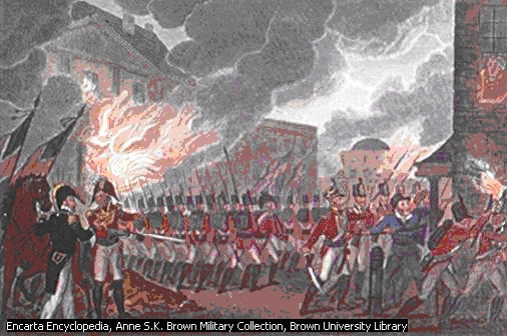
British troops torch Washington during War of 1812
While he did not use the term “national park”, the architect of native resistance to American invasion in the War of 1812 had a term of similar power for its time. This was the concept of “Indiana”, an Indian buffer state between the United States and Upper Canada. Indiana was the vision of the great native chief Tecumseh. He was acutely aware of the consequences of American expansionism on the environment, noting that it promoted deforestation and subsequent soil erosion which polluted water. Tecumseh sought the establishment of Indiana under native governance which would remove American expansionists from native lands in the states of Michigan, Illinois and Ohio.
By provoking the Americans to declare war on Great Britain in 1812, Tecumseh won what appeared to be a partial victory. Through war he sought to bring down the weight of a great power upon the United States to achieve the realization of Indiana. Although Tecumseh died in battle in 1813, the defeat of Napoleon in 1814 gave some hope to his cause. For the last six months of the war the issue of Indiana was the only point at which American and British diplomats could not agree upon. This resulted in some of the fiercest battles of the war, including the burning of Washington. D.C. by British troops.
Rather than showing Canadian red coats fighting against the threat of a National Park, a more accurate image would have been to illustrate how the fear of Indiana motivated American forces. This is what would have prompted the call for American troops to hold the line following the burning of Washington and during the British attack on Baltimore. The danger was well understood by Francis Scott Key. Following the celebration of the American victory in Baltimore, he composed America’s national anthem, “The Star Spangled Banner,” and went on to become the U.S. attorney that battled in court to expel the Cherokee Indians onto the Trail of Tears.
Although being branded as traitors by the Conservative spin doctors and cartoonists, Canadians who oppose the construction of the 731-mile-long Northern Gateway Pipeline are continuing the heroic tradition that motivated resistance to the American invasion in the War of 1812. Native nations such as the Gitga’at living along the coast of British Columbia hope to maintain a subsistence way of life based on the abundance of salmon, like the Sac and Fox of Illinois in 1812 attempted to save a way of life based on buffalo. Their vision of a B.C. coast protected from oil spills is as compelling as Catlin’s call for the perpetuation of another magnificent civilization.
The Standard’s cartoon also puts into disturbing context the Canadian government’s combined celebration of the War of 1812 and causing the Niagara Region to be recognized as part of these events, as our nation’s “Cultural Capital.” The making of our region as the Cultural Capital, like the Standard’s distorted cartoon, represent an effort to have Niagara become a testing ground for making the efforts those who want to protect the environment look like treason.
Over the next three years as the war of 1812 is celebrated, we can look forward to a number of distorted historical interpretations that equate environmentalism with American sponsored extremism and subversion. Conservative spin doctors must be spinning out a monumental torrent of propaganda in all the diverse forms of high culture – plays about conniving Canadian tree huggers in 1812 colluding with American invaders to establish national parks, poems celebrating resistance to the imposition of U.S, eco-radicals, paintings celebrating how our affluent way of life was rescued from American wiles, posters of cars rising above slain bison, and a new version of the 1812 overture, combining the symphony in a Oratorio with a chorus proclaiming our rescue from the demise of American national parks.
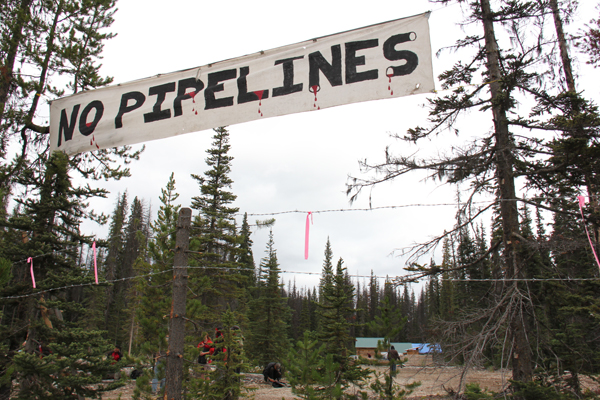
A banner protesting plans for Northern Gateway pipeline from Alberta tarsands through native lands. Photo from Council of Canadians website.
Perhaps St. Catharines and Brock Universities new performing arts center will open with a gala grand opera on our heroic rescue from being an American park due to the courage of the gallant red coats.
The prospect of federal arts funding in Niagara as a test pilot for a new thrust for Canadian culture is deeply disturbing. It however, is a sorry pattern of what Catlin deplored in 1832. He was dismayed over how powerful writers and artists would not give up such creature comforts as wine and cigars in cozy studies- to study the magnificence of the native way of life that was being assaulted by American armies. Today it seems that the Standard cartoonists are simply the vanguard of a similar attempt to use money to manipulate the cultural understanding of our times. Instead of artists struggling to save the beauty of the Pacific coast we will get a torrent of odes to oil.
John Bacher in a St. Catharines, Ontario residents and long-time conservationist and member of the Niagara-based Preservation of Agricultural Lands Society.
(We welcome you to share your views on this post. Please remember that we only post comments by people willing to share their real first and last names.)
 Niagara At Large
Many thanks to John Bacher for this article that inspires as much as it informs. We Canadians are a people shaped by geography, by the extraordinary land we live in. We must be stewards, not exploiters, if not for our own sake, then for our children and their children, down to the seventh generation. If that attitude is now considered radical, then we have to ask ourselves some serious questions about our values.
LikeLike
Despite the current government spin of referring to environmentalists as radicals, extremists, or secretly, even “enemies”, the First Nations peoples will continue to be our allies in the years to come as we defy corporate and environmental excesses.
Thanks, John, for the refreshing perspective. Quebecor media would likely not be receptive to it.
LikeLike
My wifes ancestor was taken hostage by Delaware indians in Ohio and held for ransom for 3 years,until she was freed, on payment of said ransom, the big trouble maker was a guy named William Harrison who was given the job of Governor of Ohio Territory he wanted to sell small lots of land for twenty to forty dollars a shot, he figured he could lure Europeans and Americans to settle on Indian lands, indian tribes were made to sell land, even though they traditionally never lived there, and the ones that had did not want to sell this is where Tecumseh and his brother the Prophet wanted to form an Indian Conferation to stop American expansion,the battle of Tippacanoe on the Wabash River set the fuse for the war of 1812.
LikeLike
I thank readers for their comment. The infamous American General Harrison was later elected President of the United States, largely because of his political exploitation of fighting Tecumseh. Another distortion that the spin doctors are making now about the War of 1812 that the main dispute was over British seizure of American ships. At the same time that war was declared Great Britain repealed this policy, but the US did not stop its declaration of war. The shipping interests of New England that were the most negatively impacted by this policy were not advocates of war. Support for the war in the United States came from people like Harrison who had vested interests in speculating on Indian lands.
LikeLike
John Bacher got it right!
LikeLike