
By Mark Taliano
The United Nations Climate Conference has been convening in Durban, South Africa, since November 28 and will continue until December 9, 2011. This, and Canada’s shameful response to environmental injustices, including human-caused global warming, prompted a rally and protest from the Toronto Occupy Movement this past Saturday, December 3 for a “Global Day Of Action for Climate Justice”), starting at Dundas Square and ending at St. James Park.
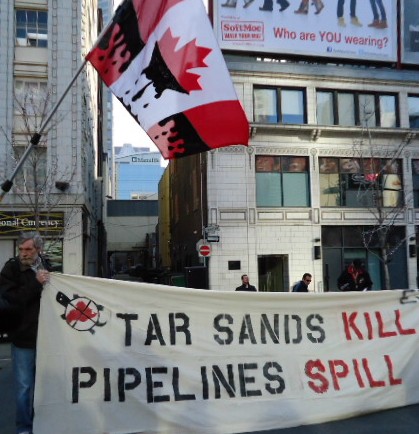
Anti-Tar Sands Rally. Photo courtesy of Mark Taliano
The rally started with a traditional Mohawk ceremony thanking Mother Earth for her abundance. Next, a speaker from Amnesty International described the tragedy of the Union Carbide/Dow industrial accident in Bhopal, India 27 years ago, and the tragic failures of the clean-up efforts.
A local teacher and spokesperson for the Good Jobs For All Coalition, discussed the as yet unrealized potential for solar panels in Toronto. Angela Bischoff, of the Ontario Clean Air Alliance, followed, and she too bemoaned Canada’s relatively weak alternative energy initiatives. She also observed that we’re still paying off a two billion dollar nuclear debt, while other countries (unlike Canada) are dismantling their programs and have committed to end-dates for the industry. Countries transitioning away from nuclear and pledging to end the nuclear power industry (with a set schedule) are Germany (by 2022), Belgium (by 2025), Italy, and Austria. Japan may well be next. Canada, on the other hand, is projecting to pay an additional $80 billion to refurbish and develop nuclear industries.
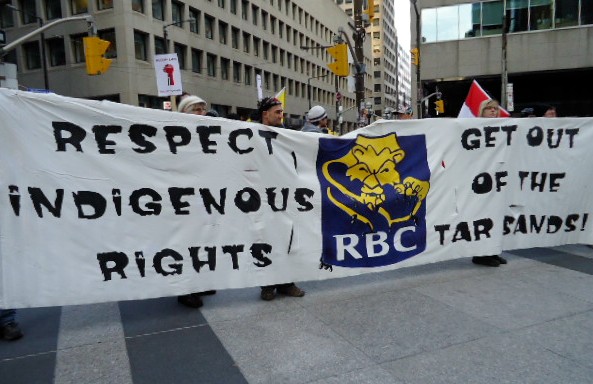
Photo courtesy of Mark Taliano
Mitigating global warming and its catastrophic effects is arguably of utmost importance, and here especially, Canada is fast becoming an international villain. The importance of this is better understood given these facts:
The Kyoto Protocol, a treaty signed and ratified by the Canadian parliament in 2002, stipulates that Canada will reduce green house gas (GHG)emissions by 6% relative to 1990 levels, by the year 2012. In 2008, Canada ranked fourth in the world for the highest GHG emissions per capita. Currently, Canada’s GHG emissions are at least 30% higher since Kyoto was signed, and, since the 1990’s, Canada’s carbon emissions have risen faster than any other G-8 nation. Canada has failed to honor the treaty.
The Alberta tar sands industry is a huge contributor to GHG emissions. Not only does its continued growth violate the Kyoto protocol, but it also violates Article 29, Section 2, of the U.N Declaration of the Rights of Native Peoples, as well as the Canadian Fisheries Act. The indigenous resistance is fortified by the immediacy of the crisis for them. In 2006, high rates of rare cancers were reported in the community of Fort Chipewyan. By 2008, Alberta health confirmed a 30% rise in the number of cancers between 1995 and 2006.
At the U.N Climate Change Summit, Canada is now lobbying other countries to reject the Kyoto Protocol with the shameful reasoning that China, for example, isn’t adhering to the treaty requirements either.
Celebrated Canadian journalist, and author Naomi Klein sarcastically observed: “Canada wants to sell more dirty oil to China (and yet) Canada wants a climate deal that will rein in China …. No contradiction there.”
Anti-apartheid hero Archbishop Desmond Tutu urges Canada to play a more constructive role in world affairs, as it did in the 80’s, when it imposed sanctions on the apartheid regime. Tutu and others signed a letter stating, ”For us in Africa, climate change is a life and death issue … pollution, tar sands mining and drilling makes the problem worse, and exposes millions of Africans to more devastating drought and famine today and in the years to come.” Africa is dealing with the catastrophe of global warming right now. The problem is immediate for them, just as the tar sands pollution is an immediate catastrophe for many of our indigenous people.
Despite the damning evidence of the cost to humanity of further tar sands exploitation, some still argue that the industry provides jobs and economic stimulus, and that it should therefore continue and strengthen on that basis. Such an argument rings hollow on several counts though. First, the job statistics used are inflated. Once pipelines are installed, they’re more or less self-sustaining. Second, a stronger focus on alternate technologies would offer the promise of a far greater number of stable, long term careers. A single proposal by Good Jobs For All, to install solar panels on all flat roofs in Toronto, would generate thousands of jobs. Finally, and most important, if the failures of the economic system of globalization were addressed and rectified, countless long term careers would resurface in this country, and worldwide.
These informed condemnations of what Canada has become point to a country governed by technocrats rather than leaders, and it aligns us more and more with the label of “courtier country” to the demands of international corporatism (regardless of the calamitous outcomes). Canada’s insistence on viewing itself and the world through this fractured prism of laissez-faire capitalism has tragic costs now, but also into the future. And we are too blind to see it.
Instead of being a world leader in efforts to preserve the planet and its inhabitants for the future, Canada is sabotaging these efforts. Our children and grandchildren will not thank us.
You can view more on this issue by clicking on http://http://www.youtube.com/watch?v=nRE8aStTq5Y&feature=player_embedded#! .
Mark Taliano is a Niagara resident and frequent contributor to Niagara At Large.
(Niagara At Large invites you to share your views on this post below.)
 Niagara At Large
Well done Mark. Great article. Too bad more people didn’t know, or care, about this. One question though. You wrote that Canada opposed sanctions on the apartheid regime. Did you mean opposed or imposed? Thanks.
LikeLike
Thanks, Dan. You’re right. It should be “imposed”.
LikeLike
Our country is still great thanks to its citizens but its politicians are an embarrassment…come to think of it we elected them so maybe it IS our fault, the result of lacadasical citizens who don’t vote or inform themselves of the issues. With all the natural beauty in our vast nation you would think we would have developed an appreciation of the ever diminishing and despoiled treasures of this wee planet but apparently not so long as there is money to be made. What can we expect with a government that is “Bush lite”.
LikeLike
Villain or realist? So what you are implying is that Canada, its government and by extension its people, not following Kyoto are complicit in a slow yet deliberate form of global genocide? Nice.
LikeLike
Check out Anjali Appadurai’s speech on Youtube : “Get It Done”
Brilliant.
LikeLike
Anjali Appadurai’s speech passionate yes,factual not so much. To ascribe the tragedy of the Horn of Africa to climate change caused by CO2 is tenuous at best, yet I could agree that other man made influences have exacerbated the problems.
I am skeptical of the influences of CO2 and it effects on temperature. The burden of proof lies with science to prove reasonable doubt. They have thus far failed.
LikeLike