
By John Bacher
In early October of 1905, the newly appointed university lecturer John Edmund Zavitz cycled 160 kilometres from the Ontario Agricultural College Campus in Guelph to the farm of E. C. Drury, at Crown Hill, north of Barrie. My wife Mary Lou and I resolved to commemorate Zavitz’s dramatic ride, to draw attention to the need to finish his task of planting a billion trees on lands not already forested in Southern Ontario.
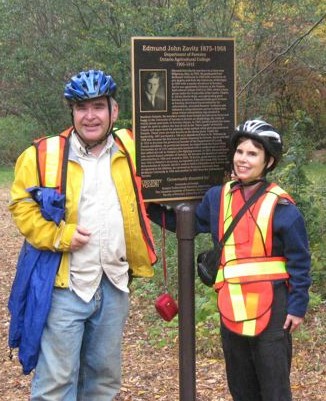
John Bacher and wife Mary Lou pose in front of a plaque for Edmund Zavitz as they retrace his historic 1905 ride through southern Ontario.
When Zavitz cycled to Crown Hill’s Height, along York Road, ( Highway 7) and then Young Street, he must have sped along with a fast and powerful beat. It would have been quite appropriate given the seriousness of the situation that Ontario was facing if he shouted loudly that; “The deserts are coming”, since they were threatening to bury the province in sand. About a fifth of the province’s arable land had already been degraded in this manner and the situation was getting worse.
In addition to spreading deserts the Southern Ontario was facing massive floods from deforestation. A few years after Zavitz’s alarm call the OAC campus in Guelph itself was cut off from the world for a day by a flood. It caused the loss of hundreds of homes and people to be rescued in boats. In 1929 Guelph only narrowly escaped catastrophe after a third dam barely held following the destruction of two upstream. While the city was saved factories experienced massive damages.
Our trip to Crown Hill began in a beautiful place beneath the towering “Zavitz Pines”, near the Victoria Road entrance to the university arboretum. Here there is now a commemorative plaque to Zavitz. The grounds have the aura of a holy shrine to the man who rescued the province from ecological devastation with trees and resolve.
It was quite moving for Mary Lou and I to be greeted by supporters, one of whom, Monte Dennis, a director of the Coalition On the Niagara Escarpment, came from Burlington and took photos. We were joined also on a ride for a half hour by a good friend, Marty Collier. Marty took care to adjust my seat on an unfamiliar rented bicycle, while a Red Tail Hawk watched us silently.
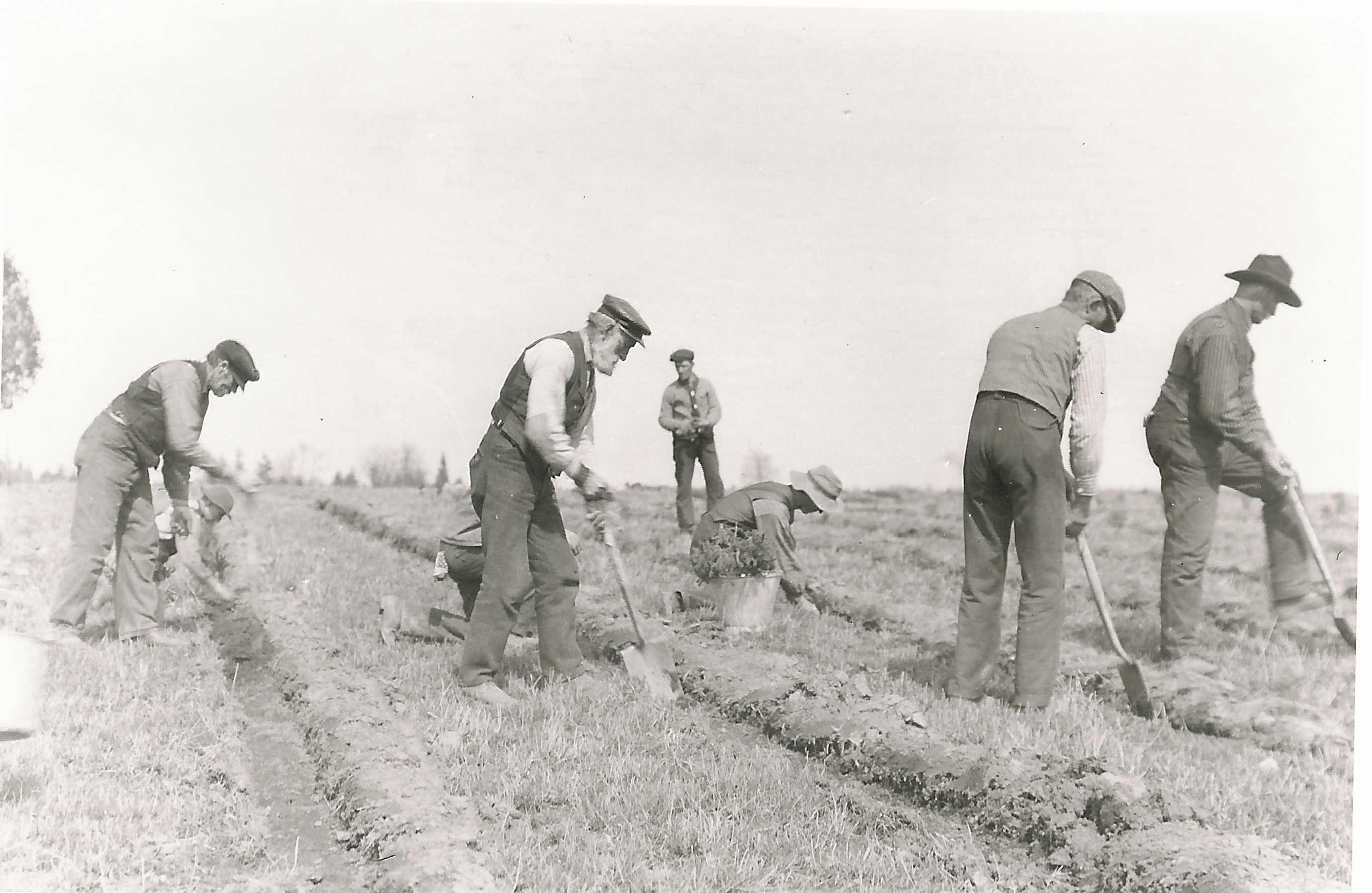
A 1905 photo by Edmund Zavitz of tree planting in Guelph.
During the first hour of the ride, we were awed by the marvellous mosaic of the conifer plantations, early successional wetlands and forests- all brought to us by Edmund Zavitz. This
ecological zone is the Guelph Drumlin Field and is now the best forested area of the vast Grand River watershed. It is now 27 per cent forested – a five-fold increase- and the danger of inundation to Guelph is long past.
Much of the species richness of the wetlands throughout the Guelph Drumlin Field is accounted for by Zavitz’s reintroduction of the Beaver in Southern Ontario. This was initiated in the late 1940s, after aircraft patrols by his Department of Forests rescued the Beaver from provincial extirpation in the 1920s in Algonquin Park. When Zavitz sped along York Road to meet the future Premier of Ontario, E. C. Drury in 1905 the tiny area of surviving forests were dying from livestock grazing and were sad relics and bones of what had been burnt out by pioneers.
In a Rockwood restaurant we are stunned by the intellectual tenor of our waitress who is a serious student of the culture of native Canadians. After intense discussions we agree that although our ancestors swindled and manipulated native people out of fair title to their lands at least Ontario largely due to Zavitz’s influence, protects these areas more wisely than the “burn baby burn” attitudes of the past.
After lunch we walk along the perimeter of the Rockwood Conservation area. This park owns its protection to the Conservation Authorities Act of 1946, which Zavitz was able to pry out of the provincial government with the help of a veterans group, Men of the Trees. The splendour of the restored woods makes a vivid contrast to the scene when Zavitz pedalled by here in 1905. It was then a smoke belching textile factory, which soon would do a booming business during the First World War.
The restored forests become more robust and prevalent when we cross into the protective area whose land use policies are governed by the Niagara Escarpment Commission. The greatest spectacle of the ride is to see above the Escarpment seven Turkey Vultures gliding and soaring in the thermal gusts of winds. We then delight in an appropriate sign proclaiming the Black Creek as a “Wild Trout and Salmon River.” When we pass over the Credit River in Mississauga despite the twilight’s gloom, the blazing red of the leaves below makes its valley’s splendour rival any formal garden.
While touring the well regulated Niagara Escarpment Plan area gives us comfort as to the strength of Zavitz’s legacy cycling through the less protected areas north of Toronto the next day gives cause for alarm. We view scene after scene of now threatened landscapes which were reforested by Zavitz. The 185 acre reforested former David Dunlap Observatory in Richmond Hill is going to a fierce battle before the Ontario Municipal Board. (OMB) We then see the former war zone of OMB battles along the Oak Ridges Moraine which in the end produced an Oak Ridges Moraine Plan. It protects only a narrow band of natural areas across Young Street around Bond Lake. This rescue was done by a land swap for other provincially owned lands in Pickering.
Nearing Barrie a flat tire is experienced which seems to demonstrate that Mary Lou’s constant praying during our trip has been effective. Shortly after this mishap we get a phone call
from Stephen Ogden, a hero in the successful struggle to defend the world’s purest water against the threat of Dump Site 41. He drives us to Crown Hill, where we meet the grandson of E. C. Drury, Robert, and his son, Robert Jr. The tree shaded nature of the grounds of the three adjoining Drury homes, with the forest to the rear which is now protected through a management agreement with Ducks Unlimited, shows how the conservationist legacy of the Drury family endures.
The one billion tree challenge ride is especially important now in that it should give what will be a Liberal provincial government secured through consultations with the New Democrats a realistic agenda to protect the southern Ontario’s threatened landscapes.
Paying private landowners to plant trees on their lands and expanding modestly the forested areas of conservation authorities, provincial parks and municipalities is a practical proposition. Much of this money would more wisely spent to reduce water pollution through trees buffering streams instead of funds handed out in expensive and questionable engineering projects. This would establish for our own day the beneficial legacy of the combination of conservationist science and political power that was the result of the drama of Edmund Zavitz’s 1905 ride.
John Bacher is a Niagara resident and veteran member of the Preservation of Agricultural Lands Society. He has contributed a number of posts to Niagara At Large on environment and conservation issues. He is the author of the recent book ‘Two Billion Trees and Counting – The Legacy of Edmund Zavitz’.
(We encourage you to share your comments on this post below.)


This is a very interesting story. I look forward to reading your book.
Thanks
LikeLike
Congratulations on your book. Very well written.. It brought back many memories for me. I am the guy who is pictured on page 92. I sincerely hope the message in your book circulates widely.
Wim Vonk, Qualicum Beach B.C.
LikeLike
Thanks. You must have had great achievements yourself as a forester following the fine example set by Edmund Zavtiz.
LikeLike