
By Doug Draper
Do you think we are overrun with municipal politicians in Niagara, Ontario? Are you one of the people out there who feel we have far too many?
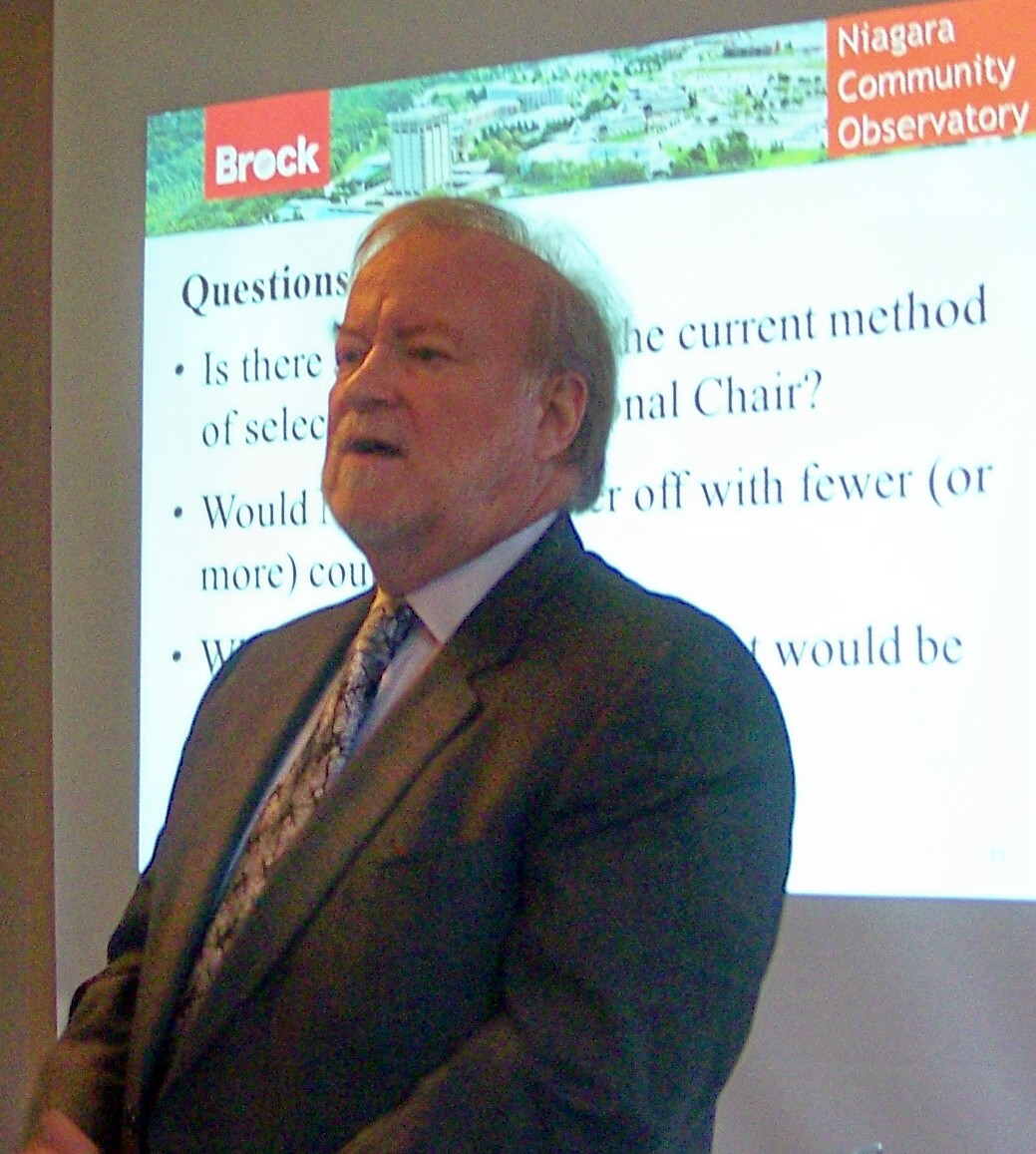
Niagara Community Observatory head David Siegel outlines policy brief on regional governance
If so you may be interested in downloading the latest Policy Brief produced by the Niagara Community Observatory, a Brock University-based research body that works in concert with members of the surrounding community to produced research on current and emerging issues in Niagara.
According to the eight-page brief, released this September 15 and titled ‘Representation on Municipal Councils in Ontario’, there is no doubt that Niagara has the larges number of local and regional politicians of 10 regions across the province that still have two-tier system of regional and local councils. There are a total of 125 councilors in Niagara, to be exact – one for every 3,419 residents in this region compared to York, another region with a two-year system that has 76 councillors or one for every 11,746 residents.
Yet reducing the number of councillors in Niagara may require making some “radical changes” in the way we select our councillors and, contrary to popular belief, won’t do much to reduce municipal spending.
The cost of councillors (in terms of their salaries and whatever other compensation they may receive to cover their expenses) is “about one half of one per cent of total municipal expenditures,” said Observatory head David Siegel following the release of the report. “So if you want to save money, that is not the place I would start.”
Siegel said he hopes the brief, written by Observatory research assistant Doug Hagar and Brock student Margaret Corbett, will inspire more widespread discussion among area politicians and the general public on now best Niagara citizens can be represented by their municipal councillors.
“It is not too early to start talking about this,” said Siegel, noting that with three years left before another municipal election, it takes time to debate something so important and to make any changes that would need provincial approval before they become part of the election process.
Gary Burroughs, chair of Niagara’s regional government, said when he was selected late this past year for the chair’s job that he wants to see a discussion on governance issues in this term of council. Although the Observatory’s brief did not broach the thorny issue of amalgamating Niagara into fewer or possibly only one municipality, Burroughs told Niagara At Large earlier this year that he would not duck that issue during any governance discussions.
A majority on the last regional council, chaired by Peter Partington who decided not to seek another term, voted against a governance review about three years ago, and that was not all that surprising. For most the past 41 years of regional government in Niagara, any talk of amalgamating one or more local municipalities has been met with strong protest from local councils and the citizens they represent. However, there is growing number of voices saying it is time Niagara behaved like more of a region than a cluster of communities representing more narrow, parochial concerns.
Siegel said the Observatory is not an advocacy group that makes recommendations on which way the region should go on one issue or another. Its role is more about providing researched information on the options available.
The body’s latest brief explores a number of areas, including whether the regional chair’s job should continue to go to an individual chosen by regional councillors or whether, as in the case in some regions in Ontario, those vying for the job should be on the ballot at election time and chosen by voters across the region.
Siegel said that from what the Observatory has learned from other regions, there are possible advantages and pitfalls to a wide-open election for the chair’s position in Niagara. On the one hand, a region-wide race for the position could stimulate more interest in regional government. On the other, anyone running for the position may have to spend far more money on a campaign to be elected, since they would not likely be all that known in all corners of Niagara. That means they may be more beholding to those who have the money they need to donate to their campaign, he said. It may also mean that if one or more of the candidates come from a larger municipality where there are obviously more voters and they are known, they may have a significant advantage over a candidate from a smaller municipality.
The brief also goes on to examine some of the advantages and pitfalls of other options, like “double direct representation” on both local and regional councils, and representation by population.
There is a good deal here for thoughtful, caring citizens should consider as any discussion on the future of governance in Niagara gets underway. You can learn more by downloading the brief at www.brocku.ca/nco. (Just a warning here from Niagara At Large. We are still trying to get links working properly on this site so you may have to scribble that one down for the moment and type it into your search engine. Sorry for that inconvenience.)
Siegel said the regional council could play a leadership role in any discussions on future governance and involving the general public in the discussion would be one more way of stimulating more Niagara-wide interest in regional government.
(Niagara At Large encourages you to share your views on this issue in the comment boxes below. Please be sure to share your first and last name with your comment or this site will not post it.)
 Niagara At Large
The article has a good point. However, Niagara Region is too St Catharines-centric. South Niagara has become terra incognita, as the hospital shamozzle and the GO Transit decision have proven.
North and South Niagara have little in common. Current history of North Niagara stripping South Niagara of population, job opportunity and resources can only perpetuate distrust. Centralization is unlikely to happen by democratic means, but by provincial mandate. In that case, I believe even the editor of NAL would object.
The idea proposed in the article would have a better chance to work if the current Region were to be split into “Niagara North”, centered in St Catharines and “Niagara South”, centered in Welland or Dain City, more or less along the riding boundries. Current Regional offices could be sold, perhaps to Brock.
Clearly there are many loose ends to my counter proposal, but it would have a better chance of rationalizing resources without leading to more unrest, while offering new prospects for “Niagara South”.
LikeLike
I can’t to go to St. Catharines to get my library books.
LikeLike
Amalgamations are a complex issue. The Harris government’s creation of Regional amalgamations (read: Chatham-Kent) has cost taxpayers millions. Look at Toronto, a desperate state of amalgamated boroughs. There are some good books addressing this, some by Ontarian Andrew Sancton.
Mr. Strugar: There is something called Interlibrary Loan available at your local library, as long as you carrying a library card , so you can access any book you like, through your local library. It’s called Interlibrary Loan, or ILLO. Do give it a try.
best regards
LikeLike
I’m well aware of the library system. Apparently you did not understand that the post was a dig at centralizing everything and thus allowing St. Catharines to take over governance of all the smaller municipalities..
LikeLike
OK, sorry, Mr. Strugar. My mistake. Sometimes nuances online go right over my head!
apologies. Gail B
LikeLike