
A Commentary by Doug Draper
With the summer here, the anglers are out in full force on Lake Ontario, dreaming of catching that trophy trout or salmon.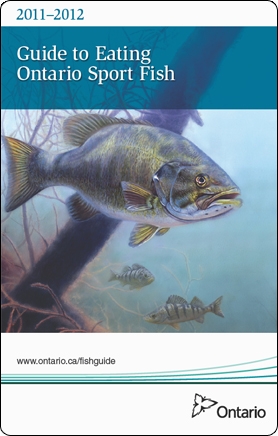
Yes, it is Salmon Derby time on Lake Ontario, as I was reminded from a recently article in The Toronto Sun, and as a longtime reporter on Great Lakes environmental issues, my mind immediately turned to wondering how much industrial chemical poison is still accumulating in those prize fish.
The Toronto Sun story referred to one 40-pound salmon caught off the northern shores of the lake near the Greater Toronto area and, sure enough, when you look up a coho or chanook salmon that size in that area of the lake in the Ontario government’s latest ‘Guide to Eating Ontario Sport Fish’, its recommended that an adult mail limit their eating to about one meal a month because of the concentrations of poisons like mercury, PCBs and mirex that have accumulated in fish flesh. Children under 15 years of age and women of child-bearing age are advised not consume salmon that size from that area at all.
Sadly, the advice from this Ontario Ministry of Environment guide book is not much different for larger salmon and trout, closer to two feet in length, caught in the same lake, off the shores of Niagara. The same is true for the lower Niagara River where one of the many chemicals of concern is among the deadlier ones known to science – dioxin.That is not to say don’t eat any fish out of our rivers and lakes, nor does it say that things haven’t improved over the past three decades since governments on both sides of our Great Lakes have worked harder together to reduce the flow of toxic chemicals to our shared waters. In the lower Niagara River, for example, the concentrations of dioxin and other poisons in the flesh of fish and the eggs of fish-eating birds have been cut by more than half since U.S. and Canadian environment agencies signed a pact in the late 1980s to reduce the discharge of industrial poison from waste dumps, and industrial and municipal effluent pipes by half within a decade.
Yet it should remain a concern to all of us that all these many years later, there are still fish in our lower Great Lakes, including some of the fish that anglers prize the most, that they can’t take home for a child under the age of 15 to enjoy even one a meal a month of. A similar guide for sport fish, available now from the New York State Department of Health, warns that people should not eat any more than one meal a month of Chinook and coho salmon, rainbow and brown trout over two feet long on the whole American side of Lake Ontario because of the concentration of PCBs, mirex and dioxin in them. The story is the same for the same species and size of fish caught in the Niagara River downstream from Niagara Falls.
Going back to my earliest year as an environment reporter starting around the Love Canal disaster time in 1979, I’ve kept the bar raised pretty high when it comes to “the tragedy of the commons” when it comes to our shared fishery. And we are talking about a natural resource, by the way, that is collectively worth billions of dollars to the economies of communities on all sides of the Great Lakes. Curiously enough, it is a resource with a value that is hardly factored in to the equation when governments in both countries slash their environmental protection services to save their budgets and polluting industries a few quick bucks.
My standard is that I won’t rest until someone can catch a fish from our rivers and lakes, and not have to consult a guide book on chemical poisons to find out if its okay to feed it to their family.
In the meantime, if you are catching fish in our shared Canadian and American waters with a desire to eat them, the Ontario and New York State governments have always done a good job of putting those guide books together. Check out a copy of them by calling 1-800-565-4923 to find out how you can download or obtain a hard copy of the Ontario fish eating guide, and visit www.nyhealth.gov/fish for information on the New York guide.
(Niagara At Large welcomes your comment below on this post. Visit the rest of our site at www.niagaraatlarge.com for more news and commentary on matters of interest and concern to residents in our greater Niagara region and beyond.)
 Niagara At Large
The difficulty is also that dozens of new compounds are invented and used every year………Fire retardants are a new threat….e.g. Great Lakes company – the world’s leading producer of flame retardants have “an extensive line of products includes bromine-, phosphorus-, and antimony-based flame retardants, as well as a full line of UV stabilizers, antioxidants, blends etc”. Even older compounds aren’t rotutinely tested for – example perchlorate hasn’t been tested for, but has used for 26 years is finally being looked at by the US EPA. …..http://www.nytimes.com/2011/02/03/science/earth/03epa.html.
LikeLike
One of the reasons for the dixoin problem is garbage incineration in the United States. In Ontario although the Harris government lifted the ban on garbage incinerators, they have been few in number due to the opposition of environmentalists. A big incinerator in Tonawanda New York is likely the major reason for the lack of more dramatic improvement in the lower Niagara River that Doug complains about
LikeLike
The big pipe from the Hyde Park Toxic waste dump which drains toxins from the huge mountain of waste, the largest dump on the eastern coast of the United States, this waste is diluted with water to reach acceptable limits on dumping pollutants into the Niagara River, could be the logical source of Dioxin and mercury which lodge in flesh of the fish in the Lake ,mercury can affect the central nervous system. (Minimata Disease)..
LikeLike