
By William Hogg MD
Just about everyone by now realizes that there is something seriously wrong with Medicare in Canada.
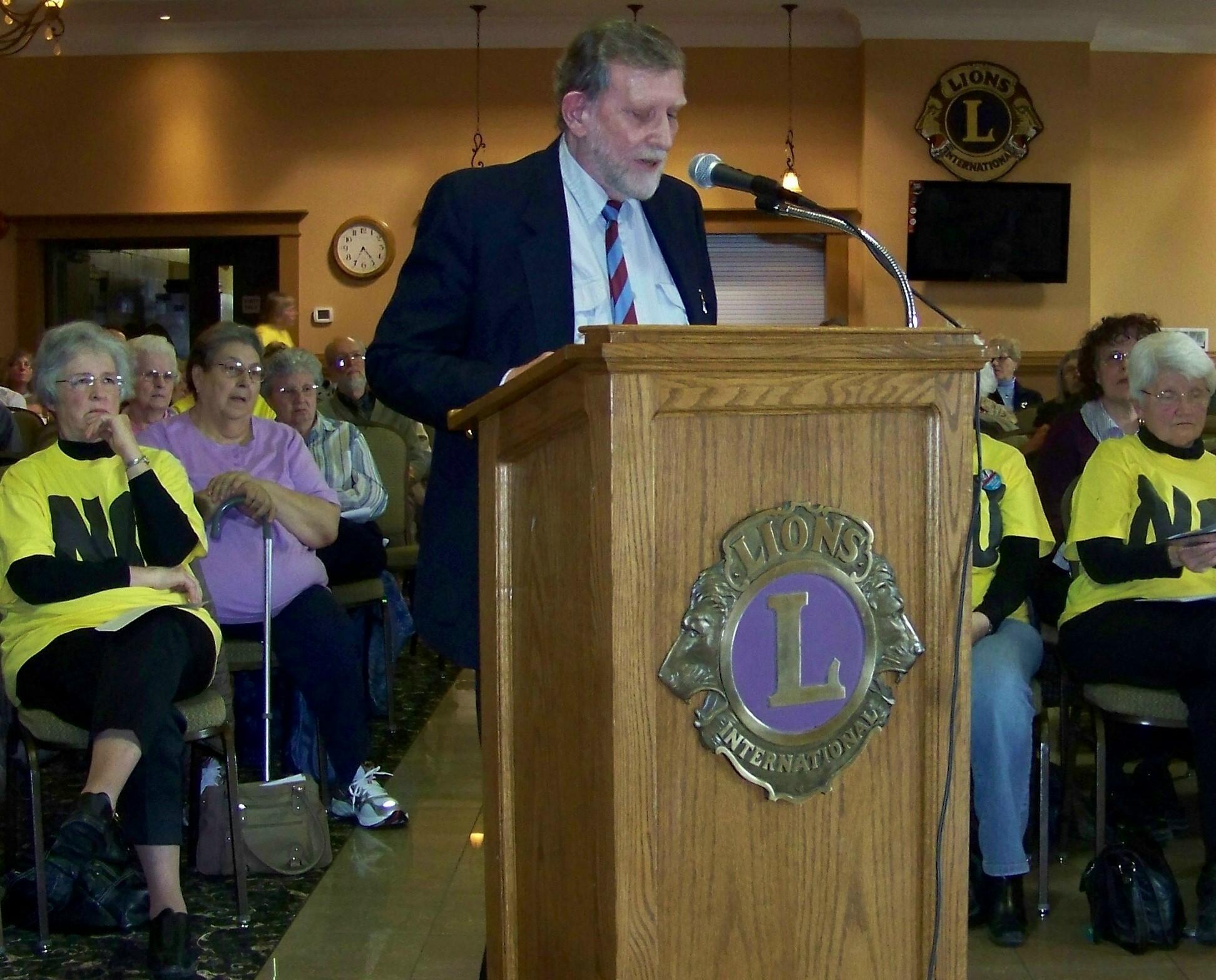
Dr. William Hogg, speaking last year in Niagara at a hearing on health care. Photo by Doug Draper
Ontario is a case in point. The eHealth scandal, in which a billion dollars was spent on incompetent and corrupt consultants, all for naught, is one example. Another glaring example is the Clostridium difficile outbreak, particularly as managed by an already failing Niagara Health System (NHS).
Furthermore, NHS also ignored advance warnings of ‘time-critical’ emergencies – deaths of patients transported long distances in ambulances as a result of the closure of outlying emergency departments. The faulty notion that centralized services could compensate (and that paramedics might replace doctors), preceded that disastrous decision to close ERs.
A key question: Is there any common denominator to these ‘health care delivery’ problems?
Some people point the finger of accusation at inept and fumbling local or provincial politicians. Others accuse a new ruling cadre of lay-managers that are now running the hospitals. A few even accuse and vilify the new money lenders, the ‘beneficent’ banks or ‘P3’ private partners of government. I am sure each viewpoint is correct in its own limited way.
A thought! Perhaps similar difficulties run rampant elsewhere. Let’s take a quick look.
Several leading Canadian thinkers have noted parallel problems pervading much of our modern world. Ronald Wright, a historical philosopher and academic, in his book, A Short History Of Progress, keenly emphasizes our chronic and repetitive collective blindness to history. He says that it results in “runaway growth in human numbers, consumption, and technology, placing a colossal load on all natural systems, especially earth, air, and water.”
John Ralston Saul, in Voltaire’s Bastards (a ‘nicely’ named and most seminal book), tackles the problem from the unique angle of badly functioning business models. Saul, a novelist, intellectual and former CEO, perceives the issue as the distorted application of reason in a corporatist-run world. Each of these men, Wright and Saul, are both probably right. After all, their ideas have been aired as Massey Lectures by the CBC, Saul’s in 1995 and Wright’s in 2004. However, it is most noteworthy that Marshall McLuhan, of “the medium is the message” fame, saw a prime source of our current problems as far back as fifty years ago, when he cryptically asserted, “role now precedes goal,” which I’ll try to explain later, space and time permitting.
Obviously these broad societal concerns (which I raise within the narrower context of our sadly failing Medicare) have been around for a while. But, is there a common thread of explanation that might tie it all together? If so, what is it? And, most important, is there a thread or two that will lead to any real practical remedies? Let me further set the stage before I tell you.
Long ago, the great German poet, Johann Wolfgang von Goethe, pointed out that “we see only what we know.” That is, we often fail to see what’s in front of our very eyes until we know what to look for, and even then, someone else usually has to draw our attention to it first. Now, remember Dr Watson? That renowned, but fumbling fictional medical mind, had to have most non-medical things pointed out by his all-knowing detective friend, Sherlocke Holmes. OK. Another little pointer: Even that, pointing things out, wont work – unless we are open and willing to crawl out of our narrow little envelops of personal existence, out of our deep narrow, specialized professional work-traps. We must all open our minds, voluntarily. Only then can we act reasonably sensibly.
A bit of local history: In the Niagara region, some ten or so years ago, an extra layer of bureaucrats was created. It called itself the Niagara Health System. Its mandate was to balance the bottom line and get a couple of self-serving hospital administrators into line. Those old administrators had titled themselves with the CEO label and given themselves exorbitant salaries.
The new NHS boss promptly proceeded to call herself CEO and the new, self-appointed, board padded all their salaries. And failed to balance the budget to boot. In fact, they most callously stole the endowment of the only local hospital that actually was operating in the black. Then they went on to bite off something that was not even in their original marching orders – they decided to mix themselves into the actual management of professional medical and nursing services.
To make a long story short, it was a mess in the making. Outlying emergency rooms were shut down and people in transit died. Well run local services – like obstetrics, pediatrics, and more – were centralized, far away from where people are at. Local doctors were left with no plant in which to work. All or most of this the reader will be aware of.
The new NHS boss and PR-persons claimed that everything they did was most reasonable. They had a marvelously HIP plan (HIP = Hospital Improvement Plan) that was designed for a far off city, and it was foisted upon their ‘ignorant’ country cousins. The new CEO, and her now self-perpetuating and secret board, instead of seeing themselves as managers, public servants entrusted with public hospitals in the public weal, soon began to act as if she/they were the owners. Capital! As if they had designed and built it themselves. Very ‘hip’ indeed! But reasonable?
OK. Reason works – when tempered by common sense and morality.
The standard business model, which worships reason only (without morality and common sense), fails to work, especially when transposed into fields other than its own. That is, in our case, when imposed unmodified upon public health care delivery. The business model – a la Harvard, the Chicago School of Economics, even the Ivey School of business at London, ON – all produce MBA graduates, ‘products’ with almost the same, cookie-cutter, amoral bottom-line mindset. That mindset is the Friedman way of economics: so-called free markets, give big business big tax-breaks, take over, downsize, tax the poor to help the rich, outsource. It’s really an ideology. That’s about the size of it.
Now, big business itself, as it falls prey to its own stereotyped heroes – the Harvard-type of CEO – can even destroy itself. Remember Enron and GM? The US housing mess? The frightfully expensive public bailouts? Productive industry, the only real money-maker (outside of farming), is shipped out and shut down by cookie-cutter business types. Its own labour force is downsized.
More and more managers are then hired until the system is top heavy with unproductive parasites. As real manufacturing declines, the ‘pure’ money market, tangible products be damned, is perceived as holy and worshipped as the be-all and end-all of all things.
And, in return, every CEO is rewarded with disgustingly excessive salaries. The rich get rich and the poor get ever poorer. This retrogressive brand of business and economics has come gradually to permeate much of our organized world. It promotes itself as able to cure anything. As a doctor, I have a name for that – quack, quack, and quack.
Here are some examples of that quackery…
Higher education is a prime example of what happens when this business model invades. University students actually become ‘product.’ The humanities, the essential core of civilization, are downgraded and science funding is co-opted by big corporate, big pharma, interests. Business ‘ethics’ pervade all.
Politics (and government) is another example where this business model is beginning to reign supreme. The natural goal of democracy is to enfranchise the individual. But business-oriented functionaries and lobbyists strive to undermine our hard won rights and freedoms by relentlessly promoting the corporate interest above all. The individual voter? S/he becomes discouraged or contemptuous and apathetically opts out of civic responsibility. No responsibility. No more freedom.
Poor Premier McGuinty! Supposedly a liberal, Dalton has become the captive of his P3 private partners from the big business world. He might as well be a dyed in the wool conservative – a real neo-con like US-America’s George Bush or Canada’s own Harpo-con. But Who-dat(?), his immediate opponent, is worse. One can hardly blame our poor premier for the mess that has befallen Medicare in Ontario.
The Niagara Health System is the prototype of a “health care delivery” outfit that is killing off patients while self-destructing. It is top heavy with lay-managers – the parasites with “sunshine” incomes. Like corporatists everywhere, they have little conscience and no common sense. But they think they have a corner on reason. Their business school case studies, that come out of a theoretical vacuum of pseudo-reason, always provide a ready-made, precooked answer to any question. So they never have to ask any nurse or doctor any medical questions. Their ready-made answer(s)? Lay off more nurses. Close more hospital beds.
Shut down another emergency department. Outsource cleaning to cheap amateurs in the face of an epidemic of C. difficile. Once in a while, when things get hot and the public is clamouring, in keeping with the standard ‘cruel’ business practice, they sacrifice one of their own – with a soft-landing ‘retirement’ parachute made of money: a Ms Debbie Sevenpifer (X-CEO) is publicly fired on a cold winter’s day or some PR nonentity is dumped with no explanation. Lop off somebody’s head (gently) and the public will be satisfied is their motto. Finally, when the lay-managers run out of ready-made answers they hire another expensive PR person to spin things. Or lie.
So, this is the picture of health care delivery and hospital management now in Niagara. Lay-managers, business managers, not medical managers, prevail. In kind and gentle Canada, NHS is particularly cruel and harsh. And totally business-stupid. It can’t even balance its own bottom line. But it kills patients.
What is the real solution? Protests as usual? Vote the bums out? Boycott the P3 private partner banks?
Don’t think so? The business model permeates them all – it is the common thread we were looking for. A real societal virus, worse than C.difficile. It runs the big money lenders. It pervades government. It manages health care delivery. So what can we citizens possibly do in the face of such a noxious juggernaut? Perhaps I’ll outline what must be done another time.
Oh yes, I’ll also explain that curious statement, “role now precedes goal” (by McLuhan), then too. That is, if you all want.
William Hogg is a retired medical doctor living in Fort Erie, Ontario.
(We welcome your views below on this post and continue to visit Niagara At Large at www.niagaraatlarge.com for more news and commentary on matters of interest and concern to residents in our greater Niagara region and beyond.)
 Niagara At Large
Thanks so much for this fabulous essay, Dr. Hogg — what we have been going through here in Niagara is just part of a larger and evolving pattern. We cannot hope to change our health system (or anything else that belongs in the public domain) for the better unless we can see the big picture, and understand who the real power-brokers are.
LikeLike
Many interesting points. I’d like to amplify one of them somewhat. If I am an expert rower, I will “see more” than an untrained rower when I watch a regatta; I’ll be more aware of strategies, technique, and so on. If I am a dentist, and I look at someone’s mouth, I will “see more” than a lay person. Likewise for people running hospitals. They don’t “see” the system the way a trained doctor does. This is why it is imperative that trained doctors call the shots.
It’s also imperative that the public read articles such as these to counterbalance some of the mainstream, “sitting at the dinner table, with apple pie, and enjoying tax cuts” nonsense.
LikeLike
That was more of a read than I expected when I clicked the link. Thanks for a great article. Not to lessen the thoughts of Saul and Wright, but I also couldn’t help thinking of Charles Taylor and his thoughts on instrumental reason also featured as a Massey Lecture in 1991.
LikeLike
Thank you Mr. Jantz. The reference you cited is eye-opening, lucid. I’m reading Taylor’s “Malaise of Modernity” now. And all over again, at 80, am discovering how narrowly educated I was/am. /wfh
LikeLike
Good synopsis as usual Dr. Hogg. When a business mindset takes over, care suffers. This is supposedly justified by keeping the bottom line financially sound but they haven’t accomplished that either. For years, as a prelude to corporate takeover, words such as “client” instead of “patient” have been encouraged. This is to get staff to think along business lines. Sorry, I’m not selling insurance here! It’s called depersonalization.
Mark says MD input is needed. True BUT – who spends 12 to 14 hours daily in the hospital and close up with the patients? Nurses. Docs give orders but the nurses somehow have to find the resources, both human and physical, to carry the orders out. Cleaning and auxillary staff also know what is needed but are being cut back. How can they control an outbreak of infectious disease like C. diff without enough staff or resources.. I guess the poopbas consider them unimportant – WRONG! As I stated before, when I see folks in heels and with clip boards and no barf or poop on their shoes, they’re likely redundant. Years ago things ran very smoothly without all these talking heads. Why are they necessary now?
When corporate interests supercede individual interests only the big guys benefit. How many examples in society do we need before we realize that? Right now the biggest problem health care is facing is not the inverted administrative pyramid or lay people playing doctor but the ABSOLUTE APATHY of Ontarians who are letting this happen. Like Joni Mitchell sang – “You don’t know what you’ve got til it’s gone”. Well boys and girls, it’s going!
LikeLike
It’s time we found out just who’s running the healthcare show, and for whose benefit. Here’s one:
The President and CEO of the powerful Ontario Hospital Association, Tom Closson, has an undergraduate degree in engineering and an MBA. Check out the member of the large OHA Board, and you’ll find their qualifications tend to be managerial rather than medical. Yes, you’ve seen Closson’s name before — he strongly criticised our local politicians for participating in last week’s rally outside the GNGH. He’s a big proponent of keeping hospital records exempt from public scrutiny.
LikeLike
In response to Linda’s comments, I meant to say health care professionals.
I covered that point and the relevant statistics in my article.
LikeLike
“… When the proportion of registered nurses in hospitals was increased by 10%, there were 5 fewer patient deaths for every 1,000 discharged patients (from acute care)…”
LikeLike
Health Care Delivery is Failing – What To Do About It: At this point I realize that I have bitten off a bigger task – What to do about our failing Medicare? – than I can yet swallow. So I’ll be chewing on it for a while before publishing any more on this topic. In the meantime may I suggest that interested activists read the Massey Lectures by Charles Taylor, John Ralston Saul, and Ronald Wright? Their ideas may help us all understand and better formulate rational and effective actions. /wfh
LikeLike