
(Just as a foreword to this fine piece by Don Alexander, a Niagara resident, urban planner and good friend of the late Jane Jacobs, billions of books have been published in the last 50 years but only a very few of them made a difference in the way we think and live as a people. Among them are Rachel Carson’s ‘Silent Spring’, Marshall Mcluhan’s ‘Understanding Media’, Harper Lee’s ‘Too Kill a Mockingbird’, and Jane Jacob’s ‘The Death And Life Of Great American Cities’, a book that strived to get us all thinking about how we might live a richer life in a healthy urban environment, evem while many of us were moving way out beyond the edges of the city known to some, who couldn’t’ give a damn about real city life, as the suburbs.
Don Alexander, an urban planner, former Niagara regional councillor and an old friend of Jane Jacobs who produced a fine documentary film on her, talks about Jacobs on the 50th anniversary of her seminal book and Niagara At Large is proud to post it here.)
By Don Alexander
Fifty years ago, we began to learn about city planning and living in a different way.
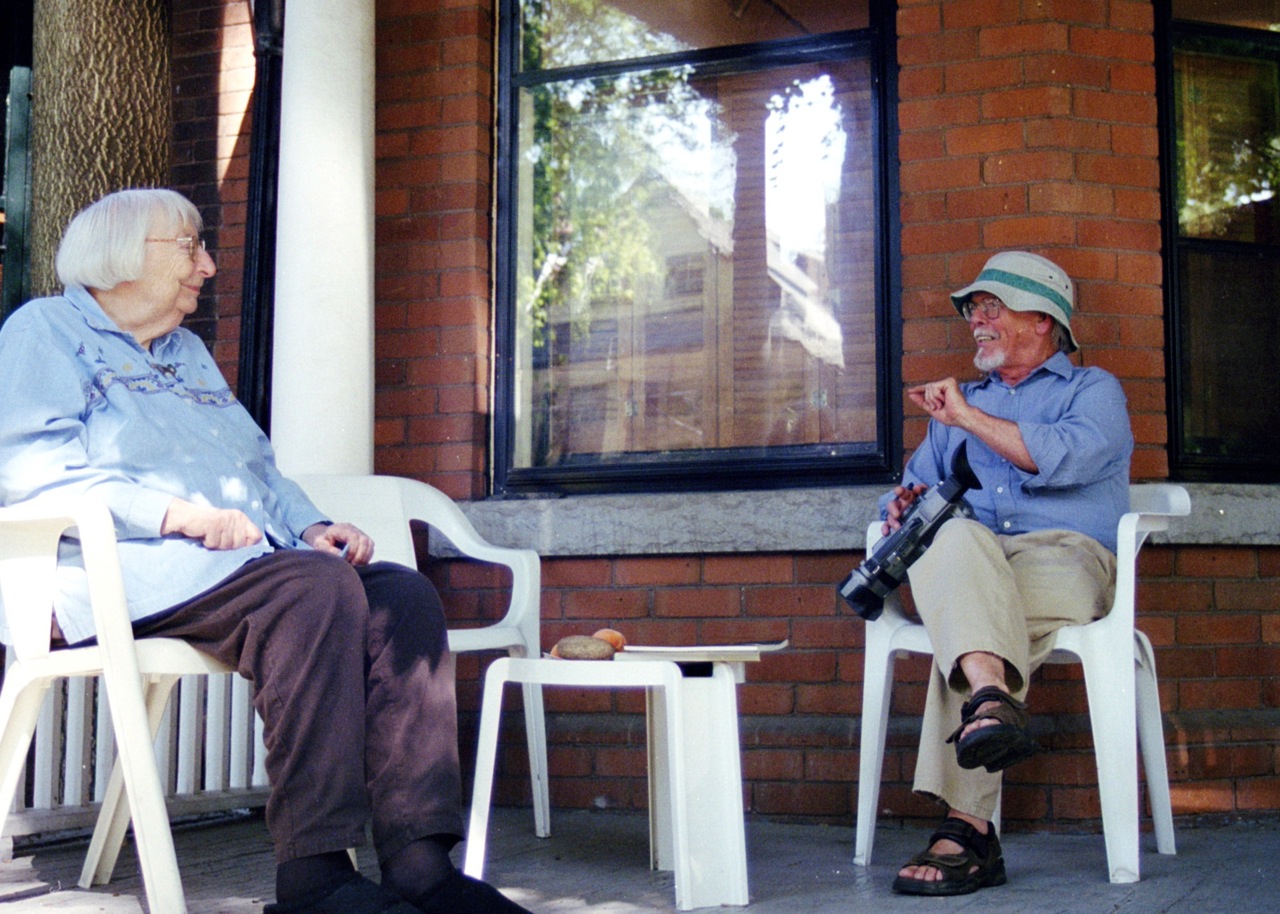
Jane Jacobs with Don Alexander. Photo courtesy of Don Alexander.
The publication in 1961 of “Death and Life of Great American Cities” by Jane Jacobs turned a corner in the way we think about cities. The book still resonates with those who think and plan about the future directions of cities.
I first read the book, with wonder, about 1963. I began to imagine a different future for cities. Since that time, I have measured many of the city sights I see against the potentials that were held in Jane Jacob’s book and in later publications about the economies of cities and regions.
In the mid-1990s Jane Jacobs and I became friends and our friendship continued until her death in 2006.
I came to appreciate the way she thought about things. Her writing 50 years ago helped turn aside the linear way of thinking about traffic growth and subdivision sprawl. As time went, on her ideas were what she described as being interlaced like a spider’s web, “a web way of thinking”.
I produced an educational TV program about her entire work and the evolution of her ideas (Jane Jacobs: Urban Wisdom, 45 minutes, 2002).
In a series of interviews over the years, Jane reflected on her writing and her ideas. She called herself a non-fiction writer and resisted the “urban-guru” nomenclature.
Talking about the ideas in The Death and Life of Great American Cities, she felt the way streets worked were the key to understanding the potential of cities, “people weren’t just walking around or riding around with nothing on their minds but where they were going. They were doing all kinds of other things, by the way…the more you watched the more interesting and amazing connections you saw.”
In the City of St. Catharines, for example, I have seen how a return to two-way traffic has again given pedestrians rights that had been lost to one-way traffic that was just passing through. It is interesting to watch cars defer to pedestrians at crossings. A politeness has been achieved (mostly).
Another key observation she made in that book, fifty years ago, was that regimentation of zones was killing vibrant city life, separating residents from business and industry, “all boring and repetitious.” Her way of thinking kicked in with her looking at “where people work, the social and institutional things, how they all effect each other. You just couldn’t count on putting things in a place and expecting people to react.” Jane added, “How the people reacted with each other made all the difference…how the people are interweaving in this tapestry of life. That’s what’s important.”
Living here in the Niagara region I think about those talks with Jane and what I am observing. I look for active street life. I notice vacant sidewalks. Yes, I see the dominance of the automobile but I see instances of people reclaiming streets and parkettes.
I have hopes that the new performing arts centre in St. Catharines will allow for wide walkways and places to interact. How people get from the marketplace and library to the arts place is of concern, not just the buildings themselves.
How would Jane Jacobs observe our current concerns about “intensification” within our urban limits? She once said “do not be afraid of density” and went on to talk about how density of people and their activities was the very breath of a lively and livable community.
Looking back on the fifty year history of this important “non-fiction writer,” I think most about how Jane thought about things and the interconnections she observed.
– Once when we were walking she asked, “ever wondered why more people are spending time on their porches?”. Her answer: “Not only were fewer people smoking in the house but the really inexpensive plastic furniture—four dollar chairs at nearby Honest Ed’s—meant people were not constantly concerned with security of furniture.”
– She corrected an interviewer from New York City every time he referred to this or that “issue”. She said it was not an issue, it was a “problem”. For me it was a good way of getting to the subject at hand instead of couching it in elliptical terms of being a debatable issue.
-She felt her inclusive “web way of thinking” now permeated all kinds of fields. It was now common, and she had helped shape this way of thinking. In the documentary we made together she said, “It is a kind of thinking that is now becoming quite common, thinking about how things connect with each other instead of thinking about things in a linear way.”
Don Alexander lives in St. Catharines. He was an elected member of Niagara Regional Council and its Planning Committee for two terms in the 1970s. He is now a Commissioner on the Niagara Escarpment Commission. In the 1960’s he was part of a team that used alternative methods—like the web way of thinking– to eliminate ship delays and congestion in the Welland Canal.
(We encourage you to comment on this post and we also encourage you to draw your friends and associates to Niagara At Large at www.niagaraatlarge.com for more independent news and commentary for residents in our greater Niagara region and beyond.)
 Niagara At Large
The last time I met Jane Jacobs was some years ago during a garbage strike in Toronto. I was walking in her neighbourhood with my friend Marie-Lynn Hammond (Stringband co-founder; CBC Musical Friends, plays, solos, Candian identity talent). Jane was out with her walker, and attendant. Marie-Lynn and I were passing on the sidewalk from the other way. I was just coming back from a pristine lodge North of Huntsville. The last image of Jane in the Toronto garbage will always frame her powerful vision in my mind. Wish we could have talked about it.
LikeLike
No that Jane’s thinking has rather successfully made its way into provincial, regional and municipal planning policies, it strikes me as imperative that it be embraced quickly by Ministries of Education and their boards. Otherwise …
LikeLike
It was a pleasure to be part of one of the three or so ‘Jane’s walks’ implemented about a month ago here in Niagara. There was an interesting core of the city I knew something of, but certainly by no means all. I hope we can encourage more participation in such neighbourhood awareness through these walks. Niagara does have a rich heritage, much of it unknown.
G. B.
LikeLike
Most definitely … but I truly think Jane Jacobs will roll over in her grave if she ever knew how Niagara has been built around the car and has cultivated a very suburbanite attitude among some residents. Definitely can use a bit more of Jane Jacobs’ thinking in this region.
LikeLike
I like Jane Jacobs for an odd reason: I knew her sister, Elizabeth Manson. They lived together for a while in the tranquil New York neighbourhood, The Village, which Jane protected. Later, Elizabeth Manson and her husband, Julius preceded me by two decades in running an office opposite the United Nations for the easy and fare second language, Esperanto. All are looking for logic and tranquility.
LikeLike