
A Commentary by Doug Draper
‘Welcome to The City of Niagara – Population 427,421’.
How about that for a greeting sign, my fellow Niagarians?
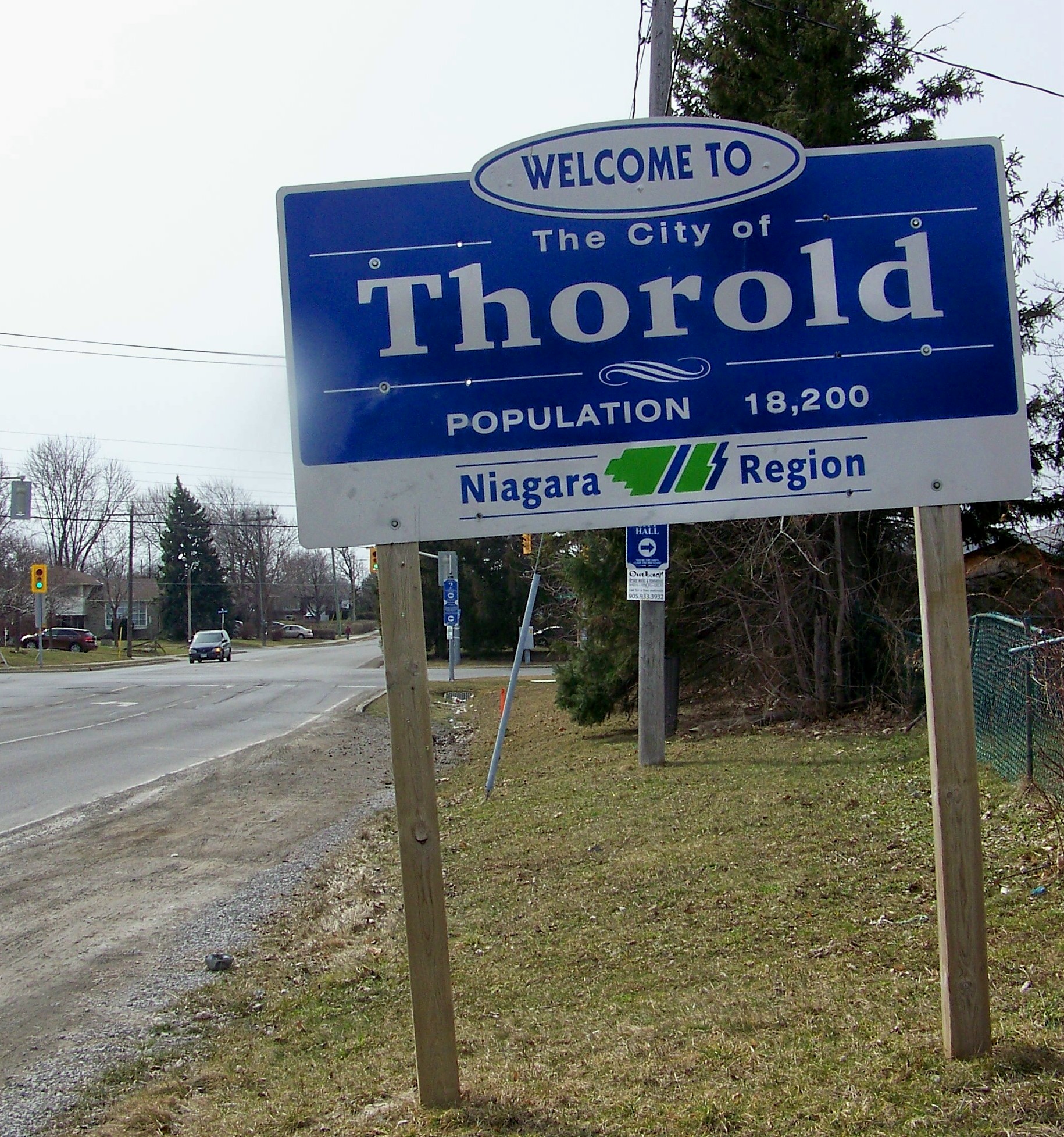
This commentary is willing to give up this sign, about a hundred metres away from his home, for one 'City of Niagara' if it might mean a more promising future. Let's at least have a good, open discussion about it.
I was born in Niagara, Ontario almost 60 years ago to this day and I sincerely hope that before I die here, I see signs featuring those words and an whatever the population figure happens to be at the time at every gateway leading into this region – east, west, north and south.
Enough of the same kind of talk I heard when I was a kid growing up in Welland and you had all of these folks arguing that if the two counties and 26 municipalities we had at the time were amalgamated down to one regional government and 12 local municipalities, all of these towns and villages like Crowland and Humberstone and Fonthill and Beamsville and Chippawa would lose their identities, and would probably end up getting short-changed on services too.
Last I checked these communities are still there and are benefiting from most, if not all of the same services people in the larger communities likes St. Catharines, Welland and Niagara Falls are getting – water, wastewater, household waste disposal and recycling and a host of other services they would probably never been able to afford on their own if they were not pulled in to a more regional fold. And now it is time to consider taking the last big step to one City of Niagara.
We have had more than 40 years now of a regional government in Niagara that has too often seemed afraid of its own shadow and 12 local municipalities that have more often than not over that time been engaged in turf battles over what services they still have jurisdiction over and competition over which one is going to get the next big box store or the new hospital or police headquarters, or whatever other prize catch might be out there.
Through so much of this, the larger question of what is in the best interest of all the people in Niagara has too often gotten tangles up in a web of more narrow, parochial agendas – sometimes to a point where proponents of what may be a plan that could benefit the region folded their tent out of a sense of frustration.
In a recent conversation this columnist had with Mike Watt, a Walker Industries executive who is working with a group of more than 40 businesses in Niagara to launch a ‘Great Niagara Chamber of Commerce’, he put it as well as anyone else. “If an industry is interested in coming to Niagara, why should it matter whether it goes in St. Catharines or Fort Erie or Welland. …. It is a win for all of Niagara.” The business group, by the way, decided to take matters into their own hands because, according to Watt and others, they have grown impatient with the regional government’s Niagara Economic Development Corporation and the economic development offices of five local municipalities in the region they feel have too often spoken for their part of Niagara rather than for the region as a whole.
Then there is the patchwork of planning departments across this region that are all understandably working for their own local councils. There are some good people working in these departments but the problem is they are trying to work new development proposals into municipalities that, in some cases, have little room for growth left in their existing urban boundaries. So much so that in the case of West Lincoln for example, that Niagara municipality is fighting to have its urban boundaries expanded into surrounding rural lands.
If we disbanded the local municipalities and had the whole map of Niagara to work on to decides where best certain types of residential, commercial and industrial development could go, we might finally get rid of this situation where every municipality is competing for a piece of the development pie. If we were all one ‘City of Niagara’, we have a better of locating new buildings, etc. at sites in this region that do not compromise what is left of our precious farming and natural heritage lands.

The 12 local municipalities on this map might work fine as 'wards' of a new City of Niagara.
Finally, there are services like transit, and water and wastewater. Waterloo region finally took over responsibility for public transit from local municipalities within the past decade and now has one of the fastest growing, best used municipal transit systems in the province, compared to the fragmented system Niagara has, run largely by three transit commission fiefdoms in Welland, St. Catharines and Niagara Falls.
On water and wastewater, an independent provincial study conducted about a decade ago noted that Niagara, which is one of the few regions left that splits the jurisdiction for these services between the regional government and local municipalities, cannot possibly deliver residents the most cost effective services possible if it continues with the status quo.
The problem is that successive regional and local councils have hardly demonstrated any real will to look at uploading services like this to the regional level. The last time we had any significant uploading take place in the area of household waste management. That was more than a decade ago now and it has resulted in one of the more successful waste disposal and recycling programs in the province, and one that Niagara’s smaller municipalities would have be able to afford if the region had not taken over.
A couple of years back, local municipalities barely delivered our regional government the triple majority it needed to launch a decent transit system in Niagara for people with handicaps and others with specialized needs. A bid to regionalize a transit system for the rest of us was turned down after Welland and St. Catharines – two of the three municipalities, along with Niagara Falls, that have transit systems of any note in the region – turned it down.
Like so many other bids for bring some of our services together under a single manager, you could almost see the wheels turning in the heads of so many of our local municipal officials on the transit file. In so many ways they were saying; ‘Wow, if the region takes over much more, how are we going to justify our existence.’ Never mind that a regionally run system here might offer the same expanding services people are enjoying in Waterloo, Halton and other regions.
That is why this columnist was so encouraged to hear Niagara Region’s new regional chair, Gary Burroughs, express his interest in beginning discussions later this year on the way our region is governed. When asked, he said he is willing to entertain a range of options, up to and including the idea of a single city.
I say bring the discussions on. Let’s all get engaged in them and together build the best governing system for present and future generations.
(Niagara At Large will do more on this issue and we welcome your views. Visit Niagara At Large at www.niagaraatlarge.com for more news and commentary on matters of interest and concern to matters in our greater Niagara region and beyond.)
For the full test of Niagara regional chair Gary Burroughs’ ‘State of the Region’ address click on http://www.niagararegion.ca/chair/state-of-the-region.aspx .
 Niagara At Large
I have never been a fan of Regional Government, since its inception. I see the vast amount of waste there– from the creation of NEDC (what a waste). It was impossed on Niagara by a Conservative (er, Progressive Conservative) govt of that time. Great way to build buidings full of employees and , most importantly, managers upon managers, upon managers — into a dead-weight system.
Has anyone ever asked how many middle-managers the RMof N employs? Anyone, Bueller, anyone? How many engineers?? The sinecure system at the RMN is highly suspect. Any questions, anyone?
Sure, employees have been enriched, and middle managers promoted to a level of incompetence right out of a Dickensian novel. See Brian Merritt run. Watch John (formerly St. Catharines engineer, then Regional engineers, then head of the NPC until he was thrown out last year, sorry, his name temporarily escapes). I sortof liked the idea of all these little municipalities doing there own thing. But no more.
The time has come, The Walrus said, to speak of many things…….
LikeLike
Pingback: Kill The Fiefdoms! It Is At Long Last Time For One ‘City Of Niagara’
Kudos Doug for profiling this serious debate about our local governance model! It’s time for all who care about ‘the divided house of Niagara’ and the high costs of our local government to become engaged and to take this on-going discussion to another level.
LikeLike
Excellent column! During the last civic election campaign, most people that I spoke with in St. Catharines recognise that it is time to amalgamate. I am so sick of the parochialism that takes place amongst our 12 lower tier municipalities! It is time for “One Niagara”!
LikeLike
The name that escaped me in my late night mispelled missive was John Kernahan.
The question of costs of dismantling the smaller municipalities, over time, concerns me. I have no economic background, and hope someone can explain how ‘larger is better’. The amalgamations of Chatham -Kent, and the city of Toronto were very costly to the taxpayer. They continue to be.
The example I think of is this. You have 12 “fiefdoms” with unionized staff (firefighters, librarians, engineers, etc) all making various salaries. When Toronto amalgamated, do you think the lesser paid of those fields would agree to continue to be paid less than the more highly paid ones, let’s say in Etobicoke? or Leaside? Hardly. They all upped their incomes to the highest of those working in those fields. That happened in Toronto.
So, I have no answers, only questions. And this from a now retired, but once unionized employee, who worked on negotiating collective agrements.
One Niagara will cost us. And our children and grandchildren. I would appreciate hearing from an economist on how this will be handled.
LikeLike
I’ve always had mixed thoughts on a “city of Niagara”. I would like to see better transit to other cities within Niagara.
Like Waterloo, I’d rather have “Transit Niagara” than individual city transits.
Having been born in Kitchener, I try to keep on top of its going ons. There has been plenty of talk about a city of Waterloo (Kitchener, Waterloo & Cambridge).
Personally I’d hate to see it. All three cities are completely different. Waterloo is more “up-scale” , cleaner and greener. Kitchener has become a dump since my family last lived there (late 80’s). In some cases it has become a suburb of Waterloo, despite being four times the size.
IMO if I lived in Waterloo, I’d be dead against it.
The biggest difference between Waterloo & Niagara is distance. You can be travelling along many streets downtown Kitchener and you’d never know you crossed into Waterloo.
Kitchener to Cambridge is less then St. Catharines to Niagara Falls.
My biggest fear is we’d become another ‘Toronto’.
The actual city of Toronto has a completely different attitude and different priorities than Etobicoke, Scraborough, North York and any other suburbs that joined.
Look at their last municipal election. It pitted the old city against the suburbs.
LikeLike
I know that there is a lot wrong with the status quo in this region; nevertheless, I urge readers to take a good, long look at those Ontario municipalities that have amalgamated. The further from the urban “centre” of an amalgamated city such as Toronto or Ottawa, the higher the degree of dissatisfaction with amalgamation. What have those residents gained from amalgamation? Higher property taxes, and fewer services. Why do you think Niagara is going to be different? After all, our regional government has not exactly distinguished itself by its concern for the southern tier municipalities. Of course residents of St. Catharines and its satellite municipalities, Thorold and Niagara-on-the-Lake, support amalgamation. As as resident of Welland, I have yet to be convinced.
LikeLike
You would be mistaken in thinking residents of NOTL would support amalgamation.
We wouldn’t mind if the rest of you all amalgamate – just leave us out of it.
Regional government already costs us twice as much per capita as any of the other eleven fiefdoms – so you can keep it!
LikeLike
Doug thanks for another interesting article, although arguing for amalgamation sounds like a thesis waiting for it’s antithesis.
Why, because if amalgamation was always in the public interest, we should really be talking about amalgamating the entire golden horse or perhaps creating one giant city called the city of Canada that would extend from coast to coast.
If that seems like a silly idea, consider that there could be legitimate reasons why people want decisions made by local officials that live and work in their community and have a shared common interest in the decisions that are made.
I’ll wait for the, “Why we shouldn’t Amalgamate” article before coming to any conclusion. 🙂
LikeLike
Sorry for any confusion caused by my reference to the “golden horse” – that should have read as “golden horseshoe”.
LikeLike
Hiya, I’m really glad I have found this info. Today bloggers publish only about gossips and web and this is really irritating. A good blog with exciting content, that’s what I need. Thanks for keeping this web-site, I’ll be visiting it. Do you do newsletters? Can not find it.
LikeLike