
A Commentary by Doug Draper
Here is one helluva plan to pursue while the cost of gas and diesel fuel keeps going up, up, up.
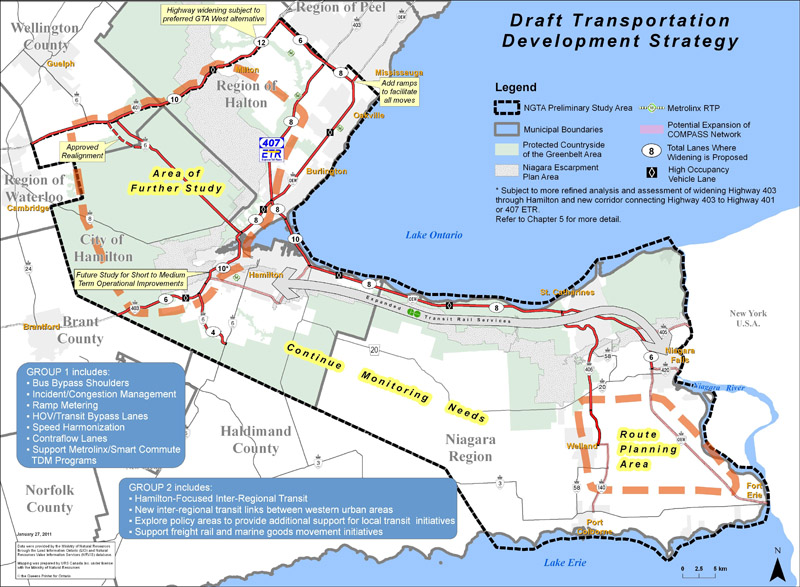
Click on this map to blow it up and note the words 'Continue Monitoring Needs' to view where a mid-peninsula highway would go.
Take two or three billion dollars and use it to build a multi-lane highway right through the heart of Niagara’s countryside. And never mind that by the time the plan is approved (if it is approved) and the highway is opened 10 or 20 years from now, cost of gas may be up to 10 a litre (that’s about $40 a gallon for our U.S. readers), and we might be experiencing enough of a global food shortage to wish we never paved over all that farmland.
Then again, why let a few things like that keep us from marching backward to the last century when a number of our provincial and municipal leaders latched on to the idea of constructing a “mid-peninsula highway” south of the Niagara Escarpment as an alternative to adding more lanes to the QEW.
The Ontario Ministry of Transportation, in a years-long study of the region’s transportation needs that the provincial Liberal government placed under a relative stringent “environmental assessment process” for vetting projects for their impact on the landscape, decided last year to place the highway idea on the backburner for at least a couple more decades while transit and other alternatives are pursued. That decision was reached after repeated consultation with numerous individuals and groups across Niagara and the Hamilton and Burlington areas. It was a decision that has been applauded by many individual citizens, along with environmental, farm preservation and other community groups, but it isn’t sitting well with some of our politicians.
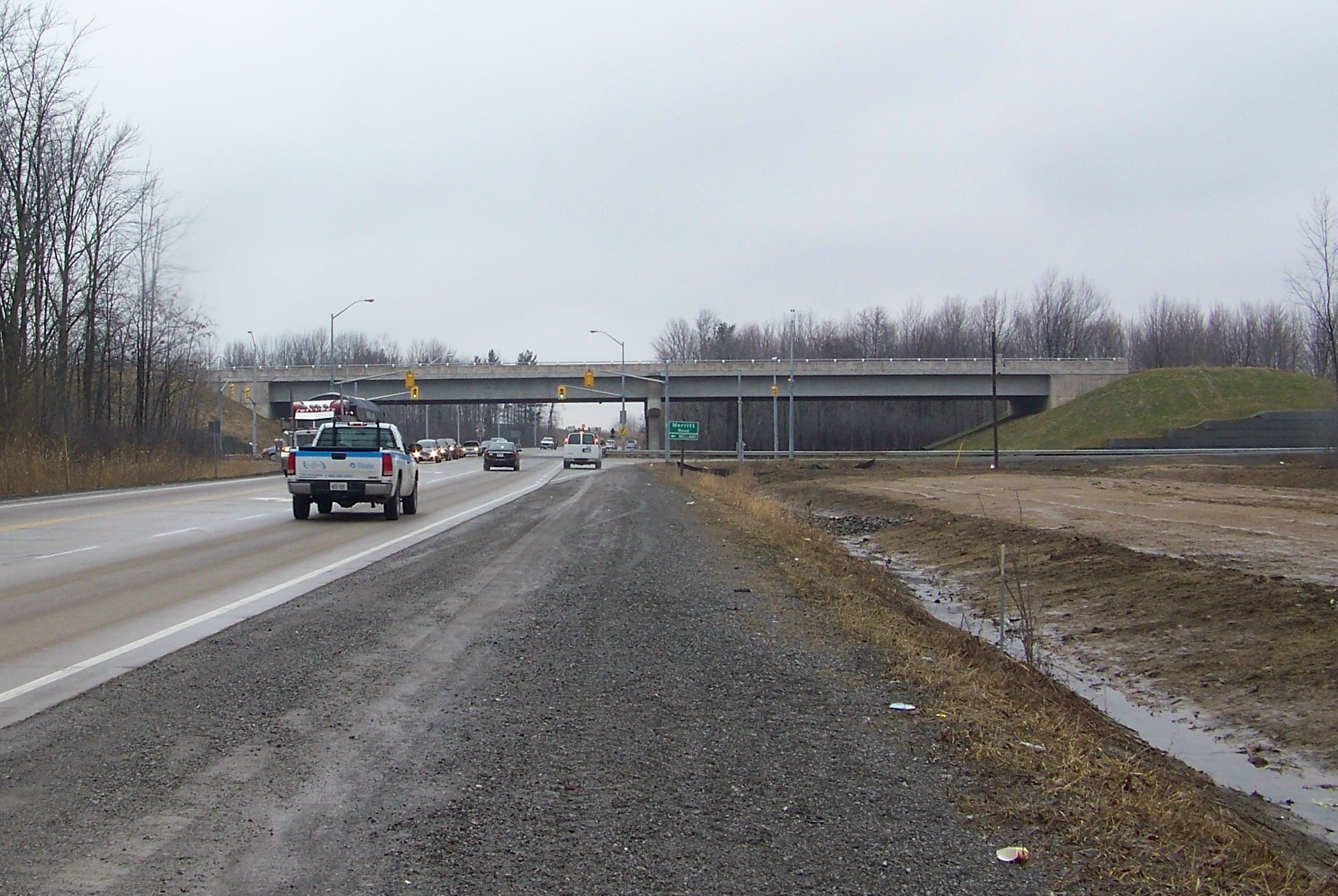
Hwy. 406 expansion is underway near new overpass in Welland. Photo by Doug Draper
Ontario Conservative Party leader Tim Hudak continues to view the mid-pen highway as essential to the region’s economic future and vows to put it back on the front burner if he becomes the province’s next premier. And a majority of Niagara’s regional councillors and mayors voted a month ago to press the provincial government to get the mid-pen project back on track. There may be a bit of a problem there, though.
The Ontario Environmental Assessment Act was written in a way that is supposed to ensure that any and all projects subjected to its scrutiny are weighed objectively against any and all other alternatives to a project without political interference. Many citizens in Niagara found that out in the late 1980s and early 1990s when the same legislation subjected plans by a then-Crown agency, called the Ontario Waste Management Corporation or OWMC for short, to locate a giant hazardous waste facility in rural West Lincoln. Residents’ groups and local politicians went to three successive provincial governments – Conservative, Liberal and NDP – in an effort to get them to kill this proposal while it was going through an environmental assessment review, and all of them said they couldn’t interfere politically in the process.
The good news is that in this case – and I’m getting to why it is ultimately better to trust the environmental assessment process than political agendas (and there were more than a few politicians back then that would have simply shoved this toxic waste toilet onto the farm fields of West Lincoln without a full review) – the review ultimately rejected the OWMC plan.
So for the province’s opposition leader, Tim Hudak, and a majority of Niagara’s regional councillors and mayors to now say, in so many words; ‘Let’s interfere in the environmental assessment process’, isn’t much different than more than a few politicians in favour of building a toxic dump in this region to compromise a full environmental assessment review on that one.
One thing Hudak doesn’t want to remind us of all that clearly is that the former Conservative Mike Harris government he was a part of placed the mid-pen highway idea under a much less stringent “Environmental Protection Act” that, as St. Catharines MPP and Liberal cabinet minister told Niagara At Large in a recent interview, says; “Let’s build a new highway, and then we will decide where it goes.”
Forget about alternatives, including the possibilities of expanding highways like the 406, or improving Go Transit to Niagara or encouraging residents using the QEW to go to the GTA in this region to consider car-pooling or anything else. Let’s just build another highway that will obviously destroy more of our farmlands, and compromise wetlands, woodlots and other natural areas along the way.
If we can’t get past what is left of the politicking in this region by those who still can’t get over the possibility that the day and age when cars and trucks, as the major way of getting goods and people around, may be coming to an end, then let’s build move head with the mid-pen highway.
For those among us who can look past this mid-pen highway business to other possibilities for getting around as oil becomes ever more costly for our pocketbooks and our environment, check out the latest reports released from the Ministry of Transportation by the so-called Niagrara to GTA (NGTA) study team.
You can review the latest material and offer your feedback on where we should go on the transportation front by visiting http://www.niagara-gta.com . Or if you would rather phone to share your feedback, you can call toll free at 1-866-890-6441. You can also review paper versions of the latest draft reports by the NGTA by asking for them at main branches of your local libraries, and at local and regional municipal headquarters.
Get your word in on this one now. Visit that site and don’t let a handful of politicians set into motion a multi-billion-dollar super highway project that we and our children and grandchildren in this region may regret was ever built for the rest of our lives.
(Share your comments on this issue below and visit Niagara At Large at www.niagaraatlarge.com for more news and commentary on matters of interest and concern to residents in our greater Niagara region and beyond.)


We need a corridor of wind farms on top of the escarpment, and fast train lines (European style), below the escarpment. As long as highways are built, there will always be gridlock. More highways do not translate to less gridlock.
LikeLike
Wind Farm corridor across the escarpment? Is no protected land safe from this agenda?
LikeLike
1. Strangely enough, wind turbines on the top of the escarpment don’t get enough wind to justify building them.
2. During the Green Energy Act debates, there were concerns that it didn’t support farmers – they weren’t allowed to supplement farm income by removing a modest amount of farmland to locate turbines and ‘farm the wind’. Can’t remember how that settled.
LikeLike
Pros and Cons to the Mid-Peninsula Corridor:
When Ontario built the Queen Elizabeth Way (opened by the Queen in 1939), no one knew that development follows highways. In fact, the government of the day debated whether the QEW should go ABOVE or BELOW the Escarpment and then said, “Let’s let our American friends see our beautiful fruit belt.”
The net result is that there is hardly any fruit belt left – certainly none between Hamilton & Toronto. (And look at how little rural land exists along the 406 corridor.)
If we expand the QEW corridor, how long will the children of the few remaining fruit farmers be able to resist the temptation to sell their land to developers or factory farms, after their parents die?
“They can’t do that,” you say, “McGuinty gave us a Greenbelt law.”
Sure we do. We also have a democracy that responds to people. Look at how McGuinty sways in the wind of his own Green Energy Act, changing it so often that the green industries he wants to attract are looking askance and putting the brakes on building new factories and jobs here. (See the Ontario Energy Association’s recent blueprint: http://www.EnergyOntario.ca )
Furthermore, look at how many of us are NIMBY [Not In My Back Yard] about wind and solar farms.
Mind you, we could petition McGuinty to bring us new jobs by locating the 2 new Darlington nuclear reactors in Niagara. This would avoid having wind turbines in our rural areas. After Japan’s Fukushima fallout, the neighbours of the Bruce, Pickering and Darlington plants will soon be NIMBY-ing to shut down their nuclear plants which provide 50+% of Ontario’s ‘hydro’ – and with good reason, eh!
You make sense Doug, about how the cost of fuel & electricity will soon mushroom upward and change our economy forever. Much less driving to fewer low-paying jobs. The few people left in Niagara will need to move within walking or bussing distance of Niagara North’s one-super-hospital-for-all (right beside the next railway tank-car derailment). The rest of us will need to move to work in the high-rise corridors of the Greater-Toronto-Area, after selling our cars.
On the other hand, maybe Niagara will expand our quality Nursing Homes as future industry (our older demographic is already 2nd or 3rd after Victoria BC). Homes-for-the-Aged congregate people and reduce the need for travel. By then, they’ll have perfected e-visiting by Skype and virtual-visiting by Wii – no need to travel at all, eh? “Go everywhere and stay in your own apartment!” (Shades of that science-fiction story we read in high school in the 1960’s, The Machine Stops – copyright 1928!).
After we abandon our small towns to rural-dom, another solution will be to just shut our eyes while the human traffickers of the earth ship in illegal immigrants. We’ll barely even notice – remember the ship that dropped off those East Indians one foggy morning in Nova Scotia ~1980? Canada is ’empty’ compared to the rest of the world, and will be even more so once we all live in only ~10-20 big cities.
Yessir, we don’t need more industry or jobs in Niagara South. We’ve been de-industrialised by the cost of nuclear power in the 1970’s and we like it that way. Let them build on the fruit belt, or replace subdivisions with sky-scrapers in St.Catharines-Thorold but we don’t want anything new in Niagara South!
PS. Don’t ask Trillium Railway where they think the Niagara GO Train route should go – it might cause development in Welland.
LikeLike
This won’t happen, but in light of the nuclear disaster in Japan, we should shut down much of the nuclear in Ontario. There is, for example, a fault line in the lake near Darlington. If we were to shut down much of the nuclear (some would say all), and all of the coal, we’d have to live and adapt to sky-rocketing electric rates, scheduled electric shut-downs etc. And we’d see alternate energy innovations sky rocket. Japan’s scientific and technological expertise is extraordinary, and it still happened to them. A catastrophe could happen to us, and it’s probably much more likely than we’re lead to believe.
LikeLike
“Insanity is doing the same thing over and over again and expecting different results.”
LikeLike
The unfortunate thing is that the the lack of a mid-peninsula corridor is a major contributor to the impoverishment of South Niagara. Communities isolated from the mainstream of life soon loose their existential imperative as sustainable communities. They wither as young people vote with their feet, moving to growing areas. At the end of the process, South Niagara will be left with pockets of poverty, dependent on welfare or some other redistributive mechanism. But the march of ideological urbanization is relentless. The “hinterland” will be doomed to depopulation and economic ruin.
It would be interesting to poll urban vs rural support for a mid-pen corridor. My suspicion is that most of the oposition will be shown to come from well served and highly urbanized St Catharines that has little understanding of the fundamental life needs of South Niagara. Exhibit ‘A’ would be the choice of location for the new hospital.
LikeLike
Chris: I agree that South Niagara faces a lot of challenges, but don’t think that a new mega-highway is the magic bullet solution for them. St. Catharines has two highways ripping through the center of it, and it is hardly a paragon of economic and social vitality and youth retention. Bigger forces are at work in the impoverishment of South Niagara than the lack of a mega-highway passing through it. If your concern is, as you say, for alleviating poverty, cultivating sustainability, and retaining youth in southern communities, then spending hundreds upon hundreds of millions of dollars of public money on a destructive highway project of dubious use is not really going to give you the best bang for the buck. Some of that money would be better used, for instance, in reopening emergency rooms, providing education and retraining for laid-off workers, strengthening transit and other public amenities and infrastructure that might make south Niagara an appealing place to live, and targeted investments in sectors that could lead to new jobs.
LikeLike
Hi Denis
Your points are quite valid. No less than you, I would like to see Niagara as my own idylic & private Walden. However if there is no work, then the population leaves. The questions then become: Emergency rooms for whom? Retraining for what jobs? Transit to where? Targetted investments by which industry? and why would they locate in areas without roads?
Why do you think schools and hospitals in Fort Erie and Port Colborne have closed? Because there was no bus service to St Catharines? or because the population has been decimated to the relative point that the bloodless actuaries at Queens Park can defund us with impunity?
The bottom line is that South Niagara may have missed the boat. At this point other areas such as Waterloo region, Hamilton and North Toronto which were not squeamish about building roads now have the jobs, which in turn generate the critical population mass required to warrant hospitals, schools, and local transit. Even the Romans knew that roads were the key.
My angst is very site-specific. South Niagara is being hollowed out. That sucking sound you hear is money and people being hoovered out of the area. And that, dear Denis, will not be cured by idealistically unsustainable 5-year “great leaps forward”. It will only be cured with nasty dirt-on-your-boots hard unpleasant decisions. A mid-pen corridor is but the first of them.
Regards
LikeLike
Well, no. No to the idea that the highway would bring the right kind of growth along its corridor. Just look at Grimsby to Stoney Creek. Is that what we want?
The right kind of growth in this century discourages car travel in favour of mass transit. Do we really think we can still build around, as Doug so aptly put it, 20th century transportation? The total faith in unending oil supplies, being able to continually grow as we have in our short experience, believing that sprawl is OK as long as it creates jobs…. Sorry, it is fantasy cure all and it would be a wasted investment in the wrong kind of infrastructure.
South Niagara, make the most of what you have, which is considerable, and be glad your are not Stoney Creek.
LikeLike
The flavour of this last letter would suggest the writer is not from South Niagara, and I would venture, gainfully employed or retired in comfort. Such “I’m all right Jack” attitudes often yield unpleasant political consequences. I am certain the disenfranchised, the unemployed, the impoverished, those who have had their hospitals reduced to first aid stations, the voters and tax-payers of South Niagara don’t appreciate being told to shut-up, take the bus and be grateful…or move.
LikeLike
Chris, it was certainly not my intention to be disrespectful of those in South Niagara. I am concerned about poverty and have been working closely anti-poverty groups across the Region for the past 30 years. So I apologize for not being clear.
My intention was to say South Niagara, like a lot of other rural communities in Ontario without current location advantage, will and should remain predominately rural for the foreseeable future. I’m sure the others rural communities want highways too, just like they wanted the railroad in the 19th century. Some got it and prospered for awhile and those that did not faded. Some of those that prospered are now barely alive as transportation technology changed. My argument is because of global warming and resource depletion, the economics of the delivery of goods will require a systemic change in transportation. That will inevitably make the new highway an expensive white elephant.
Many are expecting (think Jeff Rubin and his “smaller world”) that rail will come back as well as lake shipping. South Niagara’s location will become an advantage. The canal economy is likely to return as local manufacturing booms due to higher carbon based transportation costs. That will set up Welland and Pt. Colborne nicely for the future.
Meanwhile, wanting the highway because of a poor location choice in the 1950’s does not make a new highway the right decision today. The location of the hospital in St. Catharines was also a poor choice. That still does not justify the highway so that South Niagara can grow in population to justify another large hospital. There are other ways for health care to be delivered and that is a separate political issue and one I support.
Niagara needs much higher urban density to pay for needed infrastructure. Despite what some cherry picking subdivision developers say, there is a lot of room left or that could become available in our larger urban districts. The sprawl inducing highway will only make healthy cities with diverse walkable neighbourhoods that much more difficult to develop. Further, the highway capital and operating cost could be put to much better use to improve mass transit access to jobs – especially needed when oil hits $10 a litre.
I remain convinced a new major highway to serve the outdated and unsustainable growth vision of small centres is not in the long term best interest of Niagara.
LikeLike
I like your answer Dick, but I’m not sure where you stand on the hospital issue. Especially given the new hospital’s location, we absolutely need Emergency Rooms/hospital(s) in the southern tier. Time-critical emergencies etc. demand it.
LikeLike
Dick:
You’ve forgotten that Niagara is NOT rural; while it does have large rural areas, it’s mainly Small-Town: Fort Erie, Port Colborne, Welland, Fonthill, Niagara Falls, much of Niagara-on-theLake, Beamsville, Grimsby, Smithville.
However, as you implied, and others noted above, current ‘rules’ and conditions encourage us to concentrate everyone in high-density urban areas, despite the high cost to do so in crime, insurance, etc. (rates for most of which increase as you approach the centre of urban areas, documented since the 1920’s!).
We’d still have heavy industry in Niagara, if Ontario hadn’t equalised the power rates in the 1970’s so that Toronto wouldn’t have to pay for Pickering’s then-new nuclear power. Our cheap Niagara Falls hydro helped to balance expensive nuclear rates for those many Toronto voters.
As an example, Port Colborne declined from 23k people in 1970 to 16k ~1985, and hasn’t quite crawled back to 19k today. For some reason (Free Trade?), Fort Erie went from 22k to 30k, but will likely decline since the Yanks have ‘closed’ the border.
LikeLike
“Free trade”, especially Chapter 11, has been very expensive. Welland’s situation — we just lost another large employer (Henninger)– is typical. We can thank “free trade” for the P3 hospital mess as well.
LikeLike
Is it Free Trade -which guaranteed access to the USA market, from which our Yankee cousins regularly tried to exclude us-
(imagine how much industry we would have lost with NO Free Trade since 1988)
OR
the cost of Electricity which drove out heavy industry that had located in Niagara over the previous 70+ years because of the Welland Canal and cheap Niagara Falls hydro:
Welmet, Union Carbide, Welland Tubes, Wabasso, Atlas Steel, John Deere, Henninges, Canadian Furnace (Algoma Steel), Inco, Robin Hood Mill, Nabisco, Horton Steel, and several others which served these, including several shipping companies which are now mostly consolidated in Algoma Central Marine.
BTW, could Free Trade have been better applied? You bet. Regardless of wage rates, we should have set up a system to guarantee that tariffs were set by comparing other countries & companies with ours – labour & environmental laws, CPP, EI, Workers Comp, OHIP, etc.
LikeLike
I won’t play the “would have, could have game.” The bottom line is that the current “free trade” system is costing us too much, and when I say “cost”, I’m also referring to cultural issues which we as Canadians value. “Free/corporate trade” is underming our health care (chapter 11, NAFTA), making it more costly for taxpayers (user fees), and far less efficient. Our social programs etc. are suffering, while taxpayers are being burdened further with corporate welfare in the form of corporate tax cuts, bailouts, externalized losses etc. Faceless corporations are dictating to us too often, and then they leave town anyways. A healthier country with better health care, more accessible higher education (lower tuition fees), more progressive infrastructure, fewer social disparities, better environmental stewardship,will attract people and corporations more than further corporate tax cuts and flashy attack planes.
LikeLike
Mark. You are off topic.
LikeLike
Mid-Peninsula highway is a bad idea. We need that land for wind farming and solar panels.
LikeLike
The mid-Pen highway would be an expensive white elephant I would also be paying for and benefiting ZERO from, along with anybody else that either cannot driver, cannot afford to drive or does not have access to a personal vehicle. This will only place jobs along this new highway, more jobs that non-drivers cannot access. Why build the world for more cars, which excludes about 25 – 30% of the region’s adults that don’t drive? We need to be moving towards smart growth, urban density and alternative modes of transportation, like yesterday …
LikeLike