
A Commentary by Fiona McMurran
When I first heard about the proposed DSBN Academy, I thought it was a joke. A bad joke.
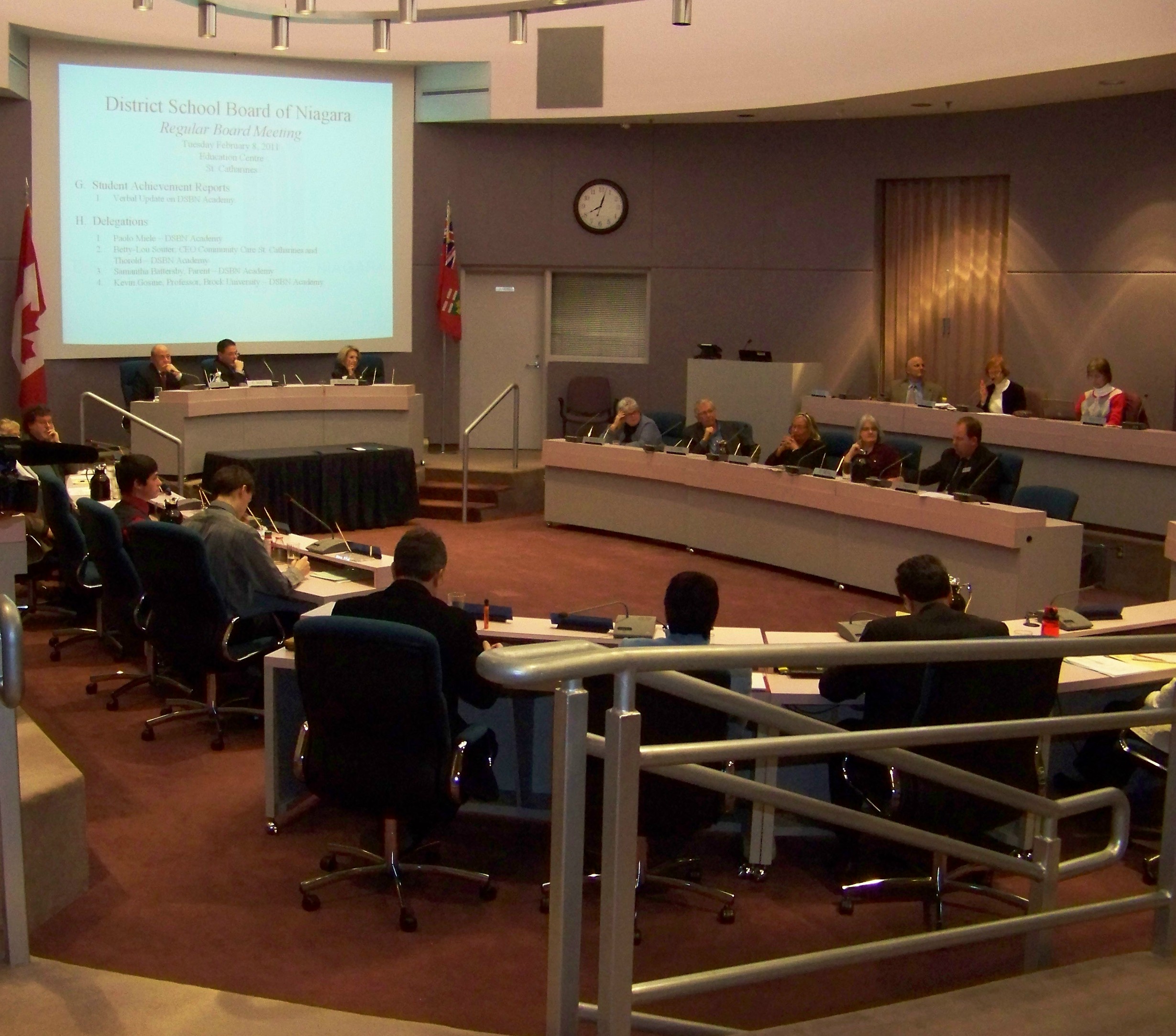
A public board meeing where, once again, the board supported opening a shool for the poor.
In the hopes of getting a more balanced perspective by hearing for myself the District School Board of Niagara’s rationale for this project to establish what has been described in the media as a school for students from low-income families, I attended the board’s meeting on February 8. I didn’t get the information I wanted from DSBN officials and trustees. What I got was a selling job on a proposal that nobody seemed to be able to adequately describe, let alone defend.Everything I heard was contradictory. “It’s not going to cost anything,” I heard. So where are the teachers coming from? Why is okay to house Academy students and staff in a building in serious need of structural repairs? At a time when the public education system is so strapped for cash, where is the rationale for spending a million dollars, over the seven-year period of this experiment, on bussing? Surely education dollars should be put towards education, not transportation.
Most of all, I missed any sort of credible argument for the establishing of this Academy. I agree with the many objections to this school voiced by residents all over Niagara, and so I will not restate them. In my view, it is up to the DSBN to justify this project; and I think they have failed to do so. If Board members think that continuing to chant a simplistic truisms about “brighter futures” constitutes justification, then they are the ones in need of further education. Post-secondary is about learning how to learn. How to frame sensible questions. How to research topics. How to come to conclusions from that research, by using a mind trained in logical argument. I haven’t seen any evidence of that from the DSBN.
The proposed Academy flies in the face of an entire generation of education policy. My 26-year-old autistic daughter spent her entire academic career in DSBN schools. She profited immensely from the individual attention she received from dedicated special education teachers, and the result of this attention is that she continues to be curious, to learn (with help), and to read to herself. Samantha also profited from being part of the community of a regular school. It was the proudest moment of our lives when Samantha graduated from Stanford Collegiate. She participated in the graduation ceremony along with other students graduating in that year; when Samantha came onto the stage to accept her diploma and punched the air with a victorious “Yes!” the audience of students and family members burst into applause and yelled, “Way to go, Sam!”
Schools that separated students with special needs from their peers have long ago been closed. If this policy is now being revisited, do we, as taxpayers, as parents, not have the right to know why? Do we not have the right to demand the justification for such a volte face as this Academy proposal represents?
After the Board meeting of Feb. 8, I was determined to return for the next one. When I walked into the DSBN Headquarters on the evening of Feb. 22, I saw a very different group of people from those who had attended on Feb. 8. The public session of the Board meeting had not yet begun, and the lobby was full of people – not surprising, given the amount of controversy the issue of the Academy has stirred up. Yet this group was unusually homogenous. Everyone seemed to know everyone else. New arrivals greeted others with pleasure, but without surprise. Clearly there had been some lobbying going on.
Finding a seat inside, the sense of a set-up became even more evident. DSBN staff and board members were greeting audience members, and, in some cases, organizing seats for them as well. A DSBN staff member solicitously seated three audience members beside me, who I later learned were Mrs. Connell, her young son, Sean, and her adult daughter. Sean and his mother had been featured on Mark Kelly’s program on CBC television, focussing on the controversy around the Academy. The CBC interview with the Connell family was shown as part of the update on the Academy given by Superintendent Stainsby.
The first of the four delegates to speak was Linda Crouch, a candidate for trustee and a mother of a child of the age to apply to the Academy. Ms. Crouch had not been alerted to the Academy proposal prior to running in the October election; she has been supported in her objections to this lack of transparency by other trustees and candidates for trustee. She attended one of the 19 presentations at elementary schools that the DSBN had hosted for parents of children in grades 5 and 6, during the fortnight between the Board meetings. John Stainsby at that meeting announced that the Academy would now be open to students whose parents had had some college or university education. This, in addition to its earlier decision to remove the criterion of poverty for applicants, certainly looks as if the DSBN is countering complaints from the public by undermining its own rationale for the Academy. What is going on here?
What kind of promises do proponents of the DSBN Academy hold out to potential applicants and their families? It is all to the good for local students to aim for a decent job or a professional career, but a post-secondary education is no guarantee of that, as far too many recent university graduates can attest (see the link below to read an article on student debt in this week’s Brock Press).
I don’t know where the DSBN gets its research data, because all that proponents of the Academy have produced so far is opinion. Where are the statistics to support the argument for the establishing of this program? The accompanying assumption—that the “problem” of lack of student motivation to continue their education past high school is a direct result of economic hardship and/or lack of parental support—has not been proven. Moreover, there have been many indications that post-secondary institutions are in fact often failing to produce graduates who have learned how to learn, to research, to use their education creatively to solve problems—in other words, to bring Canada into “the knowledge economy” we hear so much about.
Post secondary education offers more than it currently delivers. It has been gobbling up tax dollars at an alarming rate, much of it expended on bricks and mortar, rather than faculty. Increasingly, private corporate donors influence the research agenda at our public postsecondary institutions. Classes in Canada’s universities have ballooned in size, diminishing the educational value of college and university to the individual student.
In addition, tuition and associated fees have increased astronomically, so that many students cannot afford to devote full time to their studies because they have to work, often at more than one part-time job, to maintain themselves. An oversupply of graduates with bachelor’s degrees has met a shrinking job market, with the result that far too many are living at home with parents while trying to pay back student loans. The response to this on the part of both government and the post-secondary sector is not to take a serious look at the real function of postsecondary education, but to pour more resources into it. Students desiring a career in a particular field are now obliged to do master’s degree—thereby accumulating more debt. Where are the jobs for these graduates? Not here in Niagara. Is this a reasonable way to break the poverty cycle in Niagara, by encouraging still more of its young people to leave the Region?
My personal opinion is that if education in the DSBN is so ineffective that an articulate, intelligent, and motivated young man like Sean Connell cannot count on being given extra help in his own school, then something is dreadfully wrong with the public education system in Niagara. Singling out a handful of students for the Academy seems to me to be a means to ignore the problem, rather than to deal with it. Is this fast-track program actually designed as a training ground for future teachers enrolled in Brock Faculty of Education, and to provide a self-contained research project for faculty members? If not, then why are Brock University and Niagara College so interested in the project? If so, then at the very least the Academy should be a joint project between the Ministry of Education and the Ministry of Colleges and Universities.
There are far too many important questions surrounding the DSBN Academy for the Board to simply close ranks and refuse to respond.
Fiona McMurran, a Welland resident, is a graduate of Brock University, and a lapsed Ph.D. candidate at the University of Toronto. As a university lecturer, she has taught undergraduates at Brock and Trent Universities, and at the Scarborough and Mississauga campuses of the University of Toronto. She is unemployed, with a large student loan that she hopes to live long enough to repay, but has no regrets about her (perhaps unwise) choice to pursue higher education.
The Brock Press article on student debt can be accessed by clicking on www.brockpress.com/home/index.cfm?event=displayArticle&uStory_id=09e3fbf6-ef11-429c-9c04-ae0f098adcce
(Visit Niagara At Large at www.niagaraatlarge.com for more news and commentary on matters of interest and concern to residents in our greater Niagara region and beyond)
 Niagara At Large
If you are interested in alternatives to the DSBN Academy project that are more community-based, with students getting the assistance they need without having to go to a separate school, then come to the Niagara Education Community Forum on Wednesday, March 3, from 7:30 to 9:30 p.m., at the Rose City Kids’ Centre, 99 East Main Street (opposite the court house), Welland. The organizers include Laura Ip and Kevin Gosine, Brock sociology professor, who spoke to the DSBN Board meeting on Feb. 8, and has written about other options for assisting youth in the community. In particular, Prof. Gosine is experienced with the Pathways Canada program. This program, along with Success Beyond Limit, will be explored tomorrow evening. The four organizers invited the DSBN to participate, to give local residents more information on the Academy—the Board has recently declined. Q.E.D.
LikeLike
Excellent column and for your thoughts shared, thank you Fiona.
I believe that this debacle is the DSBN’s undoing, as each step is more ludicrous than the last one. and exposes the DSBN’s hierachy for what it is. How sad for our 39,000 DSBN students and the Niagara region taxpayers who pay for this board, whether they have children in the system or not.
The Minister of Education has to step in, it’s the only thing that can help us….and them.
LikeLike
Well said Fiona!
LikeLike
Fiona you never cease to amaze me with your fantastic insight into the reality of Education and the complete lack of insight put forth by people too highly paid in the administration especially when they are “permitted” to be responsible for the foundation building for our children’s livesw.
My recent response to a local editorial
Taxpayers right to KNOW
Walter Sendzik’s points are well meaning and taken as such but what this article fails to address is the “Old Boy Mentality” that exists throughout certain areas of the Niagara Region. What the DSBN did was eliminate open discussion from the taxpaying public by the use of backroom dealings and gag orders. This is not a new phenomena for it was employed by the NHS prior to and during the implementation of the HIP. The only open meeting held by the NHS was in the busy hallway of the Welland YMCA (They were offered a room but refused)
Most times when people understand a problem or set of problems they will go along with what is considered to be the best and maybe the only solution, but at least they should have the opportunity to know the causes and then have input into the solution…
This is rarely done in this Niagara Region as certain unelected people’s heads become bigger and they feel its their way or the highway. WE NEED ELECTED PEOPLE who are “REPRESENTATIVE” of the people not their own grandiose perceptions of their own intellect and know it all.
Solution; Trust the Intelligence and input of the taxpayers who pay the bills.
Joseph A. Somers
17 Lyons Ave
Welland, On
L3B 1L8
(905) 734-7037
LikeLike
My apologies to STAMFORD Collegiate for the typo in the above article.
LikeLike