
By Dylan Powell
Four hundred million animals. Twenty million in Canada. Eighty per cent on fur farms.
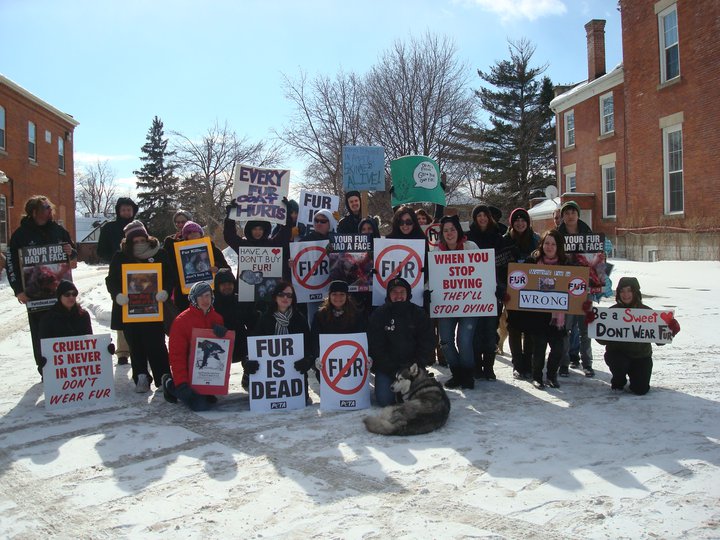
A recent Niagara rally against the fur industry.
Those are the stark statistics that surround our domestic fur industry, an industry which in recent years has attempted to re invent itself, moving from coats to trims, from the West to China (and back again) and from blight to “green.”
This past February 12, I joined a group of concerned citizens along with the Brock Animal Rights Club and more than 20 demonstrations across Canada, to shed light on one of Canada’s cruelest industries for National Anti-Fur Day. Protesting on the corner of Ontario St. and King St, next to Henry’s Furs.
We held signs showing the graphic results of skinning animals, and provided literature to urge the public to rethink their position towards the fur industry.
The 2nd annual demonstration at this specific location, this one saw numbers swell from 25 to well over 40 and the diversity of the crowd was heartening.
The hope of this idealist is that the population is slowly raising its consciousness in regards to how we treat other animals and the planet we share with them.
For those keeping track there certainly is some cause for hope; recent fur farm bans in Austria, Croatia, Switzerland and the UK, debates to ban the fur farms and/or the trade entire in countries like Israel and Sweden and Truth in Fur Labeling Legislation recently passed in the United States, all point to this.
The Truth in Fur Labeling Legislation, just passed recently, is most intriguing for those fighting against the fur industry in Canada, as it is a precedent that activists and politicians believe can be brought north. There are two private members bills currently in the works in Canada which resemble the U.S. Legislation, one sponsored by Anita Neville (Liberal) and one by Bill Saskay (NDP) and the Green Party released a statement last week in support of such legislation.
The Legislation itself works to stem the tide of cheap cat and dog fur from China being sold as fake fur in our markets by requiring that all fur be labeled by species and by country of origin. This is a dirty little secret of our marriage of convenience in animal trade with China (they import a lot of our fur and seal products) and most Canadians do not know that the fur they are wearing, even if labeled faux, could in fact be from the hide of a cat or a dog.
Considering the close relationship our culture has with those species, Truth in Labeling could have massive consequences for our fur and seal industry, two industries that are regulated solely by supply and demand.
For those wishing to learn more about how to press the Canadian Government for Truth in Fur Labeling Legislation, please contact the Brock Animal Rights Club at brockanimalrights@gmail.com. For those who wish to have a peer into this industry, embedded below is a short documentary from Sweden, compiled of undercover footage from inside the fur industry.
Unlike Canada, Sweden actually has laws in place for strict regulation of fur farms, however, enforcement and oversight always lacks for industries more interested in profit. I caution that the footage below is very graphic and disturbing. You can view it by clicking on the following website, http://theveganpolice.com/main/?p=1338 then navigating to a link that will take you to the video site. At that point Niagara At Large cautions you that you appear to have to register to view the footage by entering your email and a password. Some may not wish to share that information with an unknown entity.
Dylan Powell is a resident of Niagara, Ontario and longtime advocate for the humane treatment of all creatures great and small.
(Visit Niagara At Large at http://www.niagaraatlarge.com for more news and commentary on matters of interest and concern to residents in our great Niagara region and beyond.)
 Niagara At Large
A great article. I have participated in this demo many times in the past but there was no mention of it in my email messages, otherwise I would have been there. At any rate, I will be there next year. Keep up the good work!
LikeLike
When the first people lived, to survive, they used fur, as part of that survival. But also, every bit of the animal was used of necessity. Prayers were offered in gratitude to the animal for giving it’s life. The respect was there, and survival took the form of warmth, food source, and shelter. Then also, the bones used for hunting implements, and art.
It truly was firstly, for survival. As we have become more conscious, we realize that these creatures depend on us for their survival, and we ask ourselves do we have the right to kill these animals, when there is no need?
I was once a wearer of fur. I was cold when it snowed, and the fur was warm, and at the time, I thought luxurious as well. I rationalized that I purchased mine from a money making sale for a church or other organization. I did sell them to others as well, and supplemented my own income as a single mother of three.
Now, I know that I have responsible choices to make and have researched other ways to keep just as warm. I felt good that people were taking the side of the animal as some were facing extinction, and besides, animals need others to stand for their rights. We are the ones on the top of the list to help these animals.
We can look back and remember the scenes we have looked at, picturing the mass murder of Buffalo, the safari hunts where mass killings of animals took place for trophies. I hope that people continue to learn about ‘wants’ vs.
‘needs’. It is a complex issue, but can be simple by just saying no. I don’t want animals killed to give me their fur. I also want humane actions toward
animals everywhere.
LikeLike