
(Niagara At Large is posting this piece in the wake of concerns expressed by citizens groups and others, including mayors living in our Welland Canal communities, about plans to ship radioactive scrap from Ontario’s Bruce nuclear plant through the lower Great Lakes.)
By Gordon Edwards, president of the Canadian Coalition for Nuclear Responsibility
Supporters of nuclear power in general — and of Bruce Power in particular — are perplexed at the widespread opposition to Bruce Power’s plan to ship 16 radioactive steam generators to Sweden so that most of the contaminated metal can be melted down and blended with �clean� recycled scrap metal.
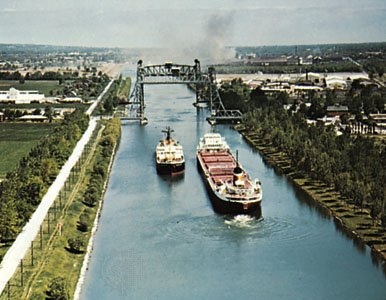
Do we want to risk radioactive-contaminated scrap being shipped through a Welland Canal that has had its share of shipping accidents?
As one of those opposed, let me explain my concerns.
During last September’s public hearings in Ottawa on its application for a transport license, Bruce Power said its motive is not to save money, nor to save space, but simply to recycle metal because it’s the right thing to do.
Unfortunately for the industry, however, nobody wants contaminated metal. So it has to be melted down and blended with non-contaminated metal in a one-to-ten ratio, and then passed off as if it is not radioactive at all. To me this sounds like a scam; there will be no label saying that the resulting scrap metal contains small amounts of plutonium and other man-made radioactive pollutants.
National and international bodies — like the United Nations and the Bureau of International Recycling — have condemned the practice of contaminating scrap metal with radioactive waste materials. The Steel Manufacturers Association (SMA) said in its 2009/2010 report on the subject, �SMA member have not, and will not, accept scrap that is known to be radioactively contaminated. Furthermore, the unrestricted release of radioactively contaminated metal from nuclear facilities for recycling would tarnish the image of recycling. The U.S. Environmental Protection Agency’s web page says that for this reason, radioactive metal is disposed of and not recycled.
Bruce Power’s environmental rationale is simply wrong, and the shipment should not be allowed to proceed. It’s not up to the Canadian Nucelar Safety Commission (CNSC) to stop it, that’s not their job. As a licensing agency, the CNSC simply runs through a checklist to see if there is any regulation that prevents a license from being granted. If not, the license is automatic.
Our politicians are the ones who have to insist that the export, import, transport, and marketing of radioactive waste materials should be prohibited. The nuclear industry is operating in a policy vacuum.
Breaking Trust
During a 2006 Environmental Assessment, Bruce Power gave a firm commitment to store the used steam generators on-site in perpetuity as radioactive waste along with all the other nuclear reactor wastes.
In April 2005, Bruce Power made a presentation to the Saugeen Ojibway, stating: scrap metals which are proven to be non-radioactive are recycled.
However much of the waste, and particularly low and intermediate level waste containing radioactivity, cannot be recycled for safety and environmental reasons. This waste is transferred to Ontario Power Generation’s Western Waste Management Facility where it is processed to reduce its volume prior to be [sic] placed in storage. (page 4)
In March 2006, the Canadian Nuclear Safety Commission issued a Screening Report on Bruce Power’s Environmental Assessment of the proposed refurbishment of the Bruce reactors. There we read that some of the waste is directly recyclable; however, the largest waste quantities are associated with the pressure-tube/calandria-tube replacement and the steam generator replacement, since the replaced components cannot be recycled and must be disposed of at the WWMF. (part 1, page 75)
In September 2007, BP submitted a Work Plan to the CNSC stating that The Environmental Assessment for the project considers the production of the wastes and transfer of the wastes to the Western Management Waste Facility (WWMF) until 2043. The long-term management of these wastes is an aspect of the Deep Geological Proposal [DGR] that is under study. (page 11-21) And in August 2008, Ontario Power Generation (OPG) published a report dealing with reactor wastes that will be placed in the underground DGR, and that includes all the used steam generators from all nuclear reactors in Ontario, including Bruce.
But these assurances turn out to be false, as Bruce Power now plans to ship radioactive wastes across the Atlantic — and back again, for about 450 tonnes of the most radioactive metal will be shipped back from Sweden to Halifax, and trucked from there to the Bruce site.
If a company can lay out one plan during an Environmental Assessment and then do something completely different later on, where is the credibility of the Environmental Assessment process?
Breaking the Rules and Bending the Truth
Over 200 municipalities, dozens of aboriginal communities and 60 non-governmental organizations oppose the transport of these 16 steam generators through the Great Lakes and the St. Lawrence River en route to Sweden. People feel cheated out of an environmental assessment.
Bruce Power, CNSC and OPG previously promised that the steam generators would never move off-site — so it was of little or no concern to the millions of people living along what we now know as the proposed transportation route.
But it has now in fact become everybody’s business. It is the first time that radioactive waste has been exported from Canada to another country, setting a dangerous precedent. It is the first time that radioactive wastes from decrepit nuclear reactors will be transported through the Great Lakes and the St. Lawrence River, another dangerous precedent. Once such exports and traffic of radioactive reactor wastes begins, where does it end? Hundreds of reactors are slated for refurbishment or dismantling in North America in the coming years. Do we want to allow this kind of traffic?
The Bruce cargo far exceeds the maximum amount of radioactivity permitted by the IAEA for a single shipment. The CNSC says it only exceeds the limit by six to nine times, but interveners have argued that it is over the limit by 50 to 75 times. Nobody disagrees that the limit is exceeded. Not very reassuring.
Bruce Power and CNSC don’t know exactly how much radioactivity is inside the steam generators. The day before the hearings, they increased the estimated radioactive inventory by 50 percent, and the external gamma radiation exposure by 160 percent; they had forgotten to include one of the five isotopes of plutonium that account for 90 percent of the mass of radioactive material inside each steam generator.
Bruce Power trivializes people’s concerns by calling the shipment Low Level Radioactive Waste. CEO Duncan Hawthorne says the total radioactivity is only 64 grams, the size of a tennis ball. He doesn’t mention that 32 to 40 grams of that is plutonium-239 — enough in principle to overdose 52 million atomic workers. Plutonium-239 is one of the most dangerous man-made radioactive substances, and its half-life is 24,000 years — the Egyptian pyramids are just 5,000 years old. Should such industrial poisons be recycled into scrap metal? Should such materials be hauled through our lakes and rivers?
The steam generators can stay where they are for 10, 20, or 30 years as per the original plan of Bruce Power, approved by CNSC. If Bruce Power maintains there is some clean non-radioactive metal that can be recycled, the highly radioactive internals should be removed from the steam generators on-site before the non-radioactive parts (if any!) are sent for recycling.
Radioactive wastes should be isolated from the environment, not dispersed into commercial products.
They should be stored and guarded, not transported halfway around the world. Sending radioactive steam generators to Sweden does not reduce Bruce Power’s environmental footprint — it makes that footprint global in scope.
This piece was contributed to Niagara At Large by Gordon Edwards, Ph.D. and president of the public interest group the Canadian Coalition for Nuclear Responsibility.
You can read more on this topic from some of the good coverage CBC has done by clicking on Read more: http://www.cbc.ca/canada/windsor/story/2011/01/21/wdr-bruce-power-decision-delayed.html#ixzz1Db4gIv3G
(Visit Niagara At Large at http://www.niagaraatlarge.com for more news and commentary on matters of interest and concern to resident in our greater Niagara region and beyond.)
 Niagara At Large
I don’t think this a good idea at all. What are THEY thinking? Just to save a buck. It is an accident waiting to happen in my opinion. This is NOT a good idea at all. I support all those who are not in favour.
We need to petition our mp regarding this serious matter.
Thanks for listening
Brenda
LikeLike
I agree with the author of this article. How stupid man can be. Money is usually at the heart of such decisions.
We need to complain to the powers that be and let many know what is about to take place.
LikeLike
Sorry, I may have not read closely enough. Has this transport already been approved? What can an ordinary citizen do to block this?
LikeLike
[copy of letter sent to the Prime Minister]
2011-Feb-17
Prime Minister:
The article pasted below is the First I’ve seen that properly explains why we should Not be shipping radioactive scrap steel through the St. Lawrence Seaway for processing in Sweden. I trust that you will take the time to read, consider and act upon it.
Until now, I have relied upon our government Nuclear Safety overseer
(CNSC) to determine that this is safe, and we along the Seaway have ‘nothing to fear’. In fact, it has struck me as hypocritical for us to oppose shipping this waste to Sweden, when 50% of our power in Ontario comes from NUCLEAR. If we don’t want nuclear waste, we should all simply shut off HALF our lights, air conditioning, and jobs.
I wrote earlier to the mayor of Port Colborne concerning this hypocrisy,
He replied that he was concerned about our Firefighters and citizens,
in the event of a fire aboard the ship, in the Welland Canal in Port Colborne.
He does have a valid concern.
However, the Niagara-At-Large article makes it clear that:
– Bruce Nuclear is violating an earlier agreement,
with the approval of the Nuclear Safety body. WHY?!
– The material is more contaminated than we’ve been led to believe. WHY?!
– As a society, we are allowing radioactive steel to intermingle with normal steel. WHY?!
What are we doing to our descendants, let alone ourselves?
—
Lorne WHITE
[contact details provided]
“A Conservative is -by definition- a careful conservationist.”
LikeLike
There appears to be some very good information that I can give my MP here locally to take with him to Ottawa.
Thanks for the letter
LikeLike
Thanks Lorne .. I like what you said “A Conservative is -by definition- a careful conservationist”
LikeLike