
By Mark Taliano
Toxic myths are running rampant these days, but the best one so far is the notion that private health care is more cost-effective and more efficient than public health care. Worse yet, we are led to believe that somehow privatization is the answer to the current economic mess and the response to an aging population. I’m not sure how or when we were lead astray, particularly with the model south of us which represents one of the world’s most inefficient Health Care systems, but somehow it happened all the same.
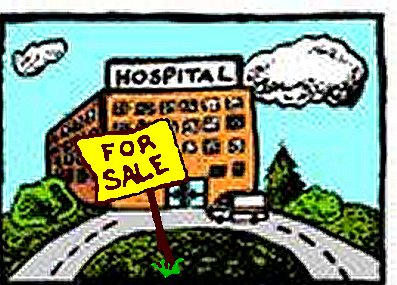
Image courtesy of Ontario Health Coalition, a not-for-profit public interest group based in Toronto.
It may have started when people from bloated bureaucracies started referring to patients as “clients”. The term “client” is less personal, and better lends itself to business terms, not dissimilar from the military euphemism “collateral damage”, which of course means civilian deaths. “Clients” can be charged, discharged, lost, over-charged, without much stress. Not “patients” though: the Hippocratic Oath tells us we must take care of them, regardless of cost. Of course healthy “clients” are great. Insurance companies don’t like unhealthy “clients”; they’re too expensive. Private systems need to extract profit from the system, and it’s harder to do if the “client” is unhealthy, or if the care is complex.
One might ask, then, how a Universal Public System can take care of a sick patient better than a Private system, and still be more efficient. The root of the answer is money, and how it is used.
Dr. Robert G. Evans, O.C. Ph.D (Economics, Harvard), F.R.S.C. University Killam Professor, Department of Economics, U.B.C, a leading Health Care economist, notes that from 1975 to 2009, Medicare spending represented from four to five percent of Canada’s G.D.P. Health Care costs not covered by Medicare (prescription drugs, dental, home care etc.) have risen at a higher rate, and currently are at twelve percent of the G.D.P. So private costs are soaring, not public costs, and private profits are leaving the system.
Likewise for P3 hospitals. As of 2009, P3 hospitals in Ontario have cost 2.1 billion dollars, instead of the projected 1.2 billion. The estimated cost of the North Bay P3 hospital was 551 million dollars. It actually cost 1 billion. Worse yet for tax payers, is that the profits are privatized while the losses are socialized. (Remember the stock market, tax-payer funded bailouts? It’s the same idea.) Fortunately, we have a case study south of the border.
The US spends far more on health care per person than Canadians. From 1980 to 2000, the US spent $7,000 per person and a million people were not insured. Canada spent $3,298 per person and everyone was insured. Notwithstanding Obama’s heroic efforts, the U.S mentality is that Health Care is a privilege, not a right. Universal Health Care, on the other hand, works on the premise that Health Care is a right for all, and it has been one of the distinguishing elements of this country. Extracting money from the system for profits, then, renders the system cost-ineffective, but the process of extracting profits necessarily impacts the quality of service as well, and not in a good way. The quality is diminished because people are devalued.
Private systems not only devalue patients, but they also devalue nurses, and this further compromises the safety and well-being of patients. As Maude Barlow points out in her book, Profit Is Not The Cure, A Citizen’s Guide To Saving Medicare, registered nurses see patients as a whole person, and the fractured “unbundling” of nursing care into tasks administered by unlicensed “service providers” is dangerous and unproductive. Consider the statistics: In March 22, 2002, the Canadian Journal Of Nursing Research documented the tracking of thirty-day death rates for nearly 47,000 hospitalized patients discharged from acute care in Ontario. When the proportion of registered nurses in hospitals was increased by 10%, researchers noted that there were five fewer patient deaths for every 1,000 discharged patients. Clearly, these outcomes are unacceptable. It gets worse: The Canadian Health Coalition notes that in Canada, 2,200 preventable deaths will occur each year if Canada adopts a privatized Health Care System similar to the U.S model.
Returning to the American privatized model, Dr. Arnold Relman, professor emeritus of medicine at the Harvard Medical School and emeritus editor-in chief of the New England Journal of Medicine, summed up two decades of research on the American Health Care system with these words: “No health care system in the industrialized world is as heavily commercialized as ours, and none is as expensive, inefficient, and inequitable…” He acknowledges that the U.S is a world leader in medical science and technology, and that its major medical centers may provide some of the best care available, but “taken as a whole,” which, he said, is the important measurement, “the American Health Care system is failing badly.”
Fortunately for those of us fighting Harper’s misdeeds, we have plenty of evidence to support our position that the privatized model of Health Care is not only cost ineffective, but most importantly, its inefficiencies render it dangerous to patients and Canadian society as a whole. The toxic myth perpetuated by our current government, and the private sector, needs to be exploded and discharged.
Mark Taliano is a Niagara resident and frequent contributor to Niagara At Large.
(Visit Niagara At Large at www.niagaraatlarge.com for more news and commentary on matters of interest and concern to our greater binational Niagara region.)
 Niagara At Large
Mark, you are preaching to the choir. The people that read this realize what’s going on but those who won’t read it are the ones who need to. Much easier to sit home with a Labbatt’s Blue watching the hockey game than actually think or DO SOMETHING!
Personally, I’m about ready to give up. A group in Fort Erie, including myself, gave an excellent public presentation a few months back. After calling over a thousand people who signed a health care petition in the community, many of whom expressed their anger and promised to come out, FIVE showed up – FIVE (not counting the Yellow Shirts and a few regulars already involved) . People are apathetic slugs and I’m beginning to think they get what they deserve. Why should we fight for them if they won’t fight for themselves?
As for relying on the upcoming election to change anything, Hudak, who promised to reopen the ER in Fort Erie, is already backtracking and stated in today’s Toronto Star that McGuinty has spent too much and there will have to be cutbacks in health and education. So much for believing either Hudak or McGuinty.
This should be making headlines but instead we hear about Canada’s junior hockey team and other such stuff as front page news.
I’m fed up!!!!!!!!!!!!!!!!!!!!
LikeLike
Linda, your continued efforts will be worth it, even though there may not be much tangible evidence yet.
LikeLike
There’s a very good article about privatization in today’s Star.
LikeLike
A Calgary for profit hospital declares bankrupcy and the taxpayers have to pick up the tab. Just as predicted.
Thanks for the info.
LikeLike
No surprise that the Fraser Institute is attacking the Canada Health Act.
No surprise either that the Klein government prematurely closed the Public Hospitals, which created pent-up demand etc. for the private one. Shock Doctrine all over again.
LikeLike
I think private health care will already be here once those private rooms open up at the new St. Catharines Hospital.
LikeLike
Privatization in Health Care is regressive. It means the unhealthy and poor pay more while the healthy and rich pay less.
LikeLike
Many of us are going to be in for a rude awaking. The Gov is slowly dismantling the system ever so slowly. In the changes will certainly be some improvements but over all I believe there is going to be American style Health Care…time will tell.
LikeLike
We need to make improvements within an expanded public system. The notion that improvements should be made by privatization is like throwing money to the wind while prevntable deaths etc. increase.
LikeLike