
By Mark Taliano
Last week, when I was reading about West Lincoln’s resistance to locate a clean-energy wind farm nearby, I was reminded of past history lessons and their impact on the future.
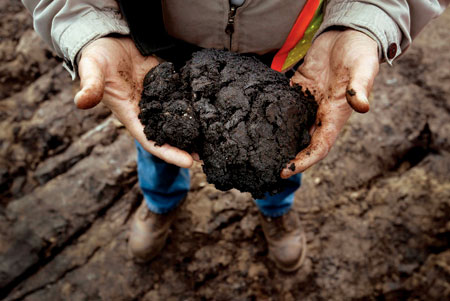
Canadian tar sand in hand
Centuries ago, Spanish Conquistadors were thoughtful enough to bring measles, smallpox, and malaria to the natives in the New World, but they didn’t do it for free. In exchange for their gifts, they burdened themselves with gold and silver. It seemed to be a good deal for everyone (except of course the natives of South America). In exchange for the inconveniences of sailing across the ocean and engaging in warfare, the Spanish were rewarded with precious cargos. Relatively speaking, it was easy: instant gratification.
A bit further north, it wasn’t so easy. The English had to work for a living. Textile industries developed, as did the mercantile classes and so forth. Ultimately, these developing industries proved far more valuable. The English were setting themselves up to be world leaders in industry and trade, while the “easy riches” of the Spaniards were in many respects illusory. The gold lead to inflation, but worse yet, it lead them down the wrong path. The future would be one of producing goods (the Industrial Revolution), and the Spanish were late to enter that revolution, so the gold, ironically, impoverished them.
Canada’s future impoverishment will be the result of not learning history’s lessons. If we dig deep enough, we’ll see that the modern day equivalent of plundered riches would be the Tar Sands. And our blindness is costing us dearly. Not only are we burdened with a tarnished international reputation, but our refusal to see past the instant gratification of the oil is restraining us from focusing on new, innovative, and lucrative technologies. This blindness will ultimately impoverish us, much as the gold impoverished the Spanish.
Last year, government subsidies worth 1.7 billion dollars were granted to the Tar Sands industry, and that number will climb to 30 billion dollars. Those funds should instead be directed to Green Energy Initiatives, and Green Energy jobs, because that’s where the future is. We’re going backwards instead of forwards.
Mark Taliano is a resident of Niagara and frequent contributor to Niagara At Large.
(Visit Niagara At Large at www.niagaraatlarge.com for more news and commentary on matters of interest and concern to our greater, binational Niagara region.)
 Niagara At Large
ABSOLUTELY correct. “New, innovative and lucrative technologies” are the future. Who would have thought 50 years ago that a computer the size of a room would become a hand-held or table-top must in most homes and the profits from the development of such technologies would make people like Bill Gates the wealthiest men in the world.
The world, especially the west, is stuck with anachronistic technologies and fuels because we think we have these big wide open spaces and don’t have to worry about destroying the planet. Also, the wealthy elite don’t want to be bothered investing in something new as long as the profits are still rolling in with little expenditure as far as research or effort. They can’t or won’t see the forest for the trees and make sure the public is kept dependent on their products such as gas fueled vehicles.
Countries with dense population concentrations are experiencing the results first hand and are leaving us in the dust in this regard. They will profit both environmentally and economically. It calls to mind the arrogance of the NA auto and electronics industries which thought Japan was no threat.
When I visited Nepal in 2008 I was amazed that they used dark-sky friendly technology in their lighting to conserve energy, lighting directed only downward. This reduces energy use otherwise wasted lighting the sky (which also disrupts the life cycles of animals) and enabling use of very low wattage bulbs. Water was recycled and filtered. Nothing was wasted. Most westerners would assume such a remote place would be backward as far as conservation. We are the backward ones. Denmark provides most of its energy by windfarms, inexhaustable, non-polluting and free. New Zealand uses the geothermal energy derived from being on the “ring of fire” for steam generated electricity and home heating at low cost. It seems we are the backward ones.
The west is increasingly being left behind and this will destroy our economies and environment and diminish our lifestyles. We will become the third world.
LikeLike
Well said, and great examples!
LikeLike
I wish we could convince our municipal politicians to replace worn out lighting fixtures with night-sky friendly ones for both cost and efficiency. On top of that we could actually see and reconnect with the beauty of our universe. I recall during the big east coast black-out, New Yorkers were calling TV and radio stations in a panic thinking the strange lights in the sky might have caused it. The lights were stars and planets. How sad.
LikeLike
Well said Mark. Thanks for the historical perspective.
LikeLike
The only reason the Spanish were in South America was the quest for gold (d,oro) this gold fits the description of blood gold, as literally millions of indians were worked to death and slaughted in the pursuit of this metal. I watched a documentary on Nepal these people are so environmentally ahead in how they run their country,it is mind boggling, China is on board big time with enviromental changes,they will own the world markets on this technology, private enterprise in the States is far ahead of it’s Luddite politicians who are a bunch old geezers locked in the past.
LikeLike
Wind farms are more advanced than the past, the new generation of windmills are quieter less friction, that was what made people ill the constant drone, `they are being replaced for the new kind, and in Europe they put them along rail lines and canal banks away from the general public.the latest in nuclear energy are the mini- reactors based on the kind submarines use, one can service a Town of 30 thousand people , and take up very little space, they can be fueled with Thorium or Uranium , a perfect back up for windmills or solar panels. George.
LikeLike
Great examples George. We’re being blinded by oil, and we’re falling way behind in so many important areas. Poor leadership.
LikeLike