
By Brent Stewart
On a rainy Tuesday evening, about 130 kilometers down the highway from where it all took place, John Pruyn and his wife Susan recount the events of that June day in Toronto, to a small but receptive crowd at St. Mark’s Anglican Church in Niagara-On-The-Lake. Accompanying them in telling their G20 ‘horror stories’ are Steve Disher and Josh Burman, two young men from Hamilton, whose paths crossed with John’s that fateful Saturday evening in Queen’s Park.
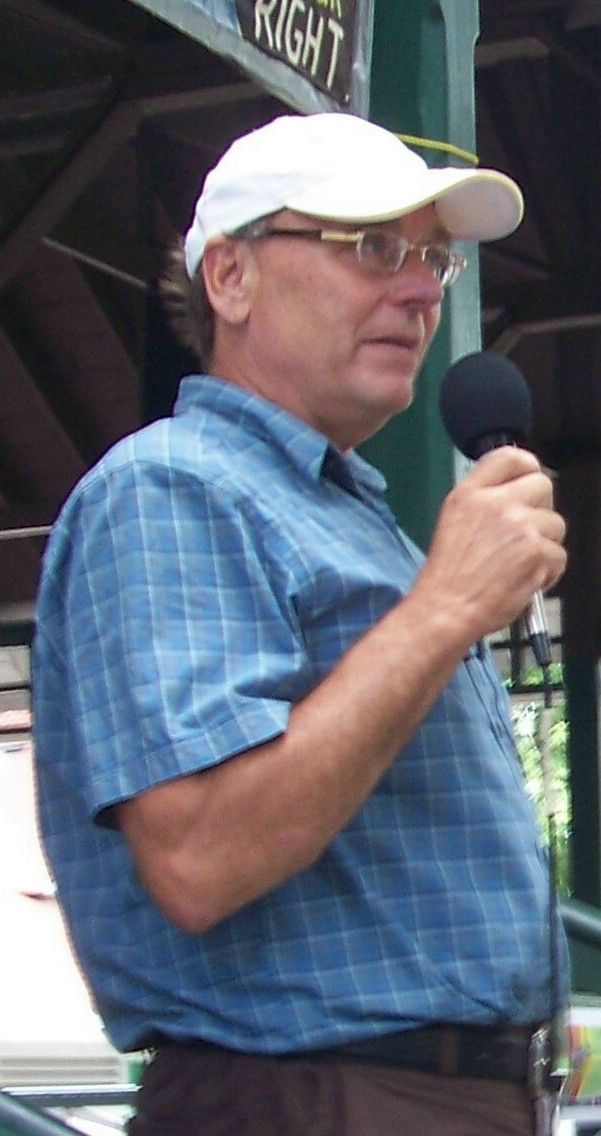
John Pruyn. File photo by Doug Draper
I learned about John Pruyn’s experience at the G20 when Doug Draper first broke the story on Niagara At Large, in July, but there’s something altogether different about witnessing John himself detailing the events of that weekend. Hearing his first-hand account of being brutalized, degraded, and humiliated by riot police at Queen’s Park is unsettling, to say the least. John is quiet, responsible and unassuming, and practically a neighbour—the fact that he is such an ordinary, decent guy highlights the bizarre and indiscriminate nature of police actions that weekend. John and others like him were rounded up, harassed and arrested in the designated free speech zone, of all places—an area that demonstrators and bystanders were told was a safe haven for exercising their civil liberties. The police actions showed a callous disregard not only for the safety and the civil rights of those in attendance that day, but also for the Canadian Charter of Rights and Freedoms itself.
John’s wife, Susan, goes on to tell her story of the tumultuous events of that weekend, relating the twenty-seven nerve-racking hours she spent desperately trying to locate John, and her daughter, Sarah, while they were being held at a makeshift detention center in a defunct film studio on Eastern Avenue. Steve and Josh then take turns recounting their experiences during the G20 summit weekend in Toronto.
They explain that they are not even activists, instead were just curious to see what all the fuss was about, and had simply decided to go up to Toronto that weekend for a closer look. Afterwards they take turns describing how they met John and Sarah in Queen’s Park, outlining the events that led up the their arrest and detention. Both men were tagged with obstruction charges after attempting to help John, a below-the- knee amputee, up to his feet, as riot police moved in aggressively and ordered people to immediately clear the area. Having been handcuffed and hauled off by police, the two men were held at the Eastern Avenue detention center for nearly forty hours, before being released in the early hours of Monday morning.
One of the young men is adamant that no matter what anyone in Toronto that day had or hadn’t done, whether right or wrong, individuals should be treated as innocent until proven guilty, and not the other way round. He speaks at length of how people were robbed of their right to due process granted under Canadian law at the G20 in Toronto. They were not read their rights upon arrest, and were hauled off to the makeshift detention center on Eastern Avenue, where they were locked in overcrowded cages, deprived of sufficient food and water for extended periods of time, and forced to use port-o-potties that didn’t include doors. Later, he confessed to me that conditions at the detention center were like being crammed in oversized kennels. And it was hours before they were granted a phone call to speak with legal council.
More than 1,100 people were arrested during the G20 summit in Toronto, giving it the dubious distinction of being the largest instance of mass arrests in Canadian history. Of the 1,105 people who were arrested that weekend, only about 100 are still facing charges. When looking at those numbers words like, “excessive,” “unnecessary,” and even “outlandish” come to mind. Were these record- breaking, history-making mass arrests during the G20 summit just by chance? Or is there more to this story? Was the decision to hold the G20 in the downtown core of the most heavily populated city in Canada, where resistance would undoubtedly be expected to be strongest, really just a random choice of venue? Or was the 19,000-strong security force deployed in the streets of Toronto that weekend, with law enforcement officers brought in from around the country, an unprecedented show of force invoked in order to send a loud and clear message to those who choose to challenge the status quo in this country? This, of course, was the very same security force that curiously stood by idly while a police cruiser burned for nearly an hour, in the center of a major intersection, in the heart of Toronto’s downtown core…the same burning cruiser that was the focal point of the national media’s G20 coverage, and an image that has been broadcast on mainstream news outlets across Canada hundreds of times during and after the G20 weekend.
Which bring me to a very important point: Do those images of the burning police cruiser and of a few dozen troublemakers smashing windows—images that have been thoroughly engrained in the minds of many Canadians due to the rather narrow scope of the national media’s coverage of the events that took place that weekend—justify the police ripping a man’s prosthetic leg off and assaulting countless other people? Was the $900,000 million price tag charged to taxpayers for security surrounding the G20 summit nothing more than an unconscionably exorbitant expenditure by the Harper government to insure the quelling and criminalization of dissent? I fail to see how all that money helped to ensure public safety in any way, shape, or form that weekend. If anything it seemed to produce the opposite result, with only the elites of the world, who had converged in Toronto that weekend to discuss global economic policy being assured safety, while ordinary citizens fell victim to heavy-handed police actions in the streets.
We’ve been told the price of security—in this case, $900,00 million—but what is the price of freedom? It’s certainly not something you can put a price tag on, that much is very clear, as John Pruyn and so many others found out the hard way that weekend. Our freedoms, whether it be of speech, expression, or assembly, were all challenged during the G20 summit in Toronto. This is an issue so critical to the present and future of this country that it simply cannot, and must not, be ignored or dismissed. The actions of law enforcement that weekend were so extreme, so indiscriminate, that you would have expected the event to provide a major wake-up call to Canadians, while irrefutably illustrating the fact that our civil liberties are clearly in jeopardy in this country. But the modest, and in many cases non-existent, objection by the majority of Canadians to the injustices and abuses of power that occurred surrounding the G20 summit bring to mind the famous quote from Benjamin Franklin: “They who can give up essential liberty to obtain a little temporary safety, deserve neither liberty nor safety.” I can only hope that this line of thought is heeded by the majority of Canadians, so that the brave individuals who choose to stand up for liberty in this country, now and in the future, will not have to pay for their pursuit of freedom with blood, sweat, tears, and tribulation ever again.
[Brent Stewart is a resident of Welland, Ontario who attended the G20 Summit in Toronto this past June as another interested party.)
(Visit Niagara At Large at www.niagaraatlarge.com for more news and commentary on matters of interest and concern to our greater binational Niagara region.)
 Niagara At Large
And now, Toronto Police Chief Blair is quoted as saying there was a piece of tape taken out of the filming of at least one of the 4 cases that the SIU determined showed excess violence. As far as he is concerned it’s an SIU set up . In fact Chief Blair goes as far as speculating that the police that day didn’t do anything to violent, except against “violent” people who participated in the demonstrations. I despair! Luckily the SIU is standing by its report on this issue,( but which is by most standards quite weak, as they couldn’t assign blame as the police in question had none of the required identification . )Let’s hope the remaining investigations do justice to good people like John , Susan, their daughter and the others who were treated abominably, and that civil liberties are not trampled and then hidden from sight by the police. This does no good for all the good citizens who were charged falsely , nor the many good police men and women in Toronto and elsewhere. chief Blair has just done them a terrible disservice.
LikeLike
I used to be proud to be Canadian – but the police action at the G20, and other recent developments are rapidly making me ashamed to be Canadian.
LikeLike
the Miami Model
When police stick to phony script
http://www.thestar.com/news/gta/torontog20summit/article/828876–porter-when-police-stick-to-phony-script
What is the Miami Model?
I called Naomi Archer to find out. She is an indigenous rights worker from North Carolina who happened to be giving a lecture on the Miami Model yesterday at the U.S. Social Forum — the G20 for community activists.
Archer, who was in Miami as a liaison between protesters and police, has a 40-box checklist to identify the Model. Here are the main themes.
• Information warfare. This starts weeks before the event. Protesters are criminalized and dehumanized, and described as dangerous “anarchists” and “terrorists” the city needs to defend against.
“Often, a faux cache is found,” says Archer. “They are usually ordinary objects, like bike inner tubes, camping equipment, but the police make them out to look threatening. It lays the groundwork for police to be violent and it means there’s a reduced accountability of law enforcement.”
• Intimidation. Police start random searches of perceived protesters before any large rallies. They are asked where they are staying, why they are walking around. Police raid organizer’s homes or meeting places, “usually just before the summit, so there’s maximum chaos organizers have to deal with,” says Archer.
“All this is meant to dissuade participants. The best way to make sure you don’t have a critical mass of people taking over the streets like in Seattle is to reduce the numbers at the outset.”
This is usually made possible by last-minute city regulations, curtailing the right to protest. In Miami, the city commission passed a temporary ordinance forbidding groups of more than seven to congregate for more than 30 minutes without a permit.
• “They threw rocks.” That’s the line police use after tear-gassing or beating protesters most times, Archer says. Urine and human feces are variations on the theme. But it’s always the protesters who triggered the violence. A popular police tactic is called “kettling.” Officers on bike or horses herd protesters into an enclosed space, so they can’t leave without trying to break through the police line. Take the bait; you provoke a beating or arrest. And of course, there are the famous agent provocateurs, outted publicly two years ago in Montebello. Police officers dressed up like militant protesters to protect the peaceful crowd, they say; Archer says it’s to instigate trouble.
LikeLike
snip snip: In a presentation he made to a lawyers’ conference in 2004, Scott, who once worked as a prosecutor, noted police officers accused of using excessive force stood a less than one-in-five chance of facing the same level of justice as civilians accused of similar crimes.
“It is an ineffective use of state resources to investigate, charge and prosecute cases in which the high probability is acquittal,” Scott wrote in 2004.
http://www.thestar.com/news/article/882189–are-these-cops-above-the-lawSee More
LikeLike
The Stanford Prison Experiment
A Simulation Study of the Psychology of Imprisonment Conducted at Stanford University
What happens when you put good people in an evil place? Does humanity win over evil, or does evil triumph? These are some of the questions we posed in this dramatic simulation of prison life conducted in the summer of 1971 at Stanford University.
http://en.wikipedia.org/wiki/Stanford_prison_experiment
How we went about testing these questions and what we found may astound you. Our planned two-week investigation into the psychology of prison life had to be ended prematurely after only six days because of what the situation was doing to the college students who participated.
In only a few days, our guards became sadistic and our prisoners became depressed and showed signs of extreme stress.
LikeLike
Milgram Experiment (1961)
The Milgram experiment on obedience to authority figures was a series of social psychology experiments conducted by Yale University psychologist Stanley Milgram, which measured the willingness of study participants to obey an authority figure who instructed them to perform acts that conflicted with their personal conscience.
http://en.wikipedia.org/wiki/Milgram_experiment
Before conducting the experiment, Milgram polled fourteen Yale University senior-year psychology majors as to what they thought would be the results. All of the poll respondents believed that only a few (average 1.2%) would be prepared to inflict the maximum voltage. Milgram also informally polled his colleagues and found that they, too, believed very few subjects would progress beyond a very strong shock.[1]
In Milgram’s first set of experiments, 65 percent (26 of 40)[1] of experiment participants administered the experiment’s final massive 450-volt shock, though many were very uncomfortable doing so; at some point, every participant paused and questioned the experiment, some said they would refund the money they were paid for participating in the experiment.
LikeLike
In times of restraint, the federal government throws a billion dollar party for the world, while they denounce and suppress protest. Why was I not surprised?
LikeLike
Ahh right Angela it’s a CPC government,,,,,Of course the Liberal Party of Canada would not have done the same, oh wait it was the provincial Liberals that did some backroom tinkering with the Statute for public order or some such,,,,I seem to remember Jean Chretien making light of the fact some protesters in BC got pepper sprayed by the RCMP…I know only PM Harper is evil….
Indeed, our Officers of the Peace have abdicated and left these corporate policy enforcers in their stead. Bully Boy Blair was caught in several lies connected with the summit enforcement policies. hmmmm seems someone needs to review Sir Roberts principles on policing. This guy needs to be sacked…..
LikeLike