
By Dave Toderick
It’s 1962. You’re sitting in your favourite chair, browsing through the current issue of Life Magazine. You stop at a page showing a photograph of a glacier. It’s an ad for Humble Oil and Refining Company. You read: EACH DAY HUMBLE SUPPLIES ENOUGH ENERGY TO MELT
SEVEN MILLION TONS OF GLACIER!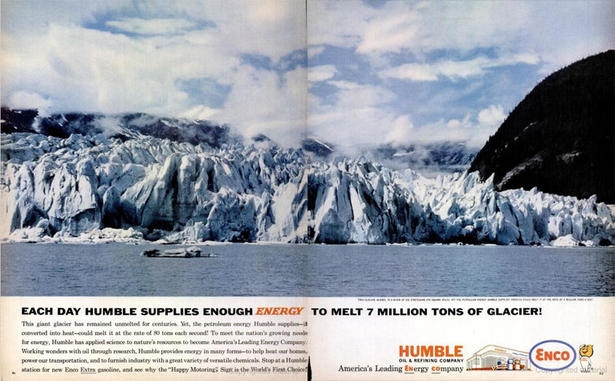
You have no way of knowing, of course, that Humble Oil will later merge with Standard Oil to become Exxon, or that Exxon’s contribution to climate change will come to threaten the world as you know it. You simply have no way of knowing how ironic those words will turn out to be.
– – – – –
It’s 2010. I’m sitting in my favourite chair, browsing the Internet. I stop at an article on StraightGoods.ca written by Stephen Leahy for InterPress Service. I read the title: Arctic Ice in Death Spiral – Researchers Fear Permafrost has Passed the Point of No Return.
Before I read on, I think about two of the feedback loops climate scientists have been warning us about: how if the temperature rises enough to melt a certain percentage of the ice, the dark water will attract more heat than the light ice did, which will melt more ice, and so on; and how if the temperature rises enough to melt a certain percentage of the permafrost, the carbon and methane that has accumulated over thousands of years will be released, attracting more heat, which will melt more permafrost, and so on. The permafrost region holds at least double the amount of carbon that is in the atmosphere, and methane has about 25 times the potency of carbon as a global warming gas.
Before I read on, I think about how we can’t do anything about the fossil fuel we’ve already burned, but how we do have control over how much fossil fuel we burn today and in the future. That is to say, we do have control over how much more carbon we put into the atmosphere. However, if we reach a certain temperature, the feedback loops will kick in, and the amount of global warming gases entering the atmosphere will be mostly beyond our control.
Before I read on, I think this: If we haven’t fallen off the cliff yet, we’re standing with our back foot tottering on the edge, and a gust of wind will be all it takes.
I proceed to read the article, and while I’m not surprised by what I learn, I’m still sickened by it, for it details the extent of the ice loss that has already occurred.
The volume of Arctic sea ice is at its lowest level since the time of human civilization. Mark Serreze is the director of the National Snow and Ice Data Center in Boulder, Colorado. He doesn’t mince his words; the “death spiral” in Leahy’s title is his expression to describe the state of the Arctic summer sea ice cover.
Two permafrost experts, Ted Schuur at the University of Florida, and Vladimir Romanovsky at the University of Alaska, believe much of the permafrost could be gone within a few decades.
And one final unsettling fact from Leahy’s piece: the climate models that scientists use as the basis of their understanding – along with historical data and current observations – do not yet factor in the gases from thawing permafrost.
I hesitate to write about this, for fear some will react with a “I guess there’s nothing we can do, so we might as well enjoy things while we can.” So let me be clear: This is not an invitation to go on living without regard to the consequences because it’s too late. There are always things that are under our control and things that are not. We need to be aware of the latter while focusing our attention on the former: in this case, by reducing our own carbon footprint, calling for our political leaders to take meaningful action on the impending crisis, and encouraging our friends to do the same.
Postscript: Thanks to Grist magazine for reprinting the Humble Oil ad after one of their readers spotted it and sent it to them. You can view the ad here: http://www.grist.org/article/2009-11-18-oil-enough-energy-to-melt-glaciers/.
Dave Toderick has moved back to his hometown Welland to walk along the canal with his dog, Koocher, and write songs about things that inspire or annoy him.
(Visit Niagara At Large at www.niagaraatlarge.com for more news and commentary on matters of interest and concern to residents in our greater binational Niagara region.)
 Niagara At Large
Great article Dave. And like you wrote, I’m not surprised by what I’ve read, but I am still sickened by it.
LikeLike
we past the tipping point at least 20 years ago too late to blow the whistle all we can do is watch , we can tinker a little but the die is cast.I picked the last of my tomatoes this day, no frost, that should tell you something about Cananadian weather these days. We are close to the tipping point with the chemicals in our environment as well, our water is poison and toxic.cheerful ain’t it.
LikeLike
Rubbish, anthropogenic global warming has been debunked. Carbon in the atmosphere does not cause global warming never did never will. On another note we would be all extinct without global warming, humans were never intended to live on a glacier. Without protective clothing we would succumb to hypothermia at 15 deg. C. Levels of CO2 have been as high as 3000 parts per million here on earth compared to the 300 parts million now. The odd part of that was man was no where to be found. Personally we have greater concern with near misses by space rubble which would definitely alter the climate on earth. A sizable asteroid or comet could raise the temperature to 700 degrees nearest the impact zone within a few thousand miles. The ejecta could also plunge parts of the planet into darkness and freezing temperatures. To think we recently had a near miss.
LikeLike